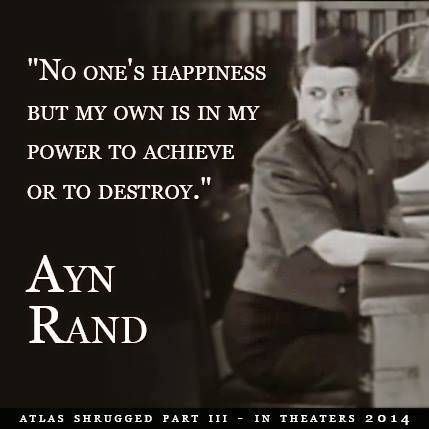
The Book of Rabyd 2:4 – “No One’s Happiness but My Own is in My Power to Achieve or to Destroy”

Text:

“No One’s Happiness but My Own is in My Power to Achieve or to Destroy” – The Book of Rabyd 2:4

Sermon:

Originally this Quote by Ayn Rand was The Book of Rabyd 2:10; but with my desire to remove duplicate quotes as far as quotes from the same people, she jumps to 2:4.  This also presents a problem of the fact I have eliminated about six verses at this point so some new people to quote from will be necessary to get the other points.  I may jump ahead to chapter three and then drop those verses from chapter 2 in when they come to me. The Book of Rabyd is after all not a closed canon of scripture like some.

This statement is more complicated the more you meditate on it. But let’s break it down.

The first concept is that you cannot make people happy.  I think this is the most enlightening thing as I have watched people give their all trying to make others happy and then get frustrated that 1) They fail or 2) They are not happy themselves.  There is a lot of energy saved emotionally and mentally when you figure this out.

You can make yourself happy, in fact, your own happiness is the only happiness that you can really strive to achieve.  You also are the only person who can destroy your own happiness.  That is not to say that others can’t affect your happiness or life and general, but how you perceive, interpret and/or act about those things that determine your happiness and those are all in your power to do.

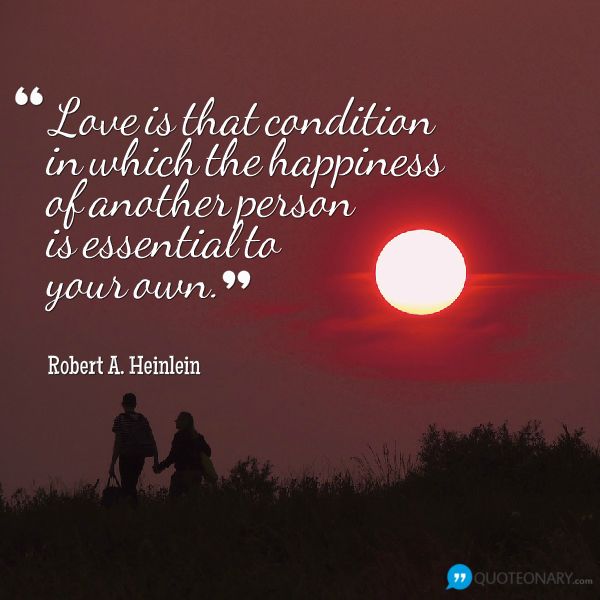
That’s not to say your emotions cannot be entwined with another.  I think Heinlein’s definition of love is applicable here.  The notion of love being where someone else’s happiness is essential to your own and vice versa. In the case of love, even here through the choices and who has the power over your happiness is still you.

In my own life, this principle has been difficult, even though the truth of it resonates with my soul.  Being an empathic person kind of causes people’s emotions to affect you at times, like it or not.  That said it is still my choice of whether or not to let that affect my happiness in general. I find also that memory can be a difficult thing to deal with at times.  I have choices to make about each and every time I remember things because my memories are highly emotional which of course causes me to relive them like they were yesterday.

All in all, though, the principle is true.  It is just you might have to make a lot of decisions and fight a lot of battles to stand on that mountain top of happiness.  It is, however, your power to achieve or destroy.

The Rabyd Skald – Wandering Soul, Bard, and Philosopher. The Grey Wayfarer.

Skaal!!!
The Pagan Pulpit – The Book of Rabyd 2:4 – “No One’s Happiness but My Own is in My Power to Achieve or to Destroy”

Happy Suns’ Day

Announcements:

We don’t pray here – we figure God, the gods, and goddesses, or whatever powers that be either know already, don’t give a fuck, or are busy with more important matters than our petty stuff. We also kind of assume that they expect us to do stuff that we can do for ourselves and that we will do them ourselves and not be lazy. We also believe in being good friends, so we don’t presume on our friendship with the powers that be by asking them all the time for stuff while giving them nothing in return.

We also don’t take an offering here.  We figure the powers that be probably don’t need it.  Let’s be honest, offerings are not giving to the divine powers, they are given to an organization to support it.  Just being honest. God, the gods or whatever never sees a dime, farthing or peso of that money; it all goes to the church, mosque or shrine.

Opening Song: “Wash It All Away” – Five Finger Death Punch

This song is on my playlist but for multiple reasons.  After my series with the Book of Rabyd, I will be doing a series on spiritual concepts that are universal and one of them is going to be ‘baptism’. This song inspired that idea although it goes back to an idea that someone else suggested to me before I left the ministry. Five Finger Death Punch is a new band for me in many ways, but I like the energy of this song.  The bridge is also very expressive of my emotional state at times:

“I won’t change for you

and I can’t take the pain

There is nothing you can do

and nothing you can say”

Poem: “I Speak to a Ghost” by The Ruined Man

Image may contain: text

Don’t have a poem of my own this week so The Ruined Man will speak for me this time.

Meditation: 

Image may contain: text

Song of Preparation: ‘Shut Up and Dance With Me’ – Walk the Moon

Just a feel-good song, we are talking about happiness after all.

Text:

“No One’s Happiness but My Own is in My Power to Achieve or to Destroy” – The Book of Rabyd 2:4

Sermon:

Originally this Quote by Ayn Rand was The Book of Rabyd 2:10; but with my desire to remove duplicate quotes as far as quotes from the same people, she jumps to 2:4.  This also presents a problem of the fact I have eliminated about six verses at this point so some new people to quote from will be necessary to get the other points.  I may jump ahead to chapter three and then drop those verses from chapter 2 in when they come to me. The Book of Rabyd is after all not a closed canon of scripture like some.

This statement is more complicated the more you meditate on it. But let’s break it down.

The first concept is that you cannot make people happy.  I think this is the most enlightening thing as I have watched people give their all trying to make others happy and then get frustrated that 1) They fail or 2) They are not happy themselves.  There is a lot of energy saved emotionally and mentally when you figure this out.

You can make yourself happy, in fact, your own happiness is the only happiness that you can really strive to achieve.  You also are the only person who can destroy your own happiness.  That is not to say that others can’t affect your happiness or life and general, but how you perceive, interpret and/or act about those things that determine your happiness and those are all in your power to do.

That’s not to say your emotions cannot be entwined with another.  I think Heinlein’s definition of love is applicable here.  The notion of love being where someone else’s happiness is essential to your own and vice versa. In the case of love, even here through the choices and who has the power over your happiness is still you.

In my own life, this principle has been difficult, even though the truth of it resonates with my soul.  Being an empathic person kind of causes people’s emotions to affect you at times, like it or not.  That said it is still my choice of whether or not to let that affect my happiness in general. I find also that memory can be a difficult thing to deal with at times.  I have choices to make about each and every time I remember things because my memories are highly emotional which of course causes me to relive them like they were yesterday.

All in all, though, the principle is true.  it is just you might have to make a lot of decisions and fight a lot of battles to stand on that mountain top of happiness.  It is, however, your power to achieve or destroy.

Closing Song: “Don’t Stop Believing” – Journey:

Just the lyrics so you can sing along.

Parting Thought: 


Image may contain: 1 person, outdoor, text and nature

Yes, they do.  When it comes to happiness you never know who or what will come along to brighten your day.  You do have to be in the right frame of mind to be on the lookout for it.

I remain,

The Rabyd Skald – Wandering Soul, Bard, and Philosopher. The Grey Wayfarer.

Skaal!!!

Odin’s Eye – Humanism – Morality and Religion

Happy Thor’s Day

Discussion:

Humanists as a general rule, dismiss the need for religion to be moral. Humanists for the most part simply see that anyone can act ethically and morality if they simply tap into their humanity. That is act on their better nature as human beings. I concur with this.

There is some thoughts that to be a humanist you have to be atheist, but I reject that as well. I think in large part those we call founding fathers were also humanists of a deist variety and I am as well.  I don’t dismiss the idea of creator or creators, I just don’t think that, whomever they may be, has any vested interest in policing our morals.  That’s up to us to define as the creators, if they exist, have left questions of morality and ethics to us.

Time to Look Through the Eye:

Faith:

Faith never cured me of being a dick. Not once did my faith in Christ lead to a better morality.  That choice was always my own. I would say also that I have seen the concept of ‘faith’ used for great evil as old ladies send parts of their social security checks to preachers on television who promise prosperity through giving.  All the while the prosperity comes to them at the old ladies’ expense. Greed justified through ‘faith’ is an old story, and one of the great proofs that religion is no guarantee of morality. Far from it.  You can also add people wracked with guilt because they were sick and that was because they didn’t have enough ‘faith’.

Religion:

I have watched in my own ministry as religion has been used to justify unethical and immoral things:

  1. Because of the Christian notion of submission of wives to husbands, I saw sexual, physical, emotional and mental abuse perpetrated by men toward their wives.
  2. Because of the notion of ‘seed faith’ I saw greed justified as people would plant their seed but the preacher would harvest.
  3. I saw harsh religious judgment as people would literally throw off good friends and even family members simply because they did not believe as they did or left the faith. This one I have recently personally experienced.  I used to have 370 or so Facebook friends.  I cut myself off from a mere 80 or so but now I have 205.  That’s 85 people who simply dropped me after I announced I wasn’t a Christian anymore.  Nice.
  4. I have watched people who, believing the end of the world was coming, ran up their credit cards and quit good jobs to be come reclusive only to find themselves in serious trouble afterwards.  This is the best example I can come up with of stupid behavior caused by religion, but I could list so many I might have the content for a book in and of itself.

That’s just my experience, historically speaking Christianity has the one problem every religion has, a creation of an ‘us’ verses ‘them’ mentality that leads to taking actions against them to justify exaltation of us.  It gets worse when you consider some theologies.

Theology:

Historically speaking Christianity has not had a good moral track record.

  1. The Catholics killed, raped, tortured, etc. people who left the faith.  They branded anyone different who did not hold their faith and punished them accordingly.  The repressed any genuine scientific and philosophical pursuit if it contradicted the teachings of the church.  The Spanish Inquisition wasn’t an anomaly, it was normal operating procedure for the Catholic church.
  2. The Protestant Church was no better.  I would say that the Western expansion into Native American territory and the genocide of indigenous population in the United States was largely due to the Calvinist religious belief held highly at the time of manifest destiny encouraged by the notion of Predestination.  You don’t have to treat people as equals or human, if you view them as predestined for hell.
  3. Regardless of stripe, the moral codes of Christianity are probably responsible for more emotional, mental and other forms of abuse.  Shame and guilt due to imaginary problems that force human beings to act against their nature lead to depression and low self-esteem which preachers exploit.  In some cases, people have committed suicide rather than face the fact they can’t live up to the code placed upon them.
  4. Cultist behavior is present in Christianity and all religions.  I love it when Christians try to differentiate themselves from what they perceive to be cults.  Mostly they will say they don’t try to control people’s sexuality or money.  So what then of this sins of sexuality list and the doctrine of tithing?  Religions all have cult behavior. All of them.

Spirituality:

For me I think I live by two notions: 1) I don’t need religion to be spiritual and 2) I don’t need religion to be moral. Spirituality and ethics are found in ourselves, in our humanity. Religions tap into that, but they twist it to their own purpose. They find ways to interpret the rules to slide through a side door into greed, lust and all the other seven deadly ‘sins’.  It’s a game of moral “I am better than you.” – not spirituality.

Conclusion:

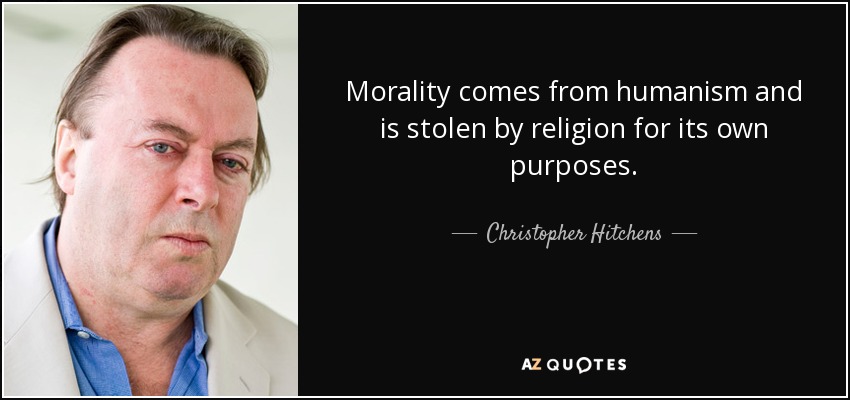
“Do no harm” and “Treat others as you would want to be treated” in some form appear in every religion.  The problem is I can say both of these and not be religious.  It is the strongest indicator that Christopher Hitchens was right, that morality comes from simply being human, but religions steal that notion and then add their own so that certain groups of people gain and others lose. There is nothing moral about that and to pretend there is, well, that is just indoctrination talking.  Sorry, spent too much time as a religious person to not know that is true.

Continuing to Walk the Path,

The Rabyd Skald – Wandering Soul, Bard and Philosopher. The Grey Wayfarer.

Skaal!!!

Of Wolves and Ravens – Love: Mutual Essential Happiness

Happy Tyr’s Day

Discussion:

I know I used a Robert Heinlein quote for the Pagan Pulpit this week, but I suppose it is also fitting that he comes up here, as love is the philosophical topic this week. Love for Heinlein was the idea that in order to be happy another person you cared for also had to be happy.  When both sides are concerned at this level with each others happiness, then love is there.

I feel the same trepidation in talking about Love as I do Fidelity.  I have never really grasped or been good at this love thing. Mostly because I am a little bit of a hopeless romantic when it comes to love. I have high ideals about it. I have discovered however that ‘love’ is not thought of as highly by others as myself. People use the word ‘love’ so often and so frequently it loses its meaning.

I find with love I represent the blundering idiot more than the person who understands it on a practical level.  Because of this, when love is lost by any cause, it hurts me – badly. It is in times like those that I find myself wishing my heart could be ripped out of my chest and removed all together.  Every time there has been that early struggle to just shut down all emotions completely and forever.  To go completely cold-blooded bastard, so I don’t have to be concerned with anyone’s happiness but my own.  But in the end the risk of love is far outweighed by the joys of it. At least when I find those joys.

To the Wolves and Ravens:

Needs (Geri):

I need love.  We all do.  As introverted and reclusive as I am, I find the need to feel that someone loves me.  I can face a whole day by myself and be happy with it, if I know someone loves me. I struggle with that though because my definition of love is so very high. My standards and expectations of love I receive is the same as I give to them.  If I am ‘all in’ with a person, I expect that in return and I need that to be true.

I need different kinds of love.  I need friendship, family love and the one I will be using the most in this post – love of the deepest nature with another human being.  In my case as a heterosexual male – love with a woman. It’s the love I need the most.

Wants (Freki):

I want love.  It has a lot of side benefits. For me, I find The Grey has no place in love. It isn’t there or does not affect me at all.  Love is the sunshine I keep in my heart where I smile even if the clouds are over me.  I can smile because the Grey has no power when I can feel that I am loved. When I know I am loved.  It is a want that is very strong, but it also makes me not think about what’s going on as much.

Reason (Huginn):

The wolves of love are easy.  The reason behind it is much harder. I have loved and lost several times both is romance and friendship.  Two times romantically were greatly significant to the point they were personally devastating.  I wrestle with the fact that I was ‘all in’ with these two women but it is clear by their actions, they were not.  It is hard when that other person’s happiness is so essential for your own, but then you come to the devastating realization that their happiness is not conditional on yours.  That takes some time to get over.

There is also trying to rebuild love. Yes, it is a real thing. Where history causes you to doubt love.   So you say it to each other multiple times every day, when you are alone you go through the box of all the notes she has sent you where she has written ‘I love you’.  You cuddle and kiss and make love and that phrase ‘make love’ has a whole new meaning because that is exactly what you are doing.  It isn’t about sex as much as making love.  To build it and surrounded it with wall and protect it.  It’s hard when you look at the damage at times, and see it is you who destroyed that part, and now you have to fix it. It is far easier to destroy than to build and that is especially true for love.

Wisdom (Muninn):

If experience makes one wiser, I can say for me love seems to be an exception to that rule. I find with love reason and wisdom seem to have little place. They probably should, but in truth we all seem to shoo the ravens away to follow our wolves of need and want. I can say that I am wise enough to really guard myself these days.  Despite my desires, I keep myself limited in who I love and why. I just know, if I am hurting I try to grasp love from somewhere and if the pain is high enough wisdom and reason are very hard to find. So, I try to deal with reducing the pain to stay in fidelity.

I suppose that is why when it comes to love I see that honor, courage and standing for truth are good emotional states as well as virtues.  Strong ones. They help with understanding love and keeping on the path despite my pain about it.  At the same time, it is this continued search for love that keeps me wandering and searching.

Conclusion:

Love is a funny thing.  It can scar you when you are the one concerned with someone else’s happiness, but they are not as concerned with yours.  But it also can bring joy, healing and strength when it is.  I don’t know if have really said much here.  I know there is a lot of emotion behind my words in this post today, but whether my philosophy behind love as a higher virtue is good I have no clue.  I am still learning.  As I said, I am a blundering idiot at times with love. But I keep walking trying to understand it.  I keep walking hoping to find the sunshine of love to keep my heart free from The Grey.

I remain,

The Rabyd Skald – Wandering Soul, Bard and Philosopher. The Grey Wayfarer.

Skaal!!!

Of Wolves and Ravens – Western Philosophy – Individual Rights

Happy Tyr’s Day

Discussion:

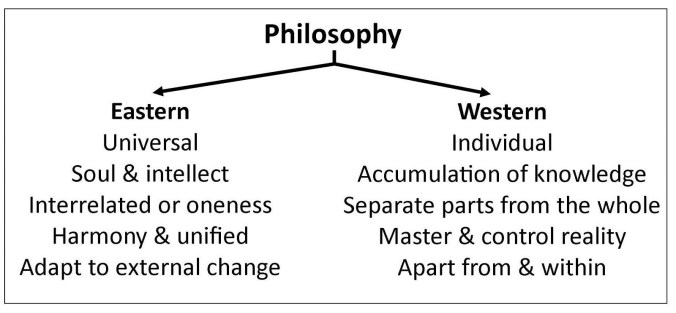
If one wants to point to the main difference between Eastern and Western Philosophy it is Collectivism vs. Individualism.  This is overly generalized on my part, and I would say there are elements of individualism in Eastern philosophy and Collectivism in Western.  It is just the results ultimately lead down these paths overall.

See the source image

Source: http://www.writeopinions.com/western-philosophy

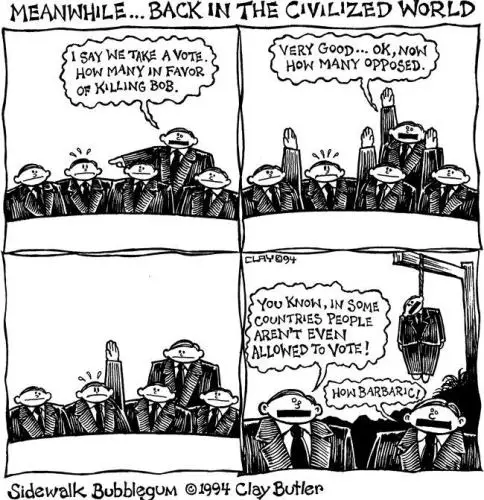
We could argue all day which is superior, but there is one element that I personally take to heart because of where it leads. The focus on the individual over the centuries has led to an understanding of individual rights.  The people have certain rights like life, liberty, pursuit of happiness and ownership of property that no collective group can take away is something very Western.  In Eastern Philosophy you get more of a rights of the group mentality. This can be detrimental to the individual.  I suppose this debate will continue until the bitter end. I am going to side with the individual and the below cartoon illustrates how collectivism or majority rule can lead to evil.

See the source image

That said there is something to be said for Eastern Philosophy in other areas. I just get real rights conscious for the individual from Western philosophy and in this regard I think it is superior to Eastern. I am not going to go into the philosophy where our rights come from at this time.  That will probably be the subject of a Of Wolves and Ravens down the line.

To the Wolves and Ravens:

Needs (Geri):

The need for an understanding of individual rights is paramount to treating each other like human beings.  If you don’t think humans have rights then it is very easy to see them as non-human.  I think it is a basic test of humanity to see what a person’s feelings about the rights of other humans are or may be. If you find they give rights to themselves and people they like but not to others, I think they fail that test.  This discussion of rights fills to needs – a) tests your own humanity and b) litmus test for others being human by how they treat other humans.

Wants (Freki):

For myself I would rather have this rights issues than the collectivist one. If the thought that you could be killed for the benefit of the ‘greater good’ bothers you, you understand why you want individual rights.  They give you the power to live your life ad protect you from those who would try to take that away from you.

Reason (Huginn):

Of course reason gets us to the point that we realize that rights only have value if they are defended and stood up for. This is another matter for the ‘where do rights come from?’ issue.  But for now, it is simply noted that the basic rights require other rights to defend them.  One thing leads to another when it comes to rights and the right to defend one’s rights stems from calling those basic rights rationally essential.

Wisdom (Muninn):

A wise world would promote individual rights.  It allows one to be both for the individual but also if everyone collectively is given the same individual rights – all benefit collectively  from having those rights.

Conclusion:

I would love to think balance between the collective whole and individual rights can be achieved, but I know people are inherently tribal and eventually they submit the rights of the individual to the fear or desires for power. There is always going to be that element in society that thinks they can come up with a better plan or system for you than you can and it seems inevitably they want you to hand over your rights to them or take them from you.  This needs to be resisted because if they can do it to you, they can do it to everyone. Individual Rights have to be defended against the mob.

I remain,

The Rabyd Skald – Wandering Soul, Bard and Philosopher. The Grey Wayfarer.

Skaal!!!
The Book of Rabyd 2:1 – “People are Stupid”

Happy Sun’s Day

Text:

“People are Stupid” – The Book of Rabyd 2:1

Thoughts and Exposition:

We are with verse one of chapter two moving into a different realm of The Book of Rabyd.  Chapter one is principles I would say are universally or nearly universally true.  Chapter Two is points of wisdom which are more about life guides and coming to a better understanding of the world.  Not hard fast rules in chapter two, but definitely can be seen to be true most of the time.  We start with the simple three word Phrase: “People are Stupid”

One might say this is a pretty pessimistic view of people in general. This is not a statement about people and their morality however, just their nature. Terry Goodkind and his Wizard’s Rules impressed me in their quick way of getting to human nature and laying it out there plainly and bluntly.  I like someone who can take a concept and put it into a simple statement and “People are Stupid” shocks you ,and yet catches your attention, because you know in you heart it is true.  I have tried to put this idea into other terms or phraseology but it never has the force of “People are Stupid.”

Terry Goodkind though really doesn’t stop with just these three words. but in his book Wizard’s First Rule he makes several other points about it:

  1. Given proper motivation people will believe almost anything.
  2. People will believe something because they want it to be true or fear it is true. (Confirmation Bias)
  3. Peoples’s heads are full of things that they think is true but is in reality mostly false. (Cognitive Dissonance)
  4. People rarely can tell the difference between a lie and the truth, but they think they can. (Ego)
  5. Because of all this people are easier to fool.

You will note Terry did not say ALL People are stupid.  His assumption is that by understanding this rule you can rise above it yourself.  First you understand it for yourself that you yourself are stupid.  Once you get this idea that you are stupid, and need analyze your own thinking and beliefs for whether or not they are true, then you are very much on the path to understanding yourself and others better.  Stupidity is part of being a human being and once you get that part, the rest of the wisdom that flows from this foundation becomes easier to swallow.  Truth is found in understanding that even you can be subject to stupidity and that means re-thinking things regularly to make sure you are basing your understandings on the truth and not just what you want to be the truth.

There is tremendous power that you gain when you understand all of this and the challenge for the vitreous person is to not take advantage of it for malevolent purposes.  It gives you an advantage when you realize what makes people, stupid including yourself is Confirmation Bias, Cognitive Dissonance, and Ego. You can use this to help or harm.  lead people to truth to a lie.  Motivate them to great good or evil.

As a leader over the years’, I have come to realize the difficulty of researching and coming to know the factual truth at times, but knowing full well that to motivate people to act on it, requires a great deal of tapping into people’s ‘stupidity’.  Otherwise they will never be motivated to act.  Truth rarely motivates, passion does.  That is the challenge to be motivated by truth as a leader but tap into people’s passions so you don’t on the one hand mislead people, but on the other hand get them to act.

We may see Terry Goodkind again.  I am revising a lot of these points of wisdom and combining some of them so we will see.  However many of the Wizard’s Rules echo in a lot of them.

The Rabyd Skald – Wandering Soul, Bard and Philosopher. The Grey Wayfarer.

Skaal!!!
Of Wolves and Ravens – Eastern Philosophy – The Code of Bushido

Happy Tyr’s Day

Discussion:

Eastern Philosophy is a large subject.  It stretches over several different cultures.  Middle Eastern, Islamic, Chinese, Japanese, etc. all have their philosophical schools and viewpoints.  If there is a commonality to Eastern Philosophy it is focus more on community and oneness with the universe.  In western philosophy people overcome surroundings.  In eastern philosophy, one becomes one’s surroundings if that makes any sense.

I am not going not dive into the metaphysical sea that is eastern philosophy. Today I just want to do a comparison between the Nine Noble Virtues of Ásatrú (NNV) which I follow, and the Code of Bushido (COB).  The Japanese Warrior Code is something I admire, so the purpose of this comparison is not to note superiority of one over the other.  I have a feeling if a samurai and a viking warrior sat down and had a discussion about these things they would walk away from each other with a profound amount of respect. Rather, my main purpose is to learn and grow.  To perhaps see other facets of the jewel known as the NNV by comparing it to another jewel – The COB.

There are similarities – Both have honor.  The difference is that the NNV tries to encompass in honor the idea of respect, where the COB makes that a separate virtue.  Both have Fidelity, but the COB adds the idea of Duty as part of that, although I would say it is part of Fidelity as well.   Honesty lines up very much with Truth. Compassion lines up very well with Hospitality.  Both have Courage. There is a lot of overlap as you can see.  The learning is in the differences.

The COB has Respect as separate from Honor and the Virtue of Integrity. In the case pf respect, looking at this reminds me as a follower of the NNV that Respect is a part of honor.  To me self-worth and respect are two sides of the same coin of honor.  The COB reminds me that I need to remember it is two-sided. Integrity is sticking with one’s decisions and being commuted to them.  I would say in Fidelity we see that but not so much our decisions as being committed to our relationships and making decisions based on those commitment that are loyal and true.  I can change my decisions if a different path suggests I would demonstrate more loyalty to that person or group than my current path.

The NNV has the following virtues that are more emphasized than the COB: Self-Reliance, Industriousness, Discipline and Perseverance.  It is not that the COB doesn’t talk about these things, it is just two some might be seen as expressions of the other virtues.  Discipline as part of Compassion.  To be disciplined one must then display perseverance.  However, I think the concept of ‘face’ kicks in here and failure is far less of an option in the COB as it is in the NNV.  The Viking Warrior after failing, gets up and tries again.  The Samurai might instead to stave of losing face commit ritual suicide.  The thing being that in Eastern philosophy community is far more important that the individual.

This is probably best seen in Self-Reliance and Industriousness. It is not that the COB does not emphasize them, it is just they are always seen as a part of a greater whole.  The problem with this in Viking culture is you can find yourself alone trying to survive and live.  The climate and nature of the Scandinavian world meant you are going to have to face things at times without the community. So you better figure out how to do things yourself and you better work hard or you might die or suffer for relying too much on others or not working hard enough.

To the Wolves and Ravens:

Needs (Geri):

Comparison in philosophical systems is needed to strengthen our own.  It avoids the cranial rectal inversion that some philosophers develop that I am trying to avoid.  Having one’s head up one’s own ass philosophically.  Easter philosophy with its different focus points tends to be quite revealing when you put it side by side western.

Wants (Freki):

I personally want to see aspects of the Code of Bushido expressed in my following of the Nine Noble Virtues. There is a need to remember respect as part of honor for me. To remember community is important when it comes to hospitality and fidelity.  That Integrity is a part of Truth for me. Learning how to fuller understand and express the NNV by looking at how others see the same virtue is something I definitely want.

Reason (Huginn):

I would say reason tells us that codes and virtues might be the same but which ones are going to be more emphasized are going to depend a lot of culture and society.  The Code of Bushido fits its Eastern philosophical world. The NNV virtues make more sense for me because I live in a culture that is more self-reliant and individualistic.  However if I had or do business in Japan, it might do me well, from a rational point of view, to switch while I am there.

Wisdom (Muninn):

Learning to find wisdom where you find it is key.  Wisdom knows no culture or society. It sometimes expresses itself differently depending on society but the concepts of wisdom tend to be the same.

Conclusion:

I have enjoyed this look at the Code of Bushido.  It has made my meditation on the NNV a little more fuller as I consider aspects of the NNV in its light. It has allowed me to see more of my own path and code.  I imagine I will return to it again.

I remain,

The Rabyd Skald – Wandering Soul, Bard and Philosopher. The Grey Wayfarer.

Skaal!!!


Odin’s Eye – Deism: The Search for The Rational God

Happy Thor’s Day

Discussion:

I still very much embrace Deism as the most rational way to approach the subject of the divine.  I think the notion that there is no god is just as irrational as the theist or religion who thinks he/she has god locked down.  The great challenge for me as a deist is to deal with the subject of the divine using only reason and natural revelation as a guide. Heavy emphasis on the reason part because natural revelation is still subject to human interpretation.

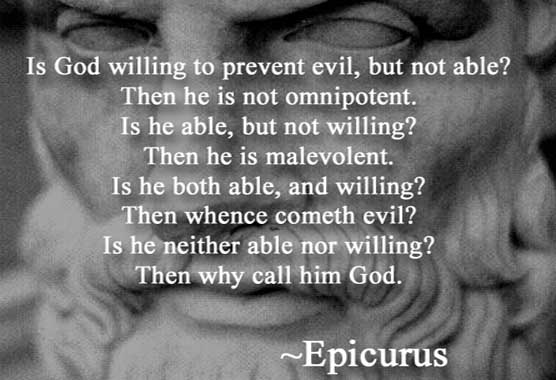
Epicurus’ argument against God is pretty well-known and I still have some of the same problems with it as I had as a Christian.  In fact much of my arguments against it have not changed because even back then the defense against philosophy is not theology, it is more philosophy.   Most notably Epicurus assumes his definition of all-powerful, etc. are locked down and cannot be challenged. He seeks basically to win the argument about god through definition which is an argument from authority based on the authority of the definition.  What his argument does do is present the rational contentions about the divine that need to be addressed very concisely and in a logically sound manner.

This is actually one time where the Eye lines up pretty good with each part of Epicurus’ argument. So….

Time to Look Through the Eye:

Faith:

If he is able but not willing?  He is malevolent

I find it interesting that Epicurus engages in faith at this point. He has faith that there is such a thing as malevolence or beneficence and assumes that god must be one or the other.  Such definition really lose their meaning if you dismiss notions of good and evil and realize there might be a rational reason why a supreme being might create and then move on.  As George Carlin points out – God may simply not give a shit.  He may be a creator, but it does not imply that he is malevolent simply because he refuses to do something about ‘evil’.  He may simply also look at humanity and say – “you did this shit to yourselves and you have the capability to get yourself out, take responsibility for the ‘evil’ and suffering you have caused and fix it yourselves.”

I actually think this is the strongest argument for polytheism. That the reason we see so many problems in the world, is it was created by a committee.  Just saying.

My faith is that if there is a god or gods or whatever, that they are creators but not necessarily cosmic babysitters. Like good parents he/she or they want us to grow up and tackle our own problems and we can’t learn how to do that effectively without struggle.

Religion:

If God is neither able or willing, then why call him God?

Actually because the definition of ‘god’ is much broader than “Omni” classifications.  We also use the term ‘god’ to describe beings of great power and use a small ‘g’.  It is religion that paint god as all-powerful in the sense that he can do anything, but there may be laws to the universe that prevent the divine from acting and they may as pointed out above, not give a shit. It doesn’t stop them from being more powerful than anything else and thus deserving the title of ‘god’.

Theology:

If God is wiling to prevent, but not able.  Then he is not omnipotent.

I like to point out at this point that Epicurus does not eliminate god with this statement as some atheists claim.  It just shows that perhaps human conception of the ideas of omnipotent, omniscient, etc. might not be properly defined. So such a god could exist with all the power that actually exists, knowing everything in the way it is knowable and be present in all places that actually exist.  Yes, these ideas create a powerful being worthy of being called god, but there are limits here. Such limits make the normal understanding of omnipotence in need of adjustment, but it doesn’t make such a god not possible or lacking in existence. All this statement really does is point out that our definitions might be in need of change.

Spirituality:

If he is both able and willing? Where does evil come from?

Moral evil is easy to justify if you use freewill as a defense and a god who does not interfere because he wants humanity as a whole to learn and grow. It may not be logically possible to have freewill without suffering. Natural evil is a little harder to justify.  Other than if god is still bound to the laws of the universe, then the laws of physics make natural ‘evil’ simple existent and God may very much be a powerful being who fights these forces but cannot do everything.  Rationally, the god that actually exists might have limits – both because the laws of the universe place those limits or those limits might be self-imposed because it is not always wise to interfere.

Conclusion:

I am not saying Epicurus is wrong.  He may very well be right and God is a figment of human imagination.  I respect the atheist position but I find it personally a little extreme because of human ignorance of the universe. His argument actually forms a lot of rational response for deism as it must address these issues to have a rational reason for belief in the divine’s existence. His argument guides the search for the rational god because the questions are valid.  That said, I do, as a theologian, see the irony of accepting certain theological definitions in order to make your argument against the existence of god, when those definitions themselves can be challenged.

For me the search for the rational God is part of the journey that I walk. But as a pagan, it is not my only criteria.

Continuing to Walk the Path,

The Rabyd Skald – Wandering Soul, Bard and Philosopher. The Grey Wayfarer.

Skaal!!!
Of Wolves and Ravens – Virtue: Moving Higher

Happy Tyr’s Day

Discussion:

Having finished the Nine Noble Virtues it is time to flip the subjects for Of Wolves and Ravens to the flip side.  So for the next nine weeks the subjects will be more Side B

  1. Eastern Philosophy
  2. Western Philosophy
  3. Love
  4. Minimalism
  5. Economics
  6. Justice
  7. Political Science
  8. Libertarianism
  9. Wisdom

These are either the Higher Virtues or other philosophical elements that guide my thinking. Subjects where my philosophy is more real and concretely applied to the real world of my life.

Today, however, we return to the general subject of virtue. Mostly the rationale behind pursuing virtue as opposed to Religion as a way of moving higher.  I suppose it comes back to the Marcus Aurelius quote I keep using.

See the source image

My main issue these days is to live a good life and so following good virtues is the path to that.  The Nine Noble Virtues (NNV) of Asatru are good ones to follow and no matter what your religion or faith, I don’t think you could fault them.  Virtue is a Human trait and if anything is responsible for the good in the world it is when people take their human capacity and guide it by good virtues.

To the Wolves and Ravens:

Needs (Geri):

At this point things will get a little more personal.  After departing from my Christian faith, I knew I would need something to guide my life philosophy. I think that is one of the problems of struggling with faith.  You hold your principles from that faith, but the basis for doing so is missing. I needed to figure out what that basis was and how I could hold a system of philosophy to guide myself and my character without having faith in a religion.  Virtue is an old discussion in philosophy and one that has always had a lot of merit to me. So I found that the need for a system of virtue was very much justified.

Wants (Freki):

I also wanted virtue.  One of the things that you get accused of when you leave the faith is somehow you are now lesser of a person.  It is never said but it is there.  Your ‘lost’, ‘going to follow your sinful nature now’, you are not as ‘good’ in the eyes of the people of the faith you left. Part of my embracing virtue is I want to show how bankrupt a notion it is to believe you need to follow a certain religion or faith to be a good person.  That you can be a better person morally without faith or religion is a hard concept for people to accept for some reason.  I want to prove that it can be done.

Reason (Huginn):

The rational reason for following virtue for me is that it upholds my thoughts that a person can actually use religion for evil while calling themselves good.  After all they are just following their authority of their holy book or holy man.  Even if that action causes harm to others, in religion it is still justified because you were doing what your authority told you.

I can’t do that following my philosophy of virtue.  Virtue demands that an action must also cause no harm to others whenever possible.  It recognizes that appeal to authority is not a rational act but a logical fallacy.  Therefore to just follow authority blindly is not virtuous, rather quite the opposite.

Wisdom (Muninn):

I feel that no matter what the twists and turns of my life are now, that the NNV allows me to navigate each fork and crossroad with wisdom.  I am not letting some blind guide pull me along.  Rather my eyes are open and I makes sure each life decision is guided by principle and virtue.  I do take into account what is best for me, but I also no longer think that shows a lack of wisdom but rather it demonstrates wisdom.

Conclusion:

On May 28th, 2018 I was no longer a pastor or a Christian officially. I even have a letter from my former church that fired me retroactively to May 27th to prove it. I keep that letter because there is a line in it that motivates me. From time to time I pull it out and read it:

“This decision was based on the fact that you no longer have the character, ability or right to be the shepherd of any flock”

Well, I plan on making them eat those judgmental and arrogant words and I plan on doing it by living a better life than I ever had as a Christian.  I plan on doing that by following virtue.  By so doing, I will move higher than I ever have before. I don’t see my leaving the flawed hypocritical virtues of Christianity to follow the NNV as a step downward, but rather a step upward. Time the pierce the sky and live a good life.

I remain,

The Rabyd Skald – Wandering Soul, Bard and Philosopher. The Grey Wayfarer.

Skaal!!!
The Pagan Pulpit – The Book of Rabyd 1:3 – “Everyone Has the Right to Liberty”

Happy Sun’s Day

Announcements:

We don’t pray here – we figure God, the gods and goddesses, or whatever powers that be either know already, don’t give a fuck, or are busy with more important matters than our petty stuff. We also kind of assume that they expect us to do stuff that we can do for ourselves, and that we will do them ourselves and not be lazy. We also believe in being good friends, so we don’t presume on our friendship with the powers that be by asking them all the time for stuff while giving them nothing in return.

We also don’t take an offering here.  We figure the powers that be probably don’t need it.  Let’s be honest, offerings are not giving to the divine powers, they are given to an organization to support it.  Just being honest. God, the gods or whatever never see a dime, farthing or peso of that money; it all goes to the church, mosque or shrine.

Opening Song: ‘Bad Reputation’ – Joan Jett (Uncensored)

Is there an opening message here about liberty.  Yeah.  Liberty often requires that you don’t do things to please others, you do what is right for you and sometimes others are just being self-righteous, sanctimonious pricks.  The message today is about respect of others right to liberty, but sometimes it isn’t about that – it’s about trying to maintain your own liberty in the face of those who would take it away though cultural and political rules that they want to impose on you. Sometimes the fight for liberty is simply a matter of telling such rules and those who impose the to ‘go to hell’.

Poem: “Untitled Meme” by Unknown.
Image may contain: text that says 'Let the gays get married. Let the rednecks have their guns. Let the atheists be atheists. Let the Christians be Christians. America is about FREEDOM. Freedom to live your life as you please. So smoke a bowl, eat a greasy burger, shoot your guns, praise Jesus and wish those two fellas next door a happy honeymoon. It's only when people FORCE their ways on others that problems begin. It never ceases to amaze me how many full grown adults don' t understand that.'
Forcing your viewpoint on others is the issue. Not sure if this is a poem, but it definitely gets the point across.
Meditation:

Image may contain: text

Song of Preparation: “Imagine” – John Lennon

“They say I am a dreamer, but I am not the only one.”

Text: 

“Everyone has the Right to Liberty” – The Book of Rabyd 1:3

Sermon:

Liberty.  It is an easy word to say and it is easy to demand it for yourself.  It becomes quite another matter to give liberty to others.  The great problem with humans is that we objectify others and nearly all methods of objectification involve this notion that people should live a certain way, or do certain things and if they don’t then they just are wrong and we should make them.

I would submit the moment you are trying to use force, threat of force or fraud to make another person or group of people conform to your vision of morality, behavior or ethics you demonstrate you do not understand the word liberty. Liberty isn’t just about you being able to live the way you desire, it is about letting others do it too.

This is the thing about calling thing inalienable rights.  This means that if you want your right to something inalienable you have to respect it in others. The other thing is there is more than one inalienable right – you also have life and the pursuit of happiness.  No use of your liberty can deter then from another person’s rights to life liberty and the pursuit of happiness.

This has some pretty astounding implication which I will get into later in The book of Rabyd, but for now note that liberty allows you to do what you want to do as long as it does not interfere in the rights of others. That means you have to think a little bit about things before you act.  There is no just do what you want and damn the consequences. Liberty demands the notion of ‘love your neighbor as yourself’.

On the flip side though, if a person is going to tell me I am interfering with their rights, they better bring proof.  If they can’t do so, then they are simply attempting to diminish my right to choosing my own path which should be considered as just as evil a crime as trying to take my life.  People use all kinds of forces from philosophy, to religion to a straight up desire to control others to justify interfering with people’s liberty.  That notion cannot be allowed.

If there is any legacy I want to leave to my children and grandchildren at this point it is I hope they truly consider the blessings of liberty.  Not just for themselves but there is also a blessing in letting others be free.  From freeing oneself from the terrible desire to control the behavior of others.   If I were ever get around to creating a family motto, it will certainly have the Latin word: ‘Libertas‘ in it. It is that important; just as much the inalienable right as life.

Closing Song: ‘Whiskey in the Jar’ – Metallica

One final Skaal!!!

Parting Thought: 

Image may contain: one or more people

Amen, Mr. Hoppe, Amen

I remain,

The Rabyd Skald – Wandering Soul, Bard and Philosopher. The Grey Wayfarer.

Skaal!!!