“Revising the Ten Commandments – Part 3 – Additions and Final Copy” – The Rabyd Skald

Happy Mani’s Day

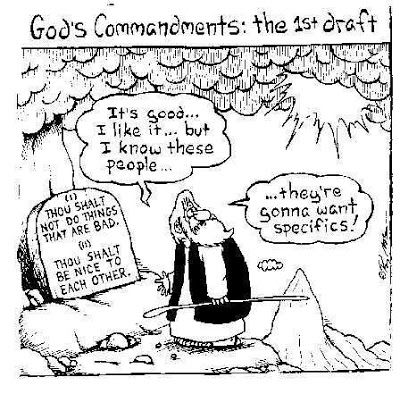
Now for the part of this where I ask the question about ‘is there something else that could be added?’ What stands outside the commandments as edited by myself that should also be on par with the other ten.  In this regard, most people don’t realize the original ten commandments does the same thing. In one place after the ten, more are listed and it has a lot to do with additions or other ideas that need to be addressed. I think that there is a call for me to do this as well.  Some other things should be emphasized.

Additions:

#11 – Until a child can make decisions for themselves, they should not have parts of their body removed, be abused or otherwise manipulated to further the agenda of adults. 

Sorry, I think children should be protected and make such decisions about circumcision, sexuality, and other religious and political matters when they are old enough themselves.  Adults should respect it is their body and their choices and until they can make informed decisions they should be protected until they can do so themselves.

#12 – In case it wasn’t already clear, the following activities should not be done as they are morally bankrupt: rape, genocide, and slavery.

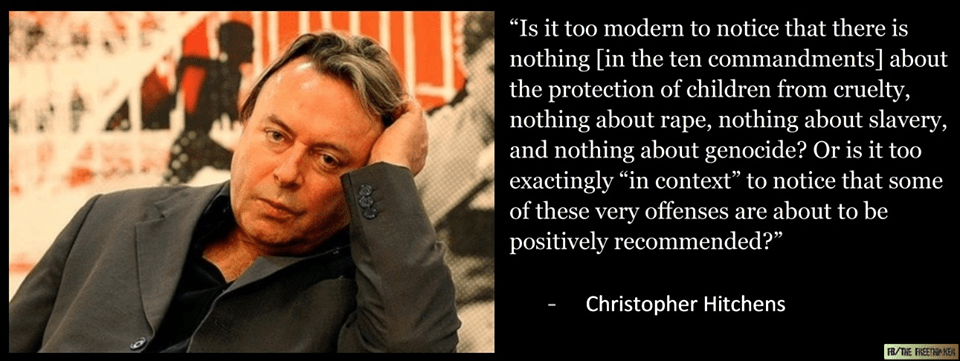
I don’t really need to say anything here do I.  Other than I have just contradicted many of the commands of the Law of Moses and the ‘history’ of the Biblical Story of god’s people to say so.  Christopher Hitchens is right.  The reason these are not in the original ten is that God’s people will be asked to commit genocide and will later both enslave and rape the survivors.

#13 – Don’t do to others, what you would not want to be done to you.

Kind of a catch-all and a negative version of the golden rule.  This is because the negative so it actually prevents bad behavior in this case.

Final Copy: The Grey Wayfarer’s 13 Commandments:

#1 – You were born free.  People will try to enslave you through many means; Don’t let them. Respect the freedom of others; Don’t enslave them. 

#2 – Be an artistic human.  Express yourself and enjoy the expression of others.

#3 – Uphold the truth and be truthful with your words.  When you’re wrong – admit it. 

#4 – Take one day a week off and do what you want to do.  Life is too short not to enjoy it.

#5 – If you have children, remember that was your decision, not theirs; so be responsible parents, earn their respect, and teach them to be good human beings.

#6 – Don’t Murder

# 7 – Engage in responsible and consensual sexual activity.

# 8 – Don’t Steal

# 9 – Don’t lie to convict or harm the innocent.

#10 – Think Freely.  Never accept any tyranny, especially that of the mind.

#11 – Until a child can make decisions for themselves, they should not have parts of their body removed, be abused or otherwise manipulated to further the agenda of adults. 

#12 – In case it wasn’t already clear, the following activities should not be done as they are morally bankrupt: rape, genocide, and slavery.

#13 – Don’t do to others, what you would not want to be done to you.

They still need refining, but a definite improvement.  In the end, I think I have demonstrated that it does not require religion to come up with a solid moral code.  Rather, it seems that one simply being human can actually come up with something better than the supposed ten commandments of God through Moses.

I remain,

The Rabyd Skald – Wandering Soul, Bard, and Philosopher. The Grey Wayfarer.

Skaal!!!

“The Cold Hard Reality of Justice” – Of Wolves and Ravens – Justice

Happy Mani’s Day

Discussion:

The cold hard reality of justice is that you may never receive it. Ever.  No matter how much you desire it or want to think you deserve it, justice may elude you. It this injustice of life that causes people to think if a final cosmic justice after death where the scales are balanced and everyone gets what they deserve.  Every type of life after death mythos has this in it in some way. The problem is that there is no evidence that this will ever happen. It might be something hoped for, but it is likely to be all nonsense and wishful thinking.

When people ask me what I believe, I tell them that I have no active belief in any god of any type. That makes me for all practical purposes an atheist. I occasionally conceded it would be nice if deism was true, but believing in a creator cause is a far cry from all the other claims of theism of any kind. Including any form of a goddess, that holds a scale in her hand one hand and a sword in the other and is blindfolded.  That is mythology.

See the source image

The sad real truth is many people will never receive justice for what has been done to them and in some cases, you have to be content with it.  Notice, I didn’t say forgive because in my opinion forgiveness should not just be given toward injustice.  Forgiveness being encouraged is often simply an excuse for those who have the power to get away with wrongdoing and abuse. A man who sexually abuses and rapes his daughter should have his dick cut off; not be forgiven.

There are other ways to get peace about things that happen to you, forgiveness needs to be carefully measured and viewed in the light of contrition from the person who did the harm in the first place.  Without contrition and restitution upfront, forgiveness is not deserved in my opinion.  Justice is a better option until those things take place.

Justice can take many forms and merits a discussion in regards to philosophy outside of any final afterlife balancing of the scales. So…

To the Wolves and Ravens:

“Feed the Wolves, but Listen to the Ravens first.”

Needs (Geri):

To illustrate my meaning here, I will use my own unpleasant experience with and desire for justice to take place toward The Dirty Pig.  I need justice in this regard as I know like so many others who have wronged me, they haunt me like ghosts to this very day. I never get over them and that is simply how I am.  I learn to cope but it never sits right with me ever.  The only exception has been when I learned later that karma or the universe had bitten them in the ass in much the same way.  The leadership of my former denomination that was instrumental in my downfall from my second church is a good example as later I learned their own bad actions caught up with them and they too were discredited.

I need something similar to happen to the Dirty Pig for my conscience’s sake.  Such justice allows me to smile and truly walk away and not look back.

Wants (Freki):

I want justice in regard to The Dirty Pig as well.  Pardon me if I think people who are fake and false friends should be seen for it. That an honorless person should be exposed as being honorless. That people who have a trail of broken friendships they no longer saw as useful to them or that were necessary to shuck off to cover their own ass should face the consequences of being narcissistic self-righteous assholes.  Yes, pardon me for think justice should be enacted on people who are sanctimonious jerks who use people to entertain themselves.  Sorry, I don’t just want to see it with the Dirty Pig, I want to take the sword from lady justice and use it myself.See the source image

Reason (Huginn):

All that said with my wolves howling for justice, the raven of reason caws and reminds me I may never see it, or be the one who holds the sword, and I need to be ready for that.  I need to be content that it may be someone else he has wronged (there are many of us) that brings down the old boar known as The Dirty Pig.  In such a moment I need to be content with simply toasting that bringer of justice’s good fortune.  I may also have to accept that he may die having never received justice. Then my contentment will come from toasting in contempt of his memory and I won’t be alone in that regard.

Wisdom (Muninn):

The raven of wisdom caws – patience. Yeah, I can do that. Mostly one day I know he is going to need friends and because he has thrown so many of us away as no longer worthy, he will be lacking in that regard. The potential and probability for poetic justice are very high given his behavior and patterns.  He also isn’t as smart as he thinks he is and that means he has the potential to make a mistake with the wrong person who will show him for what he is. Yeah, I wait and watch.  My fury can stay smoldering and focused on the right time to act.

Conclusion:

In the last two years, I can say three traumatic events have happened in my life. I loved and lost Miss Salty.  I nearly got a divorce from my wife.  Someone I thought was a good friend turned his back on me.  He lied to me and used someone I loved and a congregation I loved to get his own version of honorless justice to prove he was the kingfish. He slandered me, lied about me and stabbed me in the back.  In doing so he demonstrated his lack of honor, friendship and concern for anyone but himself. Of the three it is the only one I am still angry about and want justice for.  But, I realize patience and keeping myself open to the many forms justice may take is necessary.

I remain,

The Rabyd Skald – Wandering Soul, Bard, and Philosopher. The Grey Wayfarer.

Skaal!!!

“Revising the Ten Commandments – Part 2 – Positive Replacements” – The Rabyd Skald

Happy Sol’s Day

I have decided that the best way to proceed in replacing the existing commands and improving the ones that are left is to follow two principles: 1) Be Positive and 2) Provide a counter in each position of the spirit of the original commandment. In the first what I am trying to do is be more of an encouragement to people to be good human beings rather than a tyrannical dictator. In the second, I am trying to provide a counter to the original commandment negative aspects.  So, here is my revised version:

#1 – You were born free.  People will try to enslave you through many means; Don’t let them. Respect the freedom of others; Don’t enslave them. 

Unlike the original, I am not going to tell you to live in bondage to some authoritative figure just because.  Rather, allow me to tell you that you were born free and others will try to enslave you.  Don’t let them and don’t do it to others.  Live as sovereign over your own life alone and protect that.

#2 – Be an artistic human.  Express yourself and enjoy the expression of others.

Make images, music, words, or whatever your heart desires.  Every human being should find some artistic outlet for themselves to remain creative and freethinking. Learning to enjoy doing something artistic and creative, and enjoying when others do it as well, is the spice of life.  Creative activity should be celebrated not forbidden.

#3 – Uphold the truth and be truthful with your words.  When you’re wrong – admit it. 

True, the truth can be difficult at times, but it is far better to be amendable to it than defy it. Speak it or don’t be afraid to say ‘I don’t know’ or ‘I was wrong’.

#4 – Take one day a week off and do what you want to do.  Life is too short not to enjoy it.

The opposite of the biblical forth command which seems to tell you to live in a totalitarian state even on your day off, I am going to say to do what you want. Do that which helps you to get enjoyment out of life. A day off a week to do what the fuck you want to do is only being fair to yourself.

#5 – If you have children, remember that was your decision, not theirs; so be responsible parents, earn their respect, and teach them to be good human beings.

I think people have it backward.  Parents owe their kids not the other way around.  You chose to have them, they didn’t choose you to be their parents. It seems like from a standpoint of repsonsiiblity it falls on the parents to be responsible, to earn their kids respect, and teach them to be good human beings by word and deed.  Expecting your children to just be good little servants or else is kind fo training them to be slaves in a dictatorship.

#6 – Don’t Murder

Duh, No shit.  Yeah, self-evident to any human with basic moral capacity.

# 7 – Engage in responsible and consensual sexual activity.

I know there are social and cultural things that inject into the subject of sex but in truth, the only thing I see in truth is being responsible in that you understand there are consequences to sex that need to be mediated and that you shouldn’t be having sex with someone against their will.  It might be helpful if they knew what it was beforehand and had a choice about it.  So forcing an eleven-year-old to marry you is out.

# 8 – Don’t Steal

Duh.  No Shit.

# 9 – Don’t lie to convict or harm the innocent.

Duh. No Shit.

#10 – Think Freely.  Never accept any tyranny, especially that of the mind.

There should be no thought crime or even crimes that prevent certain words or language from being used. All tyrannies are bad, but a tyranny over thoughts and ideas is the worst form of tyranny.

I remain,

The Rabyd Skald – Wandering Soul, Bard, and Philosopher. The Grey Wayfarer.

Skaal!!!

“Economics and Common Sense” – Of Wolves and Ravens – Economics

Happy Mani’s Day

Discussion

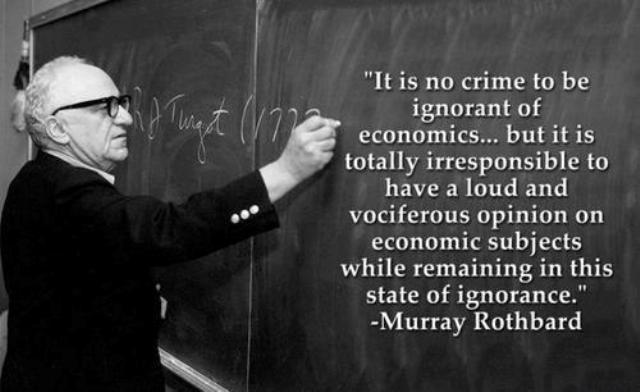
Having a minor in economics apparently puts me above the common man who has an opinion about economic matters. It does, however, add to my frustration level as Rothbard’s quote resonates with my soul quite a bit.  I find a few things frustrating about people’s ignorance of economics.  Mostly how this ignorance is used against them.

Economics is part of my overall philosophy because some of my virtues are connected to business: Self-Reliance, Industriousness, and Hospitality all of more direct economic issues so knowing something about how economics actually works helps me have more for my ravens to say about those decisions involving those virtues.

Because of the law of scarcity, for instance, I know that there are some things in life not available to everyone, so if you want them you have to earn them.  It gets rid of a sense of entitlement which, to be honest, is one of the most detrimental things a person can have as part of their personality makeup.  Economics is often called codified common sense and so it is a valuable tool in my philosophical toolbox.

To the Wolves and Ravens:

“Feed the Wolves, but Listen to the Ravens first.”

Needs (Geri):

I suppose my need for economic knowledge in relation to philosophy surfaced with some of my decisions when I first went back to school and decided on my major. I knew I wanted something that was in demand and marketable but also flexible.  The one thing I had noted over the years, as technology and knowledge change, so does how business is done and those who can adapt thrive.    The need for flexibility and marketability long term was an issue of the Law of Demand.

Wants (Freki):

On the flip side, the kind of job I wanted is an issue of the Law of Supply.  What’s available. was an issue.  The thing was that Political Science opens that up by one simple thing – I could always be in administration and that is everywhere. Not to mention that just having a Bachelor’s degree from a university that is real-world instead the plastic bubble of religion opens up even more.

Reason (Huginn):

So my current struggles beg the question of which law deals with the fact that I am struggling to find a job and the economics of hidden costs and unintended consequences of economic policies might be a factor. the simply truth is that if someone hires me that has a good benefits package my being older is going to cost them more money even if that benefit is simple health insurance, the premium for me will automatically be higher.

Wisdom (Muninn):

This leads to the wisdom that I need to be ready to give up some raw salary to compensate for that.  It is something I will give up because I would still come out ahead of where I am now. Economics helps me realize that flexibility is called for.

Conclusion:

Personally, economics being part of my overall philosophy has been something that has had a calming effect.  I don’t get bent out of shape when an employer does certain things but I rather ask what the economic issue might be.  Sometimes I have to ask why they don’t consider economics but people are people so they don’t always have economic knowledge and that includes people in charge.

I remain,

The Rabyd Skald – Wandering Soul, Bard, and Philosopher. The Grey Wayfarer.

Skaal!!!

“Minimalism and Time Management” – Of Wolves and Ravens – Minimalism

Happy Mani’s Day

Discussion

One of my overarching philosophies is the philosophy of minimalism.  That is the question that this adds is very simple – do I need this or does this bring me joy?  if the answer is ‘no’ then minimalism says that you get rid fo it.  Now, this does not just apply to things like furniture and clothes, but also relationships, health, fitness, and just about anything else that this question can be leveled at.

One of the key issues is what you are spending time on.  All things take up time and the minimalist question is whether or not the time should or should not be spent. is the time spent necessary and does it bring happiness?  If not, why are you spending them on this whatever it is?

Behind the statement “Feed the Wolves, but Listen to the Ravens First” is the wisdom and reason of ravens who are looking for things that better manage time and get rid fo time wasters. This is minimalism at its best.

To the Wolves and Ravens:

“Feed the Wolves, but Listen to the Ravens first.”

Needs (Geri):

The issue of need is always a sticky issue as what a person’s needs are can be far more than food or clothing, but also relationships and other things that allow a person to function.  There is a crossover between needs and wants but the question of do I need this to function as a human being is the starting point of being minimalist and how I spend my time.

As an example, my work wardrobe is the same and I actually have four copies of it.  Why? I spend zero time deciding what to wear for work. That time is better spent on other things like writing, and actual preparing for work.  I need to have clothes for work, but nothing says I need to have something different every single day so I save time by having it pretty much the same.  You could also accomplish this by having three to four preset outfits for work that you just rotate through.

Wants (Freki):

The second part of the question involves the wolf of want.  Does this bring me joy?  Does it make me happy?  I think this part is more about all the other things besides stuff.  Relationships, in particular, are here because some relationships are not only not needed, but they are negative and time wasters.  You might find more time if you just drop some of them and improve your attitude because you are not being drained.

For myself, my relationships are few right now but I would have to say very much necessary and they do provide some comfort and support so they do indeed provide from my happiness. My issue is new relationships as I am much more cautious about being sucked into a relationship that is going to take more than it gives. I spent a lot of time as a minister fostering relationships that were unnecessary, simply because it was expected and let me tell you I don’t want that anymore.  From a loyalty standpoint, family and friends are a different matter.  All other relationships, however, have to be carefully considered in the matter of how much time is required to maintain them.

Reason (Huginn):

I find reason is more helpful in assessing needs.  I can usually apply a pretty simple reasonable question; ‘have I used this in the last year because I needed to use it?’ and suddenly whether or not I do need it is pretty apparent.  I also can say this for relationships.  Work relationships are needed, so they stay on my lists but I am cautious about how much time I spend on each one.

Wisdom (Muninn):

The question of joy is a wisdom question because it doesn’t just involve a question of happiness but love, heart, and spirit.  There is more to joy than your own joy too.  ‘Does you having this thing give someone else joy?’ is a valid question.  I have a few things like that because other people gave them to me in trust that I would honor the spirit in which they were given.  Other things are just junk moving from one house to the next.

Long term thinking also hits this because I have a few other things that I know would give me joy if the context was right.  They may not be currently giving me joy but if things change I know (keyword ‘know’) they would.

Conclusion:

Minimalism plus time management is a healthy combo for the wolves and ravens. But minimalism properly practiced gives you more time to do other things and that is simply a fact.  It focuses my time on what is important and that is key to achieving my goals.

I remain,

The Rabyd Skald – Wandering Soul, Bard, and Philosopher. The Grey Wayfarer.

Skaal!!!

“Self-Love – The Essential Ingredient for Happiness” – Of Wolves and Ravens – Love

Happy Mani’s Day

Discussion

Just a reminder that Of Wolves and Ravens will be the second post on Mani’s Day from now on instead of on Tyr’s Day.

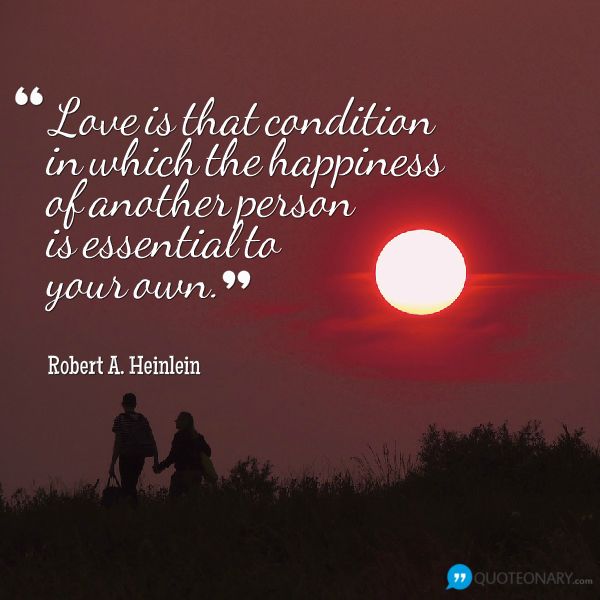
The last time I wrote on the virtue of Love, I engaged the topic of love based on Robert Heinlein’s definition which is love is mutually essential happiness.  I still hold with that which is why turning this idea of mutual essential happiness toward the idea of self-love is personally difficult.  Because it basically amounts to the simple fact that if you do not view loving yourself as essential then you will never be happy even if you love someone else and they in return love you.

I know this from painful experience as my lack of self-love led to a lot of problems with loving others.  It creates an imbalance NOT because self-love is at one end of the scale and loving others at the other end of the scale.  It is actually that self-love is the central fulcrum point on which all other loves are balanced and if the fulcrum isn’t solid the rest will collapse.

To the Wolves and Ravens:

“Feed the Wolves, but Listen to the Ravens first.”

Needs (Geri):

I hope that the above understanding of self-love demonstrates the need we all have for it.  For me, this revelation showed why things went bad and why they also went so bad once they did.  This is the difference,  When your self-love is good, then you consider your love for others as trying to balance all the rest but the central love of self will not be sacrificed while doing it.

When you don’t have that, you are like a juggler that keeps taking on another object to juggle and never considers if they can handle another one. There is no self to maintain so you just keep loving others more and more until it flips to self-loathing and then you focus on that and forget you are juggling. You can’t keep all the balls in the air at that point and they start to fall until you just say ‘fuck it’ and sit down letting them crash all around you and you don’t care anymore.  That’s what happened to me.

Wants (Freki):

This is why I personally spend a lot of time thinking about how to love myself.  Loving others comes naturally to me; loving myself is work but essential work I want to do.  Taking the time to ask the simple question of ‘If I take on loving this person, will it help me love myself or hinder me loving myself? Is this love a benefit or a burden too great for me to carry?” When things are balanced, you are not juggling, but carefully considering if things between yourself and the others you love are balanced on self-love.

Reason (Huginn):

Rationally there is also the fact that loving others and finding that person whose happiness is essential to your own keeps you from narcism.  Loving yourself at the expense of all others needs to be guarded against.  Narcism is probably the basis of all evil shit in the world. Loving others is rationally necessary to keep yourself from that path, but it has to be balanced on the fulcrum of the love of self.

Wisdom (Muninn):

Balancing the love we have for others while maintaining the central fulcrum of the love of self is the issue here. We need both to be happy.  Whenever I feel unhappy, I realize now either something is out of balance or my love for self has slipped.

Conclusion:

Going back through all my discussions on love, I have to get back to the beginning idea that Love is the combination of Courage, Honor, and Truth.  Love takes these and combines them into a very powerful force.  A force that leads us to be happy in this world and that happiness’ essential ingredient is self-love that allows us to keep all our other loves balanced.  It is this understanding of love that now guides me and so far the only issues it raises is about whether certain relationships are essential to my happiness. The most essential of these is the one with myself.

I remain,

The Rabyd Skald – Wandering Soul, Bard, and Philosopher. The Grey Wayfarer.

Skaal!!!

“Stoics and Epicureans” – Of Wolves and Ravens – Western Philosophy

Happy Tyr’s Day

Discussion

In Hellenistic Western philosophy, there is also a form a dualism that is a creation of two schools of thought – Stoicism, and Epicureanism. Breaking them both down:

Stoicism:  Nature is rational; man cannot escape the forces of nature but can uniquely follow its laws; A life lived this way leads to virtue; Wisdom is the core of virtue from which spring the cardinal virtues; Passion is irrational and thus strong feelings should be avoided; pleasure is not good or evil and only acceptable if it does not interfere with one’s quest for rational virtue; Poverty, illness, and death are not evil; Duty is the motivation for pursuit of virtue.

Source: https://www.thoughtco.com/stoics-and-moral-philosophy-4068536

Epicureanism: This is a little more complicated.  One person, I read listed eight epicurean councils: 1) Don’t fear God.2) Don’t worry about death. 3) Don’t fear pain. 4) Live simply. 5) Pursue pleasure wisely. 6) Make friends and be a good friend. 7) Be honest in your business and private life. 8) Avoid fame and political ambition. He also listed ten values of which the first five deal with ourselves and the second five deal; with our relationships to others: Prudence, Self-management, Self-sufficiency, Serenity, Simplicity, Friendliness, Honesty, Generosity, Cheerfulness, Gentle-ness

Source: https://churchofepicurus.wordpress.com/basic-principles-for-the-modern-epicurean/

I suppose the main difference I see is the fact that Stoicism is pretty straightforward, but Epicureanism seems to be a little more freeform – ‘chaotic’ if you will. It would explain while on one site about Epicureanism there was a list of 40 tenents.  The difference between the two basically comes down to the goal of Stoicism being happy through overcoming and enduring hardship, wherein Epicureanism happiness is found in training one’s desires.  I can see one major difference in that Stoics accepted the fate of circumstances and tried to be wise by enduring it where Epicureanism seems more at odds with the idea of fate. Some things can be avoided if one trains one’s desires. Both sides had the basic same goal – wisdom.  To be a person content with themselves.

Source: https://academyofideas.com/2014/03/stoicism-vs-epicureanism/

To the Wolves and Ravens:

“Feed the Wolves, but Listen to the Ravens first.”

Needs (Geri):

The fact there is a debate in Western philosophy probably indicates the need for moral philosophy. How one conducts ones’ self toward self and others is has a great bearing on what we need.  Needs are real and both schools acknowledge this. One side, however, seeks to endure while the other side seeks to live in such a way that they are dealt with beforehand.

For myself, it seems that need is more of a looking at life and seeing what is needed for survival.  This breaks down into obvious needs and personal needs.  Food, water and shelter from the elements when needed. Stoics would endure a lack of these needs while Epicureans would seek to avoid the lack in the first place. Other needs are more specific to the individual.  I think what I find is that I mix this whole debate in a blender and come out with something that is a mix between the two when it comes to needs.

Wants (Freki):

Passion and desire resulting from it, Stoics would decry, I would say that without passion there is little motivation to pursue much of anything, including virtue. I balance things, which is more in line with Eastern Philosophy.  We are all self-motivated which stems both from rational need and passionate desire.

Reason (Huginn):

From a rational point of view, it is reasonable to look at any philosophy and eat the meat and spit out the bones.  I can see from the Stoics that virtue is a good thing and agree with that, I, however, reject the notion of fate as it leads to a lot of evil in my opinion.  I can see the Epicurean point of working to avoid evils like poverty and illness, but I can see the Stoic point of sometimes endurance is needed.

Wisdom (Muninn):

I see wisdom in both philosophies, but their means are different in achieving the state of self-contentment or being the sage as they would call it.  I see the best example of my own blending of the two is the fact that the Nine Noble Virtues seems to borrow from both but each virtue might be seen as a blending of both schools of thought.

Courage, Discipline, Perseverance, Indstriousnesss are more Stoic; Truth, Self-Reliance, Hospitality, and Fidelity more Epicurean.  Both in their own way strive for Honor. Some of my other underlying philosophies borrow from both.  Minimalism is Stoic, lIbertarianism more Epicurean but both have elements of both.

Conclusion:

I guess it all reflects that I am kind of eclectic when it comes to philosophy.  That said My philosophy of “Feeding the Wolves but Listening to the Ravens first” has remained constant now for almost a year and I find many philosophies simply get too focused on my way of thinkingto me on a small group of ideas. There is more to life than reason or getting what you want, but together, the many dualisms of my philosophy come together and form something very coherent to me at least.  I borrow from many viewpoints to get a fuller view of the world and how to live life.

I remain,

The Rabyd Skald – Wandering Soul, Bard, and Philosopher. The Grey Wayfarer.

Skaal!!!

“Taoism: Yin and Yang” – Of Wolves and Ravens – Eastern Philosophy

Happy Tyr’s Day

Discussion

In the rotation, I deal with eastern philosophy directly once, but to be honest there is a lot of Taoism in my philosophical viewpoint.  Particularly the idea of balance or what the Taoist would call yin and yang. The chart below kind fo displays the basic difference.

One might say the whole concept of Wolves and Ravens represents Yin and Yang, but it isn’t that simple because in Taoism some things in my philosophy cross the lines to the other side and some of the things might be considered on both sides depending on how they are applied. For me, you might say the Wolf of Need and the Raven of Reason are Yang, but the Wolf of Want and the Raven of Wisdom (which involves a lot of intuition based on experience) are Yin.

If I take anything from Taoism it is the idea of the balance of life. Of keeping things level instead of overdoing one thing at the expense of the other.  The parallels to this idea are in truth in every philosophical system I can think of as well as a large chunk of the nature of each mythology.

Probably this is found in two other notions: 1) Order (or Law) vs. Chaos (or Liberty) and 2) Good (benevolence) vs. Evil (malevolence).   A Taoist would try to strive for a balance between these and be truly neutral about both of them.  I tend to be more Chaotic but neutral about the question of good and evil.  You might say I boil it down to the issue of law vs. liberty and lean heavy on the side of liberty, but the whole good and evil question might be invalid.  I say ‘might be’ because I am still thinking and meditating about it.  The one thing is that I am deliberately unbalanced right now from a Taoist point of view in regards to law vs. liberty. Mostly because I can see how the law is far easier connected to doing harm in the name of good intentions. Whereas to me liberty brings about a respect for the humanity of the other persons in the world which often benefits all.

I would say at that point the Taoist and I reach a fork in the road and I wish them well and then take the fork in the road that says ‘liberty is better than law’.  That said, balance in other aspects of my life is influenced and reflects an understanding of Taoism.  Balance is a constant consideration of mine.

To the Wolves and Ravens:

“Feed the Wolves, but Listen to the Ravens first.”

Needs (Geri):

The need for balance is illustrated in what happens when the balance is not maintained.  I can speak from painful experience of the consequences of not maintaining the balance between self-love and loving others as an example.  Too far on self-love and you become a narcissist and too far in the love of others makes you a living martyr that eventually leads to self-destruction.  Neither is desirable and the balance keeps you functioning both in the love of self and others without the extremes of either. The need for balance is pretty clear from a preservation standpoint.

Wants (Freki):

A proper balance is also wanted.  It leads to greater success. I have known many men and women who their life was their work and in the end, they never enjoyed once the fruit of their labors.  Because they didn’t know how to relax and enjoy the fruit of their labors, their health suffered.  On the flip side, I have known people who gave themselves over to hedonism without working at all.  Their laziness leads to poverty and quite frankly a lack of honor.  The ultimate expression of this is the thief who lives on the labors of others.  The one who learns to balance work and enjoyment will be the one who is truly successful and that is something I definitely want.

Reason (Huginn):

Reason comes into these things as you have to think about things fairly regularly to observe if balance is being maintained.  Balance doesn’t come easily or without a lot of thought behind it.

Wisdom (Muninn):

I would say Taoism as a philosophy has a lot of wisdom to it, but I would evaluate things ma little differently as far as what needs to be balanced. That said, the principles are very universal and wise at the same time and I have no trouble listening to them and applying those I think leads to wisdom.

Conclusion:

I suppose Of Wolves and Ravens is indeed my own form of Taoism.  Balancing need and want with reason and wisdom.  But there is an imbalance built-in to that – listening to reason and wisdom first. A little asymmetry is good for us actually so that is something else to consider. Next week is western philosophy and I think there is a debate there that is about asymmetry that will be good to look at when considering this.

I remain,

The Rabyd Skald – Wandering Soul, Bard, and Philosopher. The Grey Wayfarer.

Skaal!!!

“Objections to Christianity – Part 3 – The Cross and Empty Tomb – An Imaginary Solution to an Imaginary Problem”(Revised August 2019) – Odin’s Eye


Happy Thor’s Day

August 2019 Revision Notes:

It has been almost a year since I wrote these originally starting in November of 2018.  When I got to the rotation in Odin’s Eye the last time where I was going to deal with these objections again, I saw no need for revision but rather simply laid it out there that no one had responded to them to that date and moved on into the rest of the Rotation for Odin’s Eye. 

This time though I feel that I need to spend four weeks of Odin’s Eye doing some revisions that will either clarify my position, add some other thoughts or edit for other issues.  Such edits will be marked by italics.  When archived, they will appear under the original post on this Page: My Four Theological Objections to Christianity

 Mostly though this is a cut and paste with some revisions. As the series goes on there will be more revisions as I can see the need for things to change a bit in the other three objections. In part three, I felt the need to add a few paragraphs for hopefully a clearer explanation. 

Introduction:

I know I will probably get a reaction out of this one and I am not trying to be provocative.  I am simply trying to get people to see the logical problems of Salvation through Christ.  Once you dismiss sin as a made-up concept, you could say that it is really unnecessary to go after ‘God’s’ solution to the problem, but the whole of Christianity revolves around Christ’s work on the cross and the resurrection to save people from sin and from eternal damnation. You might say it is the core doctrine no matter what flavor of Christianity you live by so it deserves some attention.

For the sake of argument, let’s concede sin is real. Then does the solution the Bible presents God has for it make any sense? 

Faith:

Of course, the first thing that can be said is each flavor of Christianity stakes out is how said salvation is achieved with Christ.  The faith versus works controversy starts right away in the first century. James and Paul go at it right in the Bible.  Now I heard multiple explanations from both Protestants and Catholics of why James and Paul are not arguing about the same thing really but they practically quote each other with only one variation.  One says salvation in Christ cannot be of works so no one can boast, and the other one says that without works it is impossible to show faith. No matter how you logically try to get them to be ‘defending the same salvation only from different directions”; it is contradictory.  One is saying that works have nothing to do with salvation, and the other is saying it does.

So what this really shows is that even in the Bible and among early Christians, they had disputes and disagreements about how this works and thus it points to the Bible not being inspired by God, so much as it records those early debates among the faithful about how salvation worked.  That makes the Bible very human and also not the Word of God because if God had actually wanted to tell us how this works; because it seems it would be the most important thing for us to know, he would have made it plain, straightforward and quite frankly non-contradictory.

Religion:

Of course, every flavor of Christianity goes even further with specifics and added on things to the doctrine of salvation in Christ.  The Catholic Church plain out tells you that you can only be saved from death through them and no one else.  Many Protestant denominations will tell you the same.  My former denomination would tell people that they had the whole gospel, not just part of it.  Salvation is complicated by religion because religion seeks to use these ideas to keep people grateful and faithful for telling those people their version of ‘the truth’.

In the end, I would say that each variation of salvation through Christ is presented in a way that helps the group presenting it.  It is done to layout their other doctrinal tenants so their way of thinking about God is central to it all, and thus gives a theological force to everything they believe. Of course, this gives religion the guilt and punishment/reward options it needs to manipulate people. 

Theology:

Religion aside though, my objections are theological – what kind of God do we have, who claims to be merciful and loving, but demands for his followers to be forgiving without condition, but doesn’t do so himself?  It also brings up the question of the ability to forgive in that we are expected to forgive each other without condition because we can, even as sinners. Yet, a holy God can’t simply forgive without sacrificing his only begotten son in one of the cruelest ways ever devised by man.  He must have this sacrifice or he cannot forgive at all, and I must have faith in it and the resurrection or he will not forgive me specifically.  Worse yet if I don’t forgive others as a Christian, he won’t forgive me. He can choose to not forgive others and still be a holy God, but if I don’t forgive, I cannot be saved?  So I, as a ‘sinner’, have not only a greater expectation than my creator; but also I am more capable because I can do this forgiveness without conditions, but he cannot?

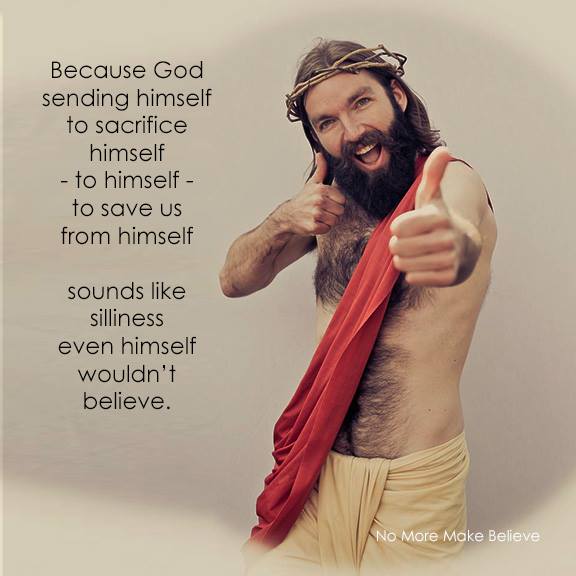
This bit of ‘logic’ pales in comparison to the fact that in order to forgive us he must sacrifice himself to himself, to appease himself to save us from himself. See the problem? Well Ed, what if then the whole doctrine of salvation as it currently stands is man-made and that isn’t the real doctrine of salvation God wanted? How then would we ever know the real one? It seems a little too confusing for something so important as eternal life.  My response that the current one is man-made? – exactly, and that is probably true from the start of Christianity to where it actually stands today.   It seems to me that this idea is just as man-made because a supreme being could have come up with the simple plan to just forgive people. As Jesus is praying in the garden “if it is possible, let this cup pass from me” we would see the opening up the heavens and God saying -“You know what, I have a better plan – let’s just forgive people like I expect them to forgive each other.” That would be just, logical and consistent.

There is also another theological side issue – How much of a sacrifice is it really for Jesus if he knows for certain (which he indicates three times in the gospels) that he will rise from the dead?  Honestly, if he knew that and most people who have faith believe he did and the text certainly seems to indicate he did, then it isn’t that big of a sacrifice? He knows he is not going to ultimately be dead in the end; so why not do it, as there is no ultimate risk to him?  In the end, Jesus is risking nothing himself as God, just going through the inconvenience of temporal suffering.  Why? To make a point? What point would that be, when there is nothing actually sacrificed in the end? He lives and knows he is going to live so why the anguish?

Spirituality:

I guess this leaves me with the question from a spiritual point of view as to what salvation is? Or does it?  I mean, if there is no such thing as sin, there is no need to be saved from it. Of course, then I could be left with the question of what the real divine reality might expect from me?  I guess the only thing then is to live a good life regardless of what that divine reality might be. Marcus Aurelius rightly observes, in my opinion, this in his famous quote on the good life.

See the source image

Of course, you are kind of left to things yourself as to define what virtues you will live by to attain that good life. In short, what is defined as a good life is left to you.

Conclusion:

The implications of losing the whole notion of sin and a need for salvation have been very liberating. There is no guilt or shame in my heart or mind at all these days.  I do try every day to be a better man than I was the day before. This, I have found is a far better way to live. 

Better yet, is discarding the notion of a loving God who also sends people he loves to hell.  Because the god of the Bible seems to have some major issues with justice, but that is the subject of the next post.  

I remain,

The Rabyd Skald – Wandering Soul, Bard, and Philosopher. The Grey Wayfarer.

Skaal!!!

“A Virtue By Another Name” – Of Wolves and Ravens – The Higher Virtues

Happy Tyr’s Day

Discussion

Having finished a discussion of all the Nine Noble Virtues of Asatru (NNV), we flip to Side B for “Of Wolves and Ravens” which is ten other philosophical discussions: The Higher Virtues, Eastern Philosophy, Western Philosophy, Love, Minimalism, Economics, Justice, Political Science, Libertarianism and Wisdom. The fact that I do this rotation at least twice a year is no accident as there are other philosophical guides to my life that form a significant part of my philosophy of life.  A philosophical framework, if you will.

This week is supposed to be the Higher Virtues and it still will cover them, but I want to share a discovery I made while reading Essential Asatru by Diana Paxton.  I got to the section near the end on Heathen Virtues and was excited because I was interested to see if there was anything new to discover. This, after all, was why I started gravitating toward Asatru in the first place – the NNV.   What I read as short but impactful because it introduced the simple truth that there were more than the NNV as virtues of Asatru and that there was something also called the Six Goals of Asatru.  In addition to all this, some of the NNV had other names which gave a different spin on their meaning.  While there wasn’t a lot of depth in the book, the simple statement of this was enough to get my wheels turning.

Firstly was the additional virtues that Paxton says some heathen groups have: Equality, Friendship, Strength, Generosity, Kinship, and Wisdom. Wisdom is already one of my Higher Virtues. but the other five merit some discussion.  The ideas of Friendship and Kinship are not fully explained but as I see those words I know that in large part represented by the Noble Virtue of Fidelity.  I treat my friends like family and Kin but the result is the same for all – I am loyal to those who are loyal to me.  Equality and Generosity I would say I have as background understandings of Hospitality and the Higher Virtue of Justice.

One meditation that was good was on Strength.  I could imagine the NNV forming the three strands of the higher virtues of Love, Justice, and Wisdom.  Then Those three strands forming a strong rope – Strength in a multiple-corded rope of virtue.  In a sense Strength is one of the major goals of being a person who follows a code like the NNV.

The Six Goals of Asatru I had never heard of before and it tells me that there may be things inside these Asatru Brethren groups that art taught and encouraged that don’t make it outside them very often. Not secret but not as popular with the general public.

The six goals are: Right, Wisdom, Might, Harvest, Frith (Peace) and Love.  It should be noted Love and Wisdom are already considered by me as part of my three higher virtues. Right, I have dubbed Justice. Frith is a new one for me but it means Peace both personal and community. I feel this is a worthy goal and one that would be the result of Justice, Love and Wisdom are acting their part.  Might and Strength are related. almost the same but the first refers to the strength of the community as a goal and the second personal moral strength, so there is that connection.  Harvest is an interesting one that goes very much with the Virtues of Self-Reliance, Industriousness, and Hospitality.

More significant for me is that Paxton gave different names for some of the NNV that offered a different perspective on how to look at that virtue. Courage has the second name of Boldness.  Truth and Honor remained the same, but Fidelity was called Troth which is a very unique word to use and thus indicates its value to the community. Discipline is called Self-Rule, so the idea of personal sovereignty is a part of the idea of Discipline. Hospitality was the same but given some of the other virtues above it becomes very much defined more concretely with more facets. Industriousness is the same. Self-Reliance becomes independence which the goal of Self-Reliance but I can see where it is a virtue in and of itself. Perseverance becomes Steadfastness which adds as I have remarked before the virtue of standing in the midst of adversity not just getting up from failure; it shows this virtue is also a means to victory, not just a response to defeat.

There is a lot to think about here but for now, my definitions will remain the same as changing those is a soul searching decision. I may, however, look at my higher virtues and meditate on them and some of these new ones more to establish a clearer picture.

What’s the point? Some might ask, well…

To the Wolves and Ravens:

“Feed the Wolves, but Listen to the Ravens first.”

Needs (Geri):

Men need a code.  Women need a code.

I can tell you what, people should be very glad I found the NNV and started to follow it last year.  If I had not I would be a monster without a code of conduct – destructive to both others and myself. I had that ‘women suck’ moment right after the Breakup with Miss Salty and I can tell you I came very close to becoming the Wolf in both the spirit of Fenrir and the predator at that moment. Chaotic, evil and full of rage.  I can think of nothing scarier than an empath that is malevolent.

The NNV came along and also filled a need for making sense of myself and getting me some sort of focus that I needed.  Otherwise, the wolves would be loose right now and men who wronged me would be targets and women in general objects for my use. In a sense, the NNV helped me find my true self and bring the wolves into my service rather than running wild.

Wants (Freki):

A code also allows you to start focussing properly on what you want and how to properly get it. Otherwise, you have no plan and follow it to the end. Focusing on the virtues you think is important begins to retrain your brain to follow after them and how to achieve them.  This is something you want, trust me.  No greater progress in your life will be achieved until you first find out what you value.

Reason (Huginn):

Mostly though, the NNV brought me back to a reasonable meditation on life and principle. It has brought me to Asatru as a form of spirituality, but it is a rational spirituality, not one that is making shit up. It is focused on value, goals and my journey has purpose because of it.  I am not wandering lost.  I may wander, but I am not lost, I am engaged in the purposeful pursuit of virtue wherever that journey may take me.

Wisdom (Muninn):

I find there is greater wisdom in the wisdom you discover for yourself than in ‘wisdom’ that is dictated to you.  No Wisdom is one size fits all, so to speak. The best wisdom is confirmed by virtue and experience combining into something that allows you to live better.  Wisdom may indeed be the highest virtue of them all, but it is also the result of living a code of virtues that you value.  For me, it started with adopting the NNV into my life.

Conclusion:

Essential Asatru has me thinking about virtue a lot since I read that section.  I am looking at it once again very holistically.  Mostly though I am glad I adopted the NNV and began to conceive them in a way that was helpful to me in a very dark time.  It allowed me to see myself as a human being again and more importantly helped me see others as human beings again.  I still have serious trust issues with my fellow humans, but it is getting better.  A lot of it has simply been about being true to myself in the full truth of following the NNV as best I can.

I leave you with Marcus Aurelius:

See the source image Still Walking,

The Rabyd Skald – Wandering Soul, Bard, and Philosopher. The Grey Wayfarer.

Skaal!!!