“Objections to Christianity – Part 3 – The Cross and Empty Tomb – An Imaginary Solution to an Imaginary Problem”(Revised August 2019) – Odin’s Eye


Happy Thor’s Day

August 2019 Revision Notes:

It has been almost a year since I wrote these originally starting in November of 2018.  When I got to the rotation in Odin’s Eye the last time where I was going to deal with these objections again, I saw no need for revision but rather simply laid it out there that no one had responded to them to that date and moved on into the rest of the Rotation for Odin’s Eye. 

This time though I feel that I need to spend four weeks of Odin’s Eye doing some revisions that will either clarify my position, add some other thoughts or edit for other issues.  Such edits will be marked by italics.  When archived, they will appear under the original post on this Page: My Four Theological Objections to Christianity

 Mostly though this is a cut and paste with some revisions. As the series goes on there will be more revisions as I can see the need for things to change a bit in the other three objections. In part three, I felt the need to add a few paragraphs for hopefully a clearer explanation. 

Introduction:

I know I will probably get a reaction out of this one and I am not trying to be provocative.  I am simply trying to get people to see the logical problems of Salvation through Christ.  Once you dismiss sin as a made-up concept, you could say that it is really unnecessary to go after ‘God’s’ solution to the problem, but the whole of Christianity revolves around Christ’s work on the cross and the resurrection to save people from sin and from eternal damnation. You might say it is the core doctrine no matter what flavor of Christianity you live by so it deserves some attention.

For the sake of argument, let’s concede sin is real. Then does the solution the Bible presents God has for it make any sense? 

Faith:

Of course, the first thing that can be said is each flavor of Christianity stakes out is how said salvation is achieved with Christ.  The faith versus works controversy starts right away in the first century. James and Paul go at it right in the Bible.  Now I heard multiple explanations from both Protestants and Catholics of why James and Paul are not arguing about the same thing really but they practically quote each other with only one variation.  One says salvation in Christ cannot be of works so no one can boast, and the other one says that without works it is impossible to show faith. No matter how you logically try to get them to be ‘defending the same salvation only from different directions”; it is contradictory.  One is saying that works have nothing to do with salvation, and the other is saying it does.

So what this really shows is that even in the Bible and among early Christians, they had disputes and disagreements about how this works and thus it points to the Bible not being inspired by God, so much as it records those early debates among the faithful about how salvation worked.  That makes the Bible very human and also not the Word of God because if God had actually wanted to tell us how this works; because it seems it would be the most important thing for us to know, he would have made it plain, straightforward and quite frankly non-contradictory.

Religion:

Of course, every flavor of Christianity goes even further with specifics and added on things to the doctrine of salvation in Christ.  The Catholic Church plain out tells you that you can only be saved from death through them and no one else.  Many Protestant denominations will tell you the same.  My former denomination would tell people that they had the whole gospel, not just part of it.  Salvation is complicated by religion because religion seeks to use these ideas to keep people grateful and faithful for telling those people their version of ‘the truth’.

In the end, I would say that each variation of salvation through Christ is presented in a way that helps the group presenting it.  It is done to layout their other doctrinal tenants so their way of thinking about God is central to it all, and thus gives a theological force to everything they believe. Of course, this gives religion the guilt and punishment/reward options it needs to manipulate people. 

Theology:

Religion aside though, my objections are theological – what kind of God do we have, who claims to be merciful and loving, but demands for his followers to be forgiving without condition, but doesn’t do so himself?  It also brings up the question of the ability to forgive in that we are expected to forgive each other without condition because we can, even as sinners. Yet, a holy God can’t simply forgive without sacrificing his only begotten son in one of the cruelest ways ever devised by man.  He must have this sacrifice or he cannot forgive at all, and I must have faith in it and the resurrection or he will not forgive me specifically.  Worse yet if I don’t forgive others as a Christian, he won’t forgive me. He can choose to not forgive others and still be a holy God, but if I don’t forgive, I cannot be saved?  So I, as a ‘sinner’, have not only a greater expectation than my creator; but also I am more capable because I can do this forgiveness without conditions, but he cannot?

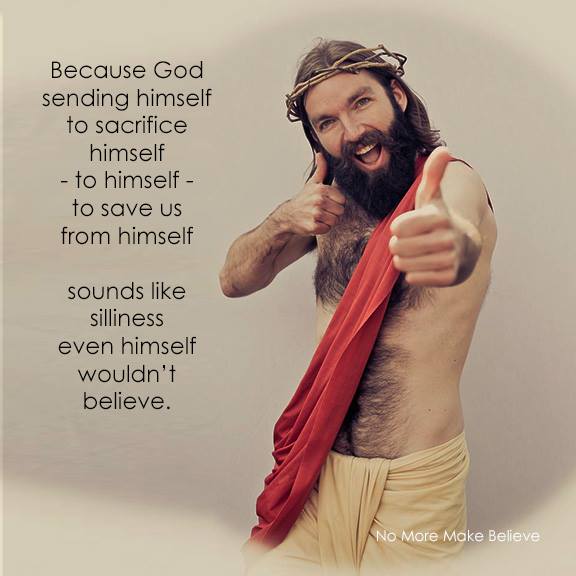
This bit of ‘logic’ pales in comparison to the fact that in order to forgive us he must sacrifice himself to himself, to appease himself to save us from himself. See the problem? Well Ed, what if then the whole doctrine of salvation as it currently stands is man-made and that isn’t the real doctrine of salvation God wanted? How then would we ever know the real one? It seems a little too confusing for something so important as eternal life.  My response that the current one is man-made? – exactly, and that is probably true from the start of Christianity to where it actually stands today.   It seems to me that this idea is just as man-made because a supreme being could have come up with the simple plan to just forgive people. As Jesus is praying in the garden “if it is possible, let this cup pass from me” we would see the opening up the heavens and God saying -“You know what, I have a better plan – let’s just forgive people like I expect them to forgive each other.” That would be just, logical and consistent.

There is also another theological side issue – How much of a sacrifice is it really for Jesus if he knows for certain (which he indicates three times in the gospels) that he will rise from the dead?  Honestly, if he knew that and most people who have faith believe he did and the text certainly seems to indicate he did, then it isn’t that big of a sacrifice? He knows he is not going to ultimately be dead in the end; so why not do it, as there is no ultimate risk to him?  In the end, Jesus is risking nothing himself as God, just going through the inconvenience of temporal suffering.  Why? To make a point? What point would that be, when there is nothing actually sacrificed in the end? He lives and knows he is going to live so why the anguish?

Spirituality:

I guess this leaves me with the question from a spiritual point of view as to what salvation is? Or does it?  I mean, if there is no such thing as sin, there is no need to be saved from it. Of course, then I could be left with the question of what the real divine reality might expect from me?  I guess the only thing then is to live a good life regardless of what that divine reality might be. Marcus Aurelius rightly observes, in my opinion, this in his famous quote on the good life.

See the source image

Of course, you are kind of left to things yourself as to define what virtues you will live by to attain that good life. In short, what is defined as a good life is left to you.

Conclusion:

The implications of losing the whole notion of sin and a need for salvation have been very liberating. There is no guilt or shame in my heart or mind at all these days.  I do try every day to be a better man than I was the day before. This, I have found is a far better way to live. 

Better yet, is discarding the notion of a loving God who also sends people he loves to hell.  Because the god of the Bible seems to have some major issues with justice, but that is the subject of the next post.  

I remain,

The Rabyd Skald – Wandering Soul, Bard, and Philosopher. The Grey Wayfarer.

Skaal!!!
“Belief in the Norse Gods (Asatru Part 6)” – The Pagan Pulpit

Happy Sol’s Day

Announcements:

We don’t pray here – we figure God, the gods, goddesses, or whatever powers that be either know already, don’t give a fuck, or are busy with more important matters than our petty stuff. We also kind of assume that they expect us to do stuff that we can do for ourselves and that we will do them ourselves and not be lazy. We also believe in being good friends, so we don’t presume on our friendship with the powers that be by asking them all the time for stuff while giving them nothing in return.

We also don’t take an offering here.  We figure the powers that be probably don’t need it.  Let’s be honest, offerings are not given to the divine powers, they are given to an organization to support it.  Just being honest. God, the gods or whatever never sees a dime, farthing or peso of that money; it all goes to the church, mosque or shrine.

Theme Song: “The Pagan Norse” – Burnt Page Films:

Meditation:

Image may contain: 1 person, text

Even death is just an epitaph to your story as your legacy and influence can have an effect long after you are gone. But while you are alive the story is still being written and you can have an effect on the end of the story and what that legacy will be.

Text:

See the source image

If you want more details about Asatru, I can’t recommend this book enough.

Sermon:

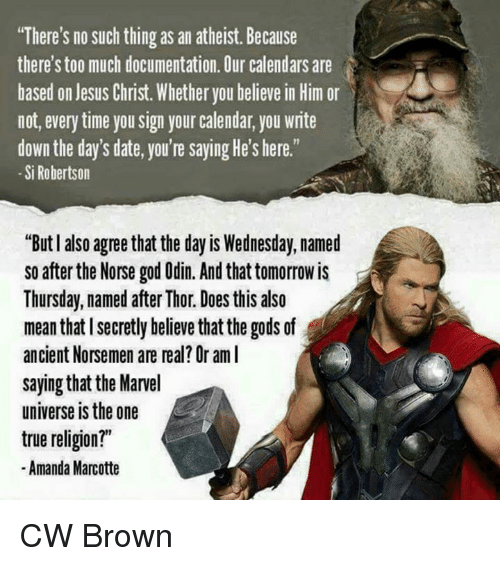
As we head into the second part fo our text, a sermon is in order about belief in the old gods, but first, a disclaimer from myself as this is the part of Asatru I have the ‘hardest’ time with.  I don’t have a problem with people believing in the Norse gods any more than I have a problem believing in Christ, but I find that the actual existence of such divine beings as Odin or Christ for me needs to be defined. For me, this would be a belief for me that is more about the personification of divine or spiritual forces, not a belief in an actual being known as Odin or Thor. It’s kind of like saying Spiderman exists.  Is there a real guy that is named Peter Parker with spider powers? No.  But there is a creation in the literature that is a beloved comic character that teaches life lessons and personifies certain very human ideas. That is very real.

I think the same is true for all the mythologies.  Certain cultures created stories that reflected their values and there was a perceived need to have these values preserved and restated through myth.  The Norse people were no different in this regard. Whether Odin and Thor actually exist is irrelevant to me as this part of Asatru, it is the values and virtues they portray in their stories that matter to me.  In that respect, the gods exist and the had an influence on my ancestor’s lives and that is enough for me.

For followers of Asatru, there is an identification with gods that is often individual and very personal.  Some followers of Asatru worship all the gods, but they’re always a favorite god for many which earn that follower a title – ‘Thorsman’ or ‘Freyawoman’ or some other title with the god’s name.  I don’t think you have to do much more than look at this blog to see what god would be in my title. I am an Odinsman.  Not the warrior Odin in his hall so much as the wanderer looking for knowledge and wisdom.   It is an image that inspires me and motivates me.

See the source image

Asatru is about the Norse gods in the end and their worship and veneration.  It is about honoring them and what they stood for. This is something one can accomplish without necessarily believing in a literal Thor, Freya or Odin. Religion is ultimately a personal construct that you can share as a community construct. Many followers of Asatru are also like myself in that we are returning to the faith of our ancestors.  A faith that was taken from us by the invasion of Christianity and now we have the freedom to once again embrace.

In the coming weeks, we will be looking at the spiritual significance of many of the gods to the followers of Asatru.  Essential Asatru does this by first covering the gods and then the goddesses, I will be going back and forth to maintain a little more male/female balance. In some cases, I will probably combine a few of the gods and goddess together.  This will be done when there is little known about them or that the combination has a significance in the mythology.

Parting Thought:

Quit explaining your life, live it.  Those that love you will give you the freedom to be what you want to be because they love you.  Haters?  Fuck ’em.  They get silence.

I remain,

The Rabyd Skald – Wandering Soul, Bard, and Philosopher. The Grey Wayfarer.

Skaal!!!

“Objections to Christianity – Part 2 – Sin: An Imaginary Man-Made Problem” (Revised August 2019) – Odin’s Eye – Theological Objections to Christianity

Happy Thor’s Day

August 2019 Revision Notes:

It has been almost a year since I wrote these originally starting in November of 2018.  When I got to the rotation in Odin’s Eye the last time where I was going to deal with these objections again, I saw no need for revision but rather simply laid it out there that no one had responded to them to that date and moved on into the rest of the Rotation for Odin’s Eye. 

This time though I feel that I need to spend four weeks of Odin’s Eye doing some revisions that will either clarify my position, add some other thoughts or edit for other issues.  Such edits will be marked by italics.  When archived, they will appear under the original post on this Page: My Four Theological Objections to Christianity

 Mostly though this is a cut and paste with some revisions. As the series goes on there will be more revisions as I can see the need for things to change a bit in the other three objections. In part two, I felt the need to add a few paragraphs for hopefully a clearer explanation. 

Introduction:

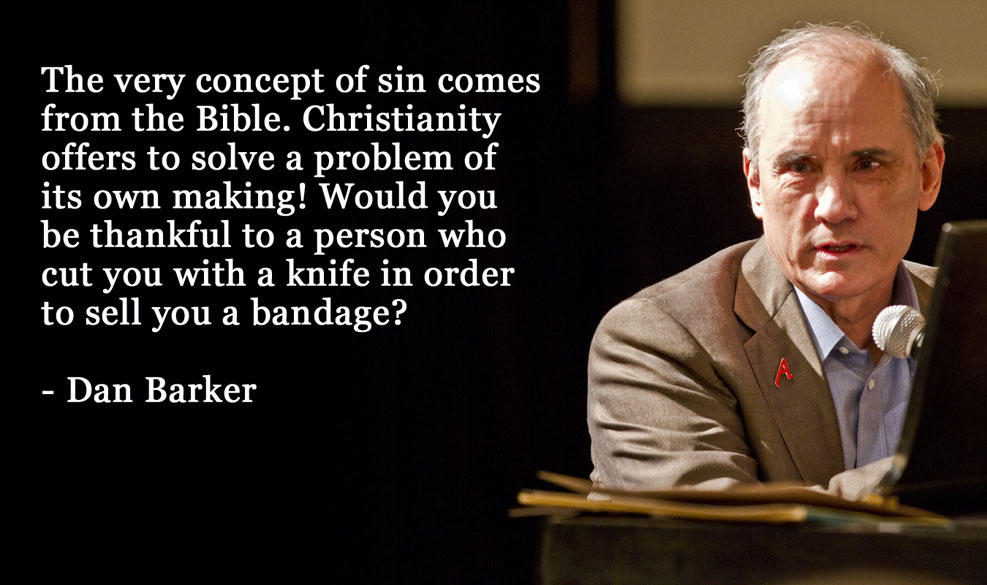
My loss of faith really started here.  I can actually go back to a message I was preaching on sin and salvation through Christ and the fact this quote from Dan Barker from Losing Faith in Faith ( a book I still want to read) was rolling around in my head.  I was trying to think of something that would make his assertion wrong.  I got up preached the message and sat down.  I can site this moment as the time my crisis of faith began. I realized he was right.

I realized there is no proof that sin rationally exists.  I only believed that because that was what I was told by a preacher and read it in the Bible.  Unless the Bible was truly inspired, then I had no natural or logical proof that there was this thing called sin, a sinful nature or my actions were righteous or sinful. God Himself had never come down and told me I was a sinner, that was men either in the form of preachers or the men who wrote the Bible.  Over time, I began to realize that sin has the same problem as the inspiration of the Bible – the Bible asserts it but never proves it.

Going back to my pulpit moment, I sat there thinking and my faith started to unravel.  I sat there thinking: “I make a living by telling people they are sinners so they will feel guilty, then they accept the ‘gospel’ and feel better.  Out of gratitude they throw money in the basket and pay me. WTF.”  It was a bad moment for me, and one that led to my eventual downfall over two years later.

Faith:

If you are a believer you take the existence of sin as purely a matter of faith.  Basically, if you believe that sin exists, you do it for the same reasons you believe the Bible is inspired.  You have faith it is true – you hope and believe it is true, but you do not have a proof or a rational argument to say it is true.  The Bible writers assume sin is real and a problem.  They never prove it, and the believer is left to take that sin exists as a reality and that God has solved it.  You believe all that without rational evidence.  It is purely a matter of faith.

Now I want to emphasize that this does not disprove sin’s existence, but it puts on the same plane as believing in a lot of things that we believe exist but have no proof of.  The issue then is should we order our lives on faith in the idea that man is sinful, or go based on our own observations of human nature and conclude that if anything we can have faith in the fact that all human beings are human. 

Religion:

I now think that sin is a man-made concept.  It probably originally. like so many things might have had a good intention.  To keep people from making bad decisions given the cultural context.  I mean sex without birth control and modern medicine can lead to deadly diseases and unwanted pregnancies. So you tell people not to have sex except with people they are committed to and get married to so the child will be legitimate. The practical side of this is the lessened risk of STDs and unwanted pregnancies. It is a wise course of action.

When just showing the wisdom of this to others doesn’t work, you throw in the wrath of God to bring about a more forceful form of persuasion – tell them it’s a sin against God and He will bring down his wrath on the one who sins.  This is where you make up the concept that sexual sin is an affront to God and he will send you to hell if you don’t repent of it and stop doing it.  It is ultimately a fear tactic that uses guilt to prevent certain behaviors.

The dark side of this gets worse though as people genuinely think they’re taking the side of God when the punish sinners.  The real problem with sin is that some people think they have risen above the concept of it.  They feel qualified to judge others using their religious beliefs. It gets worse because the said concept can be held by people in power who wish to impose their views on people to create a ‘righteous society’.  To force others to follow your moral code of some behaviors being sin and thus outlawed. The problem is the difficulty using reason to prove something is a sin.  It’s not self-evident.

Theology:

I don’t believe in sin as a theological concept anymore. I think in large part it is a bad one because all it does is produce guilt and then in a guilt-ridden state people can be manipulated.  I haven’t looked at this fully but I have a theory a large part of religious people have a poor self-concept and that is because they have a large amount of guilt associated with their ‘sins’.  This leads them to think they are bad or even evil people and the cycle of self-destruction begins.  You spend a lot of time putting on masks at that point to protect yourself from the social wrath of being a sinner while at the same time being wracked with guilt because you can’t seem to escape your sin. If it sounds like I have been there – yep.  I would say a lot of my initial causes of depression came from this struggle.  Yes, I am saying that religion, particularly the Christian notion of sin,  may have has a great deal of influence in causing my depressive issues.

My theology about mankind has certainly changed since I discarded man as a sinner.  I don’t think of myself as a sinner but simply a human being. I am not all-powerful, all-knowing or all-present; so I am going to make mistakes and there is really nothing I can do about it. I have needs that are normal.  Wants that are normal.  I have my reason and wisdom to guide me. I am not perfect and I make mistakes and have errors in judgment, but that doesn’t mean I am a sinner, just human. To me, life is no longer about overcoming sin and removing it from my life.  Rather, it is about discovering the virtue in me and causing it to grow. And there is a virtue in who I am as a human being if I look for it and develop it.  It’s about growing into the best human being I can be.

Note: Unlike the atheist, I have not discarded the idea of a spiritual side to mankind at all, but rather I am saying that sin is not something I believe is real about it.  Humanity is more complicated than he is all bad or all good. 

Spirituality:

This is why spiritually speaking I spend more time meditating on the Nine Noble Virtues as a way to learn where I need to grow. I am not trying to get rid of sin out of my life, praying that God is gracious, etc. I have come to see some things as normal and human, not sinful.  My goal now is to build character, not remove sin because I think sin is a made up imaginary concept.  I meditate on the good things, not the bad things.  I grow the good in me, rather than trying to deny my humanity by calling it sinful. I find it makes me much happier and far more at ease in this world.

One good example of this is my changing attitudes about sex and sexual desire. I feel sexual desire is normal in humanity and it is normal to feel a sexual desire toward a lot of different people.  Lust is made up to me unless you are using the term to describe passionate sexual desire which is neither good nor bad. What might be a factor in sexual desires is wisdom and reason saying that not all sexual interaction is beneficial. Some of it could be detrimental.  The real issue is that sex in and of itself is not sinful in any form. Enjoy, but be smart and wise. 

In my case, sexual fidelity is part of my marriage because that is the oath I swore as a Chrisitan that I still honor. If it wasn’t, having sex with another woman would not necessarily be a violation of fidelity as there is no sin to it, but one might challenge my wisdom.  Like it or not people get jealous and envious and that can lead to relationship issues. There are also cultural expectations to consider which do have an effect on how a person is perceived. This is not about sin anymore is the point, but rather what effects it might have on relationships and troth issues may or may not be affected depending on the specific nature of oaths of fidelity. 

Conclusion:

After concluding that the Bible is a human book with no proof of inspiration and the sin is a concept made up by the writers of the Bible.  There are only two things left on my four objections to Christianity.  The first is the other imaginary thing the Bible creates which is the solution to sin being Salvation in Christ and finally, the god of the Bible seems to have very suspect standards of justice.

The Rabyd Skald – Wandering Soul, Bard, and Philosopher. The Grey Wayfarer.

Skaal!!!

“Objections to Christianity – Part 1 – The Bible’s Inspiration by God” (Revised August 2019) – Odin’s Eye – Theological Objections to Christianity.

Happy Thor’s Day

August 2019 Revision Notes:

It has been almost a year since I wrote these originally starting in November of 2018.  When I got to the rotation in Odin’s Eye the last time where I was going to deal with these objections again, I saw no need for revision but rather simply laid it out there that no one had responded to them to that date and moved on into the rest of the Rotation for Odin’s Eye. 

This time though I feel that I need to spend four weeks of Odin’s Eye doing some revisions that will either clarify my position, add some other thoughts or edit for other issues.  Such edits will be marked by italics.  When archived, they will appear under the original post on this Page: My Four Theological Objections to Christianity

 Mostly though this is a cut and paste with some revisions. As the series goes on there will be more revisions as I can see the need for things to change a bit in the other three objections.  In this one, however, the objective remains pretty much the same. 

Introduction:

I want to state upfront, this is a long post. I want to be complete as possible in stating this objection and the ones that follow.  Mostly as I will state later that I for a long time wanted answers; I still do.  It was hard leaving my faith because I wanted so desperately to believe. Reason itself eventually prevailed and I will stand by that decision.   The reason I am putting a lot of words into this is that I still would accept answers: if they could be proven rationally that Christianity is the true religion.

I have written on my crisis of faith a couple of times. Despite some people’s assertion that this was due to personal events, it actually started in 2015 with my second objection which is that I think ‘sin’ is a man-made up concept.  It started when I preached a message about sin and I had heard a quote that week from a critic of Christianity that basically said sin was made up and that because of it Christianity solves a problem of its own making.

I will get into this moment in more detail in my second objection post, but it got me rethinking everything in the light of skepticism and I began to form four theological objections for which I still have no satisfactory answers. While the sin question got my original thinking going, it is this first question involving the Bible and divine inspiration that forms the foundation of the other three.

Now, I want to state for the record that I am no amateur when it comes to the Bible or Theology.  1) I have degrees in both Biblical Studies (BA) and Theological Studies (MA).  2) I am a ‘professional’ theologian and have been since 1996.  3) I was a Christian from the time I was eight and as I approach my 50th birthday that would have been close it forty-two years. 4) I was a pastor (now retired) for twenty years and have spent many years since school studying the Bible and engaging theological questions.  5) I have had several crisis moments in my theology and up until two to three years ago I could answer them all or found ways to explain them.  Not anymore.

I will also say I am not hostile to Christians, I get it.  It took me a long time to face the facts of the objections I will present in this series. I still am open to anything that answers them.  My largest problem when I discuss this is people sometimes get offended because I seem to be very aggressive, but I am not really doing that, just being as honest as I can.  People don’t always like it when you ask questions that are hard about what they believe. Cognitive dissonance is a real thing, so I get.  Understand I am not being hostile to your faith if you have it.  I am just being hostile to mine or what mine used to be. That’s because I take as a central core idea that if the God of the Bible is the real god and the Bible is inspired by him, then it should make sense and have rational proof this is so.

Faith:

Bottom Line, faith is trusting in something that you have no evidence for and that is the problem.  You hope it is true and you believe it is true, but you don’t know it is true. This is particularly true for many church doctrines and one of the most notable is the divine inspiration of scripture.  The reason I can say this is no matter what school of thought you follow in looking at inspiration, there is no evidence that God came down and inspired the Bible.  You simply have to believe the simple statement “All Scripture is given by inspiration of God.”  There is no attempt to prove this, just a statement of fact that the reader must simply accept.

An example is probably in order:

“The Rabyd Skald’s writings are inspired by the god Odin.  Everything he writes comes straight from the mouth of the god Odin.” 

You say ridiculous.  I ask why?  You say because I simply have made an assertion and have offered no proof that what I say is true. I want to tell you the Bible does the exact same thing with the exact same level of proof that God came down and directly inspired the writers of the Bible – none. It’s pure faith, no evidence even from the Bible itself.  The Bible writers simply assert this; they never prove it.

Religion:

Looking at the doctrine of inspiration historically, once again we have no proof of the inspiration of Scripture by God, just the creation of the doctrine of inspiration and various councils of men deciding which books are inspired.  There is no record of God coming down and saying – “these books are my inspired word.” Just groups of men doing that.  That is what you actually see.

It stands to reason that religions do this.  In the end, you need a common core of beliefs and authority and it is far easier to make a group of writings do that because it has a greater chance of standing the test of time.  Especially if you inject a tradition of copying and transcribing these books from one generation to the next. Even in this though, two problems develop. 1) People abuse the authority of said books and can twist their meaning and 2) the transcription of said books can be flawed.

The second brings up an additional inspiration question which is: ‘Is the Bible still inspired even though people have put mistakes into it and changed it from one language to the next where meaning is going to get changed?’  The human factors are definitely present in the Bible.  Does that undermine inspiration or simply point to the fact that the Bible is a wholly human book? Because we don’t really have proof God is involved, are we just making up the whole divine inspiration thing in order to make this human book have more significance?

Theology:

I spent a great deal of time and digital ink pouring over this question of inspiration.  On my blog All Things Rabyd (which is still there although no longer active)  I spent nine posts looking at the various theories of divine inspiration.  You can find the link to all of them here. I eventually settled on Dynamic Inspiration as the best possible explanation to handle the human element of the bible.  That much like the doctrines of Christ state Jesus was 100% God and 100% Man, so was the bible the same way.  It satisfied me for a while but there was a fatal flaw in the whole thing.

The flaw? I still had no proof positive that the 100% divine inspiration part was real.  There is no photograph of God reaching into the head of Paul or Moses inspiring them to write things.  I mean you could say God is the inspiration for the Bible like a person might be inspired to write about nature from being outside. There is however no proof that God took an active hand in telling the authors what to write or how to write it.  That is purely a matter of whether you believe that or not.  It really is blind faith when you consider that particular question.

Spirituality: 

I will probably handle other objections involving scripture at a later date.  My purpose today is to get the main parts of my first objection to Christianity out there.  The question always comes – do I still read the Bible and what value do I place on it?  Well, yes I do.  I value it in that it contains a lot of ‘truth’ small ‘t’.  I just don’t think it’s the Truth with a capital ‘T‘.  Rather a lot of men wrote about their sincere belief in God.  God inspired them in that way and they wrote but in the end, it was human inspiration ABOUT the divine.  It was not God coming down and whispering in their ear what to write, no matter what their claims.

It also, because it is a human book and not divine to me, contains a lot of Bull Shit and spiritual opinion by ancient authors which may or may not be valid.  You still have to use a lot of judgment in looking at the Bible because if some of it is objectively true then the god of the Bible becomes at times both inconsistent and a sadistic tyrant.   

For me, I still draw a lot of inspiration from the Bible.  Some of its stories are great.  It has men wrestling with the question about God.  Some of the teachings of Christ are some of the best on human relationships you will ever see.  That said, it is only one avenue of being inspired, not the only one and it is a very human book.  In short, it has its flaws, and I think some of the morality it promotes could be questioned as to whether it actually does good or not.

Conclusion:

When the doctrine of inspiration goes, then you can look at the Bible objectively.  This caused me to really realize the god of the Bible has a few problems.  1) Sin seems to be made up as a concept and used to control the behavior of people 2) The plan of salvation God comes up with does not speak well of supreme being because it makes God both sadistic and masochistic. 3) God’s justice seems a little suspect especially when you consider final judgment.

The Rabyd Skald – Wandering Soul, Bard, and Philosopher. The Grey Wayfarer.

Skaal!!!

“The Christian Invasion – Asatru (Part 4)” – The Pagan Pulpit

Happy Sun’s Day

Announcements:

We don’t pray here – we figure God, the gods, goddesses, or whatever powers that be either know already, don’t give a fuck, or are busy with more important matters than our petty stuff. We also kind of assume that they expect us to do stuff that we can do for ourselves and that we will do them ourselves and not be lazy. We also believe in being good friends, so we don’t presume on our friendship with the powers that be by asking them all the time for stuff while giving them nothing in return.

We also don’t take an offering here.  We figure the powers that be probably don’t need it.  Let’s be honest, offerings are not given to the divine powers, they are given to an organization to support it.  Just being honest. God, the gods or whatever never sees a dime, farthing or peso of that money; it all goes to the church, mosque or shrine.

Theme Song:  “Viking War Song – Fehu” – Wardruna 

Meditation:

Image may contain: text

There have been a lot of really shitty things that were legal for people to do. Legal is no metric for right and wrong. Truth and Justice are not about what is legal.

Text:

See the source image

If you want more details about Asatru, I can’t recommend this book enough.

Sermon:

It is at this point, that I hope that why I am going through the history of the Germanic/Scandinavian religion that it will be clear why the modern movement of Asatru is necessary as a reconstructionist effort. The main cause is that the Christians were very good a wiping out paganism for the most part. It certainly made sure that whatever aspects of paganism that survived had to 1) go underground or 2) hide in the midst of Christian tradition.

As a former Christian pastor, I lived with a couple very terrible bits of historical revelation.  1) That the spread of Christianity was due in large part to missionary efforts that involved bribery, diplomacy and violence more than the truth of the religion as it stands on its own, and 2) That these tactics have continued to the present day.  There is what Jesus taught and what Christianity does to spread the faith, and they are miles apart. Light years really.

Paganism in the middle ages started to face a new invasion from a religion that was relentless in its missionary zeal.  The basic tactic of Christians was to approach a ruler and offer them salvation in the church. The offer was often sweetened by the fact if that ruler was facing an opponent that was difficult or wanted some sort of help in a conflict they were having with a neighbor, conversion to Christianity brought church financial support as well as the support of Chrisitan allies as they went after those ‘unwashed’ heathens.

Inside each new ruler’s country then the process would start of identifying pagan practices, making them illegal and then purging the pagan practices and if necessary the pagans themselves. There are stories that survive of the slaughter of heathens on a grand scale, destruction of pagan sacred sites and the seizing of pagan property which found its way either into the church’s hands or the ruler of the country. There came a tipping point in Europe where it was either join the church or die and many chose to join the church.  A few brave souls chose to die with honor along with their countrymen.

The problem for those who now follow Asatru with all this is that Christianity was very effective in wiping out a lot of the old ways to the point that much has been lost. Asatru is a reconstructionist movement at its heart trying to search out and find things that were lost and then restore them.

It is only recently in the history of the world that some countries have added the Norse/Germanic religions to their list of accepted state religions and thus opening up even the ability to try. For the most part up until then, pagan practices survived by bastardizing their practices by combining them with Christian ones.  See Easter’s bunny and Christmas’ trees and lights.  Or they went underground passed secretly from one generation to the next. Some things survived in ancient writings and mythology. This is why Asatru is necessary as it is trying to put back into place what has long been lost.

For myself, I knew all these things as a Christian for many years about what my faith had done but justified it.  Now, I call it out for what it is – gross hypocrisy.  I would also say that Christianity has acted in greed, malice, and lust but called it manifest destiny, the divine right of kings (government), and missionary zeal. They really should be ashamed of their history, but they go on merrily talking about how loving and humble they are and a force for ‘civilization’. There is nothing very civilized about running a sword through someone simply because they have a different faith than you.

The problem for me is I live with a Chrisitan and my family is mostly Christian.  They are good people and for the most part ignorant of their religion’s history.  That said, I know that their faith has blood on its hands going back quite a bit and in some contexts, they would, because of their faith, do some pretty shitty things to others. For Me, Asatru is about getting back to my spiritual roots before Christianity came into my ancestors’ lives and changed things.  It is about finding that which is lost and restoring it back to my weary soul.

Parting Thought:

Image may contain: outdoor and text

An obvious note in Asatru.  Loyalty is, but not obedience. That belong to the religions that expect blind loyalty and servitude.  We are free people and respect and allegiance are earned.

I remain,

The Rabyd Skald – Wandering Soul, Bard, and Philosopher. The Grey Wayfarer.

Skaal!!!

“Naked Before Who?” – Odin’s Eye – The Grey Wayfarer’s Spiritual Side

Happy Thor’s Day.    

Discussion:

On May 17, 2013, I wrote this post: Naked Before God – Part 1 – The Positive Spiritual Side of Nakedness.  It was the first post in a series of posts called Naked Before God.  At the time, I was trying to reconcile some findings I had found in my biblical study of nakedness and current Christian practice and its perception of nudity. At the end of that post, I reflected on six positive spiritual aspects of nudity.  Vulnerability, Openness, Intimacy, Genuineness, Wholeness, and Equality.

Those qualities are very spiritual when you think about them as they go to the core of who we are and how we perceive ourselves in relationship to others and the world.  Of course, the problem with this series of posts now; for me personally, is what do I mean about the word ‘God’?

I personally still find being an at-home nudist beneficial.  I am actually quite private about it with no real exhibitionist tendencies being introverted as I am.  That said, I am as comfortable in my own skin as I am in clothes.  Actually sometimes more comfortable because of the spiritual qualities I outlined so long ago still remain true despite my change in faith/religion/spirituality. My issue is redefining how this means to me spiritually.  The change is not the spiritual qualities of nudity so much as the notion that the Christian god is the one I am naked before is no longer true to me.

I suppose this is going to take some time and meditation to redefine, but the problem seems to be that some of these spiritual qualities are dependent on there being some divine force to be naked in front of in the first place. There is also the issue of whether such a divine force gives as shit cares about it.  Yet, I feel at these times that I have spiritual peace or at least a better possibility of spiritual peace than at others.

Time to Look Through the Eye:

“To see the truth, change one eye for another”

Faith:

I know it sounds strange, but I feel that my faith in myself grows in my times of spiritual meditation and part of that is connected to the fact I meditate in the nude. All the spiritual qualities combine at the time. I am open to the universe around me and vulnerable to it. I can see myself for who I truly am (genuineness) – equal to every other man and woman.  There is a non-sexual feeling of intimacy with myself and the world I don’t experience otherwise. I am the whole and true me and me alone.  This faith or whatever you want to call it has lead to a lot of inner healing for me. To those of you out there who practice ‘magic’, is this magic?

Religion:

Of course, I have to from time to time shuck off the shackles of my former religion which trains people to be ashamed of being naked.  I now believe this is what leads to a lot of body image problems and poor self-image problems for people. There was a fear developed in me from an early age by my past religion that if I was naked I should be ashamed of it, my body and being naked automatically lead to sexual sinful thoughts. None of this is objectively true, but if you are going to dominate and manipulate a person, engaging in shaming people for who they are in truth is a good start.  Nudity and sex are great targets for this.  I don’t buy any of it anymore but the indoctrination still has a few things that cause irrational fear that I have to throw off.

Theology:

It is interesting that in pagan theology, there seem to be a lot less moral codes about nakedness.  If anything, there is at worst neutrality about the subject, or at best blatant positivity about its benefits.  The naked pagan walking in the woods is probably a common and an accepted image.  We are human and come into this world naked.  It is our most natural state and foundational spiritual state, and so it is considered beneficial by most.  Whatever power that be that made/evolved us, doesn’t seem to mind our nakedness, so why should we.

Spirituality:

If there is a spiritual challenge to nudity for me now it is twofold. 1) The dumping of artificial man-made social mores that no longer apply to me.  2) Coming to terms with the fact there is a call in my heart to more social nudism.  The first I find it easier every day I spend in the buff doing normal and everyday things. The second is the simple fact that much of the spiritual qualities I have outlined that nudity possesses are incomplete without others to experience them with you. It is a value shift for me that is probably been long in coming, considering how long I have been addressing the subject of spiritual nudity. It isn’t a question of spiritual negativity anymore for me, but a practical question.

Conclusion:

The main question of this post still remains as to who I am naked in front of anymore. If not god, then who.? Do such powers even care? Mostly I think I am naked with myself and coming to terms with the fact that I am very comfortable with it and becoming more so every day. It is a part of my daily at-home activities particularly when I am alone. Only time will tell if I gain a more spiritual understanding of myself and the people and world around me as a result.  There is a part of my journey that now involves walking this path.

I remain,

The Rabyd Skald – Wandering Soul, Bard, and Philosopher. The Grey Wayfarer.

Skaal!!!

“Paganism: Religion or Spirituality?” – Odin’s Eye – Religion Problems


Happy Thor’s Day.    

Discussion:

I have little respect or use for religion anymore.  That said some things in my spirituality are parts of religions as parts of religious ceremonies and rituals.  I suppose you could say that my meditation and my other parts of my morning routine could be considered ‘religious practice’ but that I am not rigged about it.  I suppose the definition in paganism between religion and spirituality is a little fuzzy and I kind of like that.

In my readings on paganism in some aspects it is important that it is a religion as in some countries that allows it to be recognized as such and allowed to be practiced.  In America, with religious freedom, we sometimes forget that some religion is banned or heavily regulated in other countries so having Asatru be recognized as a religion that can be practiced is important for a lot of reasons.

That said for me personally, I don’t like religion in general and the Abrahamic religions in particular.  Weel, to be fair,  I dislike it when anyone for any reason tries to force their religion or ideology down my throat and certain religions are notorious for that.  Believe what you want, just don’t make me follow your beliefs by force, or force me to live by your moral code.    See the source image

Time to Look Through the Eye:

“To see the truth, change one eye for another”

Faith:

From a faith standpoint, paganism doesn’t seem like a religion. That is no one in paganism is trying to proselytize me into it. In fact, when I explain my differences to some of them, they nod and say that it is great.  I have had a lot of good discussion about it, but no arguments.  There is a commonality about faith in the universe and the world around us to give spiritual life and direction but no dogma or creed. We all have the faith that each one of us can shape our own spirituality.

Religion:

There are however pagans who engage in various religious forms of paganism.  Asatru, for instance, has its rituals and festivals. You might even say that across the board the celebration of holidays and festivals and events are religious and so in some resepcts, I can see the religious tone to it all.  That said you will never hear a pagan speaker tell you that if you don’t do the rituals or attend things then you are a lousy person or going to hell. There is respect for individual choices.

Theology:

Theological systems are also hard to find and often to be blunt all over the place in paganism. There some unified viewpoint about the universe but overarching belief runs the gambit.  You know what else, everyone is OK with that.  No arguments that end friendships over obscure theological points.  There just isn’t that kind of definition of what is true and no authoritative ‘holy book’ to define these things.

Spirituality:

Which is why I lean on the side of it not being a religion but more of a form of spirituality. At the same time, the more religious pagans are OK by me.  We don’t have too much to fight about.  I enjoy the spiritual side of the parts I practice and the principles of paganism, but the religious aspects I can take or leave at my discretion. so I love it for that reason alone.

Conclusion:

In the Pagan Pulpit, I will be developing this idea more and more as I go through the book I have on Asatru.  The issue is how much religion do I want in my spirituality?  I guess time will tell how much of a religious pagan I become, if at all.

I remain,

The Rabyd Skald – Wandering Soul, Bard, and Philosopher. The Grey Wayfarer.

Skaal!!!
The Family ‘Pagan’? – Odin’s Eye – Paganism

Happy Thor’s Day.    

Discussion:

Them: “So you’re a pagan?”

Me: “Sort of, I have pagan tendencies”

Them: “Pagan tendencies?”

Me: “Yeah, I believe the pagan spiritual concepts are pretty interesting, but I am not much into religion anymore, so I am not into that part of it.”

I know this conversation because I have had it a couple times.  To say you are spiritual but think all religion is made up is a hard thing for people to grasp. I mean I have my rituals of meditation on the Nine Noble Virtues and my ritual of putting on my pendant for the day but that is pretty much it. Mostly I look at paganism spiritual concepts as a way to address the possibility of spiritual reality.  In truth, I lean toward the deist side of things with an unknowable divine creator(s). The paganism simply allows me to reach out with my own sense of love and spirituality and address the question of what that divine creator or creators might be.

The issue of course for my family is that they are mostly Christian with a few exceptions.  Mostly though I think they have trouble dealing with their long-time husband, father, and grandfather, who used to be a devout Chrisitan, who now doesn’t even go to church or even pray anymore. n short I have a far easier time adjusting to them than they do to me.

Time to Look Through the Eye:

“To see the truth, change one eye for another”

Faith:

My faith these days is more about lining up my spiritual philosophy of the Nine Noble Virtues with real life.  Living virtuously means more to me than the whole mythology of choice thing. I like the Norse myths but the idea that any of those gods actually exist is the real of fantasy and no better or worse than any other mythology out there.  For me, Norse mythology is closer to my ancestral roots and resonates with me more. But I ain’t praying to Odin or Thor. If there is any concept I like it is that we don’t pray to them.  If there is a divine power of some sort, I would rather have this attitude of standing with them rather than bowing before them.

The reality of my faith is that if there is a god or not is irrelevant to it.  If there is my pursuit of virtue should be honored. If there isn’t living by virtue in this world has its own rewards.  Either way, this is the reality f choice when it comes to faith.

Religion:

My pagan religious aspects are few:

  1. I meditate on the Nine Noble Virtues every morning along with my goals.
  2. I put my pendant around my neck for the day after taking my shower.  Mostly this marks the end of my morning routine.
  3. I try to view all of life as a large spiritual lesson.
  4. I celebrate holidays with my family and do it more with a pagan mindset, which is very easy as Christians have stolen most of the symbols for their holidays from the pagans.

I suppose you could add that I study pagan spirituality and religious practice as like reading about the Norse myths. I suppose if I were to ever join a Brethren it would be more for companionship and common interest. Not really all that different than most people in the church.

Theology:

Human beings are emotional, physical and rational.  My theology simply adds spiritual to the mix as a way of tying that all together.  There is a unified cohesion to things when you add the spiritual to me. That’s pretty much it.

Spirituality:

That spirituality is what gives me my pagan tendencies as I follow the basics of looking at life through a spiritual eye from time to time. Paganism is very much a matter of individual spiritual taste and I embrace that.  mY pagan tendencies fit me and who I am and that is pretty much Ok with every pagan I know.

Conclusion:

I guess i am content to be the family ‘pagan’ for now.  I don’t have too many problems with it. So far things are simply awkward when people want to talk about church and Jesus and I don’t really live in that context anymore.  Nor do I wish to ever again.


I remain,

The Rabyd Skald – Wandering Soul, Bard, and Philosopher. The Grey Wayfarer.

Skaal!!!
“Christians vs. Pagans” – Odin’s Eye – Problems with Christianity.

Happy Thor’s Day.    

Discussion:

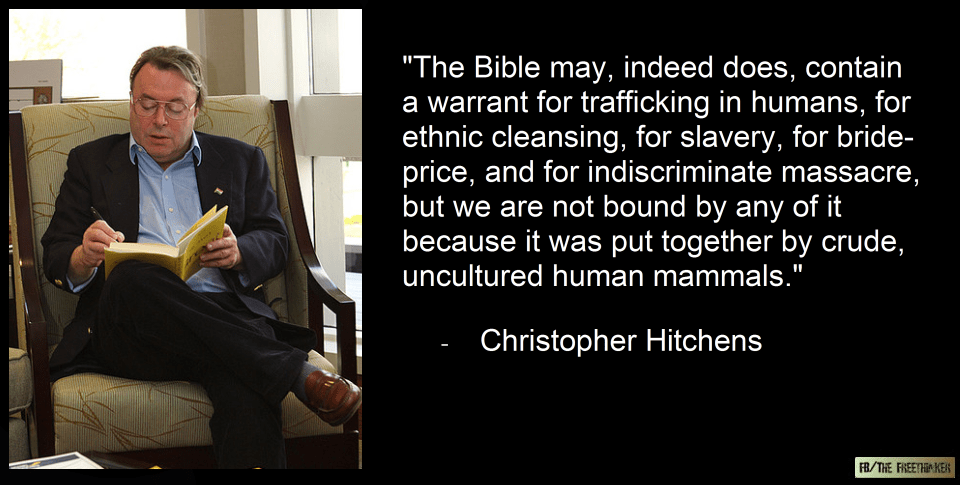
Now I am not trying to stir anything up, but I know this post probably will.  I find it interesting that Christians decry Islam for some of its more violent and politically aggressive tactics.  It seems to easy to forget that not too long ago, Christians were doing the same shit.  I would say you can still see Christians doing their level best to use at a minimal level the power of government to force their faith and morality on others.

But I have lived long enough to remember Serbia being a place where Christians killed Muslims in the 1990s. I would also say the continued bombing of Middle Eastern countries is certainly construed as (whether this is the case or not is irrelevant) as Christians killing Muslims.  So perhaps Christians should not be too hard judging Islam considering our current actions and a long bloody history of killing. coercing, defrauding and raping those who were not Christians for hundreds of years.

See the source image

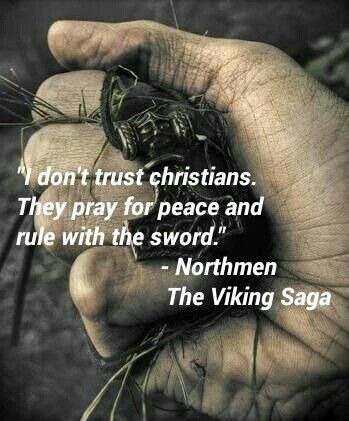
The practical problem for me is that I also know the history of paganism and Christianity and it is equally as bloody.  I am not going to say the pagans were completely innocent, because they weren’t.  But it could be argued no one need have died at all if it wasn’t for Christina missionaries converting rulers and then convincing those rulers to do the above killing and coercion of those that didn’t follow suit in their realms.  If a ruler did not convert, then those around him that had would suddenly cut off trade and go to war with him.  The church pulling the strings to make it all happen like a puppet master. The church may have split on a lot of things but they still do much the same only they are far more subtle

Why is this a practical problem for me?  Because my return to paganism is much about my returning to the faith of my ancestors as it is anything else.  Christianity to those of us of European descent is an imposition, not something that we started as. We started as pagans deriving our faith by reaching put ith the spirituality we had developed to make sense of things. For me having pagan tendencies is returning to my roots and throwing off the chains of an oppressor.

Time to Look Through the Eye:

“To see the truth, change one eye for another”

Faith:

Faith forced is no faith at all.  Faith is internal and based on personal free spiritual choices.  If you force certain choices, that isn’t faith, it is a religious imposition.

Religion:

I think the conclusion that all the Abrahamic religions are bloody is pretty fair. The fact that they use their faith to justify violence and oppression is well documented. More practically is what I have seen over the years:

  1. Families that split over faith because those that believe won’t associate with those that don’t.
  2. Moral judgment on those outside the faith leading to feelings of superiority (all disguised as humility, of course) for themselves and a viewpoint of looking at others who don’t believe as less than themselves in need of conversion from their ‘sinful ways’.
  3. Political actions that force laws on others that enforce a moral code that others who don’t believe do not accept.  Or else.

Quite frankly, compassion is not the word I would use to describe this – arrogance and pride are better words. I figure most of the wars in the western world might have not taken place if not for Christianity. Now, most of it is because of Christianity and Islam.

Theology:

As a deist for the most part who enjoys the culture of his real ancestral faith, I see how much I was spending time convincing good people to do some pretty questionable things, including myself.  My theology was one of death for those who did not believe one way or the other.  I no longer see how that can be justified as no matter how hard you dance around it, a god who just kills arbitrarily or simply because people didn’t accept his message is a pretty fucked up god. My guess, people whole like to control others, love such a god though. The amount of fear you can impose on someone with such a god is quite high; and in such fear, people are easier to control. I figure the real divine is far more thorough in his judgment of each individual human than that if he or she or whatever is really concerned about justice.

Spirituality:

Oddly enough, despite all this bloody history, I feel the pagan response is genuine tolerance until such time as they seek to impose themselves again. Then resistance is allowed.  As a pagan, I don’t go looking for a fight, but I will gladly fight and finish one to protect my right to freely choose which god myself or others choose to follow if at all. Let the followers of Abrahamic religions once again demonstrate their irrational emotionalism and hatred.  I plan to stand on higher ground than that and defend myself and others.

Conclusion:

I live in a house divided.  I am a pagan, most of my family are Christians with a few notable exceptions.  My response to most of it is tolerance, and so far no one is yelling at me or whatever. But I know the past and I know where I stand.  I stand with my true ancestors.

I remain,

The Rabyd Skald – Wandering Soul, Bard, and Philosopher. The Grey Wayfarer.

Skaal!!!
“Basic Pagan Principles: Recap” – The Pagan Pulpit

Happy Sun’s Day

Announcements:

We don’t pray here – we figure God, the gods, goddesses, or whatever powers that be either know already, don’t give a fuck, or are busy with more important matters than our petty stuff. We also kind of assume that they expect us to do stuff that we can do for ourselves and that we will do them ourselves and not be lazy. We also believe in being good friends, so we don’t presume on our friendship with the powers that be by asking them all the time for stuff while giving them nothing in return.

We also don’t take an offering here.  We figure the powers that be probably don’t need it.  Let’s be honest, offerings are not given to the divine powers, they are given to an organization to support it.  Just being honest. God, the gods or whatever never sees a dime, farthing or peso of that money; it all goes to the church, mosque or shrine.

Theme Song: ‘Völuspá’ – Einar (Live @ Castlefest Winter Edition)

Nice to hear the song written by an artist sung by that same artist.  Guy has a great voice.

Meditation:

No photo description available.


Text:

Source: http://exotic-pets.yoexpert.com/exotic-pets-general/what-are-some-of-the-basic-principles-of-paganism-2192.html

Sermon:

The above link will take you back to the original source for many of my thoughts on this series.

To recap the basic pagan principles:

  1. Responsibility of Belief – That the responsibility for what you believe about religion and spirituality lies with you and you alone.
  2. Full Personal Responsibility – That you and you alone are fully responsible for your actions and personal development.
  3. Everything is Sacred – That everything in life has a spiritual quality to it and sacredness to it.  You should respect that.
  4. Freedom of Choosing a Diety – That what diety you create and follow is your own choice.
  5. Scope of Consciousness – That consciousness is greater than the five senses, that there is a spiritual part of consciousness that exists.

When I say I have pagan tendencies to people this is what I mean.  As a deist, I am very much rational about the whole faith and religion question. Knowing that nearly all of what is termed religion is made up by human beings so pick what you want (Principles #1 and 4).  My humanist side though states that we alone are responsible as human beings (Principle # 2). My pagan side says that spirituality exists and therefore I need to respect the spiritual quality of all things (Principles #3 and #5).

I have personally enjoyed this series and meditating on its principles.  It has been enlightening, to say the least.  Next up will be me going through a book on Asatru I have been reading and digesting.

Parting Thought:


Image may contain: one or more people, text that says 'ç±³ Never push a loyal person to the point where they no longer give a damn Proud Odin's Sons'

I remain,

The Rabyd Skald – Wandering Soul, Bard, and Philosopher. The Grey Wayfarer.

Skaal!!!