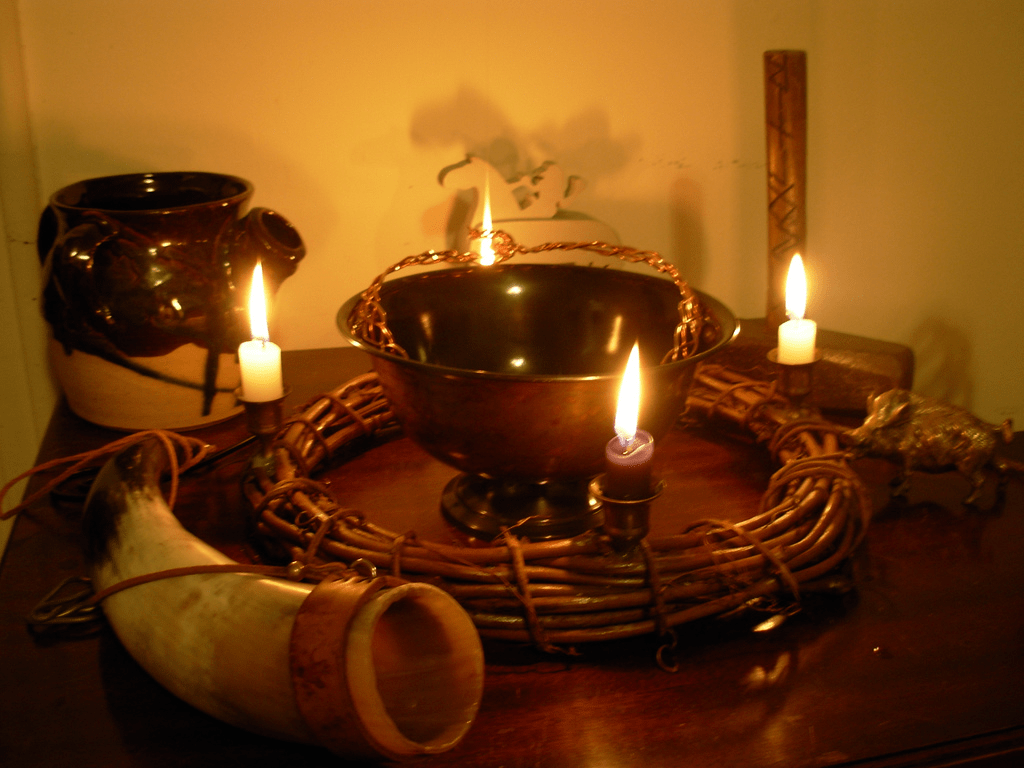
“Meditation Altar” – Odin’s Eye

Happy Woden’s (Odin’s) Day.    

Discussion:

Over the last couple of weeks, my mind has drifted in meditation and part of the issue is of course foci.  I don’t have many and there is also something to having a ritual in meditation that helps you down-center and then clears your head in order to open it up to thoughts and feelings that are more focused.

I was reading another blog a little while ago and this is why my head has been thinking of a meditation altar of sorts with a few rituals to focus and calm down. Then I can concentrate on virtues and any other thoughts about the coming day.  If you want to read the source document for my thoughts: ” Welcome to My Altars” – Myst Nokomis.

Of course, this leads to another discussion as meditation seems to indicate that I might be believing in something beyond and I have to reiterate that meditating does not necessarily indicate that one has spiritual beliefs. A book I would recommend for those who believe that meditation can be something outside the spiritual is How Words Can Change Your Brain by Newburg and Waldman.  These two guys are neuroscientists who study brain patterns and basically developed a meditative technique based purely on meditation on positive virtues.  It works in that it allows a human brain to very much focus on those virtues and it takes as little as three to five minutes.

Time to Look Through the Eye:

“To see the truth, change one eye for another”

Faith:

Meditation for me then is not necessarily about faith.  I follow Asatru for two basic reasons.  Firstly, I am a practitioner of the Nine Noble Virtues and try to apply them to my life.  Secondly, I am trying to recover my lost pagan heritage in terms of culture and religion.  My meditation is more about the virtues and my studies of mythology and religion of the Vikings are pretty much about the second.

Meditation:

Meditation is about me awakening my mind and emotions.  It about concentrating on the things that matter to me and how to engage the world around me. I turn inward in order to deal with the outward better when I come out of meditation.  My desire for a ritual and an altar of sorts is about consistency.  Religion has tapped into one thing if I take Newburg and Waldman’s book seriously, and that it understands the importance of routine and repetition.  That’s the point for me.

Theology:

For all practical purposes, I have no active belief in any god, goddess or force. It makes me academically an agnostic epistemologically and an atheist in the reality of my belief. If I have belief in anything then it is in humanity itself of which much of mythology is nothing more than personification of human forces of various kinds and the forces of nature that human beings relate to regularly.  Humanity is my ‘diety’ if you will and I express that understanding through Asatru and relate best to Norse mythology. It’s not that I don’t hold myself open to other views.  It is just I am still seeking and looking for the rational divine if it exists.

Spirituality:

Spirituality is about virtue, relationships, mind, emotion, body, and connections.  As such my one spiritual practice is meditation.  I don’t pray anymore.  I don’t fast or any of that stuff.  I simply seek to get my mind and heart right at the start of every day and then live my life. In truth, this is probably the essence of all spiritual life.

Conclusion:

On a practical side, I am going to make a meditation altar that involves as many of the senses as possible. Sight, smell, touch, sound, etc. I think the more I connect my meditational thoughts to as many senses as possible the more they will be both remembered and have a positive effect on my life.  That, I suppose, is another thing that religion does tap into that is very human.

I need something that can move and be put away, probably has symbols, candles, and incense. For sound probably I will have to use my phone and earphones.  I guess what would constitute a taste fitting for meditation might be a question I have but I will think about it.   The main objective being to have tihs in place before the month is out.

I remain,

The Rabyd Skald – Wandering Soul, Bard, and Philosopher. The Grey Wayfarer.

Skaal!!!

“Haustblot – A Fall Festival (September 22nd-23rd)” – Odin’s Eye – Holidays

Happy Woden’s (Odin’s) Day.    

Discussion:

This holiday actually was celebrated a few days ago.  Haustblot or Fallfest is associated with the end of the harvest season.  Perhaps it would be better to say it celebrates the beginnings of the end of the harvest season which will continue right up to Winternights.  This is a minor blot or festival and so it is not given a lot of fanfare per se.  But it does mark the beginning fo the fall season.

A lot of gods and goddesses are honored at this point and reflected on.  Anyone of them that is associated with the harvest or fertility is on the list. Being the beginning of fall in the northern hemisphere it is celebrated as we are starting the journey to Winternights and ultimately Yuletide.

If there is any hold out to how this holiday is celebrated it is the idea of a bonfire usually made from the lighting of the hearth in each home and then each family bringing a torch from that to light the common fire for the community. Pretty rich in symbolism.

Time to Look Through the Eye:

“To see the truth, change one eye for another”

Faith:

I think that faith that nature will continue to provide is a key element of this beginning harvest festival. Of being thankful for the powers that be or nature for providing what is needed ot sustain life through the winter. Those in four-season climates understand the importance of the harvest more powerfully than most as it means the difference between life and death.  Whether this is faith or simply a trust in the cycle of life is a good question.

Meditation:

I think a lot of this festival begins a time when the virtue of industriousness is on the one hand needed to bring in the harvest and the other hand celebrated because the rewards of this harvest are coming in. The fruit of one’s labor leading to the continued survival of yourself and your family and community is celebrated. Important things indeed.

Theology:

I suppose there is a lot of spiritual things connected with the harvest that our world of modern science has explained and allowed us to do even more and be even more fruitful. The spiritual side of this seems to be important to remember as well. To be grateful to those that do grow and harvest for the rest of us is something to be considered.  There is a connection between everyone at some point and it is often not noted because we never see one another. But in then I can eat because someone else took the time to grow and harvest the food I pay for is central.  Human connection is a theological concept.

Spirituality:

I am continually humbled by the world I live in. Life is both strong and fragile. I am reminded not only of life but death.  Things harvested are in the end dead but the give life to others as they are consumed. There is s simple truth to this that is embraced.

Conclusion:

While not a great blot or festival – Haustblot is a good moment to pause and reflect. it a good moment to take a deep breath as fall begins and then get about the business of doing what needs to be done to prepare for winter.

This completes the first time I have gone through the cycle of pagan holidays. focusing on the Vikings as much as possible.  I am going to continue doing this as each year I feel my opinions of these things will of course change. It has been very interesting this first time though and I plan on getting deeper into things each time I go through it.

I remain,

The Rabyd Skald – Wandering Soul, Bard, and Philosopher. The Grey Wayfarer.

Skaal!!!

“Heimdall – Guardian of Bifrost Bridge” (Asatru – Part 11) – The Pagan Pulpit

Happy Sol’s Day

Announcements:

We don’t pray here – we figure God, the gods, goddesses, or whatever powers that be either know already, don’t give a fuck, or are busy with more important matters than our petty stuff. We also kind of assume that they expect us to do stuff that we can do for ourselves and that we will do them ourselves and not be lazy. We also believe in being good friends, so we don’t presume on our friendship with the powers that be by asking them all the time for stuff while giving them nothing in return.

We also don’t take an offering here.  We figure the powers that be probably don’t need it.  Let’s be honest, offerings are not given to the divine powers, they are given to an organization to support it.  Just being honest. God, the gods or whatever never sees a dime, farthing or peso of that money; it all goes to the church, mosque or shrine.

Theme Song: ‘Heimdall” – Nordic Folk Music:

Meditation:

Image may contain: one or more people, people sitting and text

Never, ever stop learning.

Text:

See the source image

If you want more details about Asatru, I can’t recommend this book enough.

Sermon: 

I remember that my introduction to Norse mythology as a child actually started with Heimdall and actually the book above also when it starts looking at the Norse gods of Asatru also starts with Heimdall. Heimdall is the god that guards the way to Asgard – The Bifrost Bridge. The rainbow bridge that connects Asgard to Midgard.

Heimdall is the god of light, guardians, the coast as he is the product of Odin and the nine waves of the sea.  He lives in his fortress above the entrance to Asgard.  He has a sword and a horse.  Most notably he is the god which is considered the most benevolent to mankind as he is involved with them.

The image one might get of Heimdall is a man who sits and guards the bridge day after day but in fact, he seems to travel a bit and be very involved in mankind’s plights.  It is also believed by scholars that he was once more important that he seems to be today.  The Norse people held him in high regard as he was said to be the father of many human children so it was said he was an ancestor to many.  I remember when I watched Vikings the TV show it was this idea that was invoked when a man and woman were having a dispute about her child because it seemed the child was not the product of their marriage but the visist of a stranger. The ruling woman made the judgment the child was the child fo Heimdall and thus the family was blessed.

The followers of Asatru do have high regard for Heimdall despite the fact his role with the gods is slight.  Basically waiting to blow his horn to signal the attack of the giants during Ragnorak on Asgard and then to guard Bifrost with his life. This vigilance and connection with mankind in the rainbow, the coast and the ridges above the seas is however ever-present.  Something that is to be admired.

I am reminded that not all virtue is glamorous. There is nothing more boring and yet so necessary as guard duty.  Heimdall for his part takes on his task of guarding Asgard and the Bifrost bridge with a sense of fidelity and discipline that few can match. His story definitely also has the connection to humanity that is truly personal as he is the ancestor of many.  I find it interesting that the Norse people had no problem with the fact that he seems to have no wife yet fathers human children and they considered themselves blessed for it.  Despite what we do know there is still a lot of mystery to Heimdall which I find intriguing. Mostly his personality seems interesting but he so quiet he reveals little and his name’s meaning is unknown.  I connect with him however as his job as the guardian of Asgard connects to my first name Edward very well – ‘The guardian of prosperity’ seems to fit us both.

Parting Thought:

Image may contain: one or more people and text

I remain,

The Rabyd Skald – Wandering Soul, Bard, and Philosopher. The Grey Wayfarer.

Skaal!!!

“My Spiritual Symbolism: Valknut with Rune Circle” – Odin’s Eye


Happy Woden’s (Odin’s) Day.    

Discussion:

My struggles with magic aside, I do believe in the power of symbols. Not magical power per se but more of a power to encapsulate thoughts, concepts, and ideas into a single pattern or image.  For me, these become very powerful focuses that keep me steady in my thoughts and philosophy.  They also remind me of what is spiritually important.

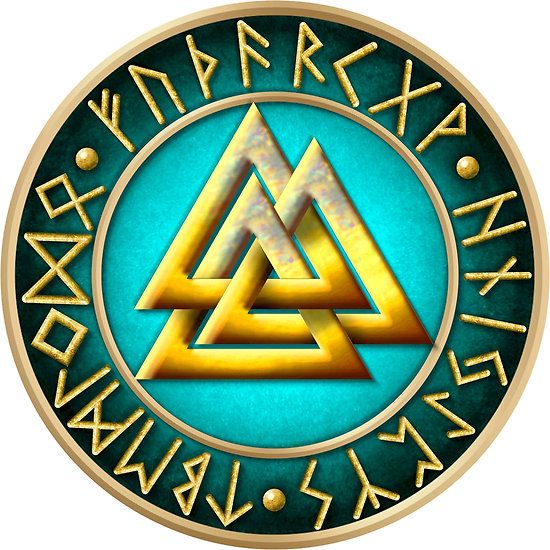
I adopted the valknut as my replacement for the cross right after leaving Christianity.  I had become fairly certain that at least the Nine Noble Virtues of Asatru were going to be my new moral code, so I looked for something to symbolize that and the symbol of the Valknut was almost always present in any website I was studying at the time and so made it my own.  The fact that it is connected with Odin and death rituals (burial) only solidified this.  The Grey Wayfarer (me) often wears a pendant of the valknut around his neck on a chain.  Mine also has a circle of runes around it like in the picture above.

Both the valknut and the runes are mysteries as to their full meaning.  Much has been lost thanks to the invasion of Christianity and the subsequent purge that followed them of all things pagan. The valknut and runes apparently were too pagan to find their way to being incorporated into Christian worship and so were actually expunged.  A few examples survive and so what we know is very little.  The valknut is associated with Odin and burial because we find them on gravestones.  Runes are everywhere but they don’t seem to be about language although some modern pagans have made it so.  From a scholar’s point of view, they are largely a mystery as well.

What this meant for me is that I was left to give this symbol and the runes around it their own meaning. So…

Time to Look Through the Eye:

“To see the truth, change one eye for another”

Faith:

I am a deistic humanistic pagan.  First and foremost I fall on the side that says while religions are bunk and made up for the most part, I don’t dismiss the idea of a supreme being, beings or force of the universe being a real possibility. However, I believe that the only real source of overcoming my own and other human problems is myself and other humans. I am pagan because my spirituality basically draws me back to the spiritual roots of my ancestors. It is far more about heritage than religion for me.  The valknut and runes are a good symbol of that as both call to my Germanic and (hopefully) Scandinavian roots.  It is at least the faith and spirituality of my own spirit regardless of biological genetics.

Meditation:

I suppose my meditation times that I have used the valknut and rune circle are the ones that have given both new meanings for me. Firstly the nine sides of the three triangles became representative of the Nine Noble Virtues.  Later, the nine formed the three triangles of the Higher Virtues of love, Justice, and Wisdom.  All of them are interlocked and the three triangles, if you look closely, cannot be separated fro meach other.  It thus forms a single spiritual path of following virtue, a single symbol – the valknut.  It also because of its connection to Odin serves as a reminder of the finality of life. Virtue is the only thing that gives that life value.

The rune circle around it is all 24 known runes. In many ways, it symbolizes the mysteries of the knowledge of the universe to me. By following the path of virtue, I begin to understand these mysteries better.

Theology:

One of those mysteries is the divine.  Part of that, to be honest, is to assess whether such divine entity or entities exist.  As a diest, I fall on the side of agnosticism that says we don’t know enough to dismiss the idea of the divine, so I believe more in its possibility than it is not possible.  I will give the atheists their due in saying they could very well be right, but at the same time, I don’t think I can myself close my mind, heart, and body off to the idea that a creator or creators exist. It seems too ‘dogmatic’ of ‘fundamentalist’ to me so to speak.

The issue then is to find meaning either way – for me, this is the following the path of virtue as a means to coming to better understandings of the world around me and perhaps finding the answers I seek.  I am a pilgrim searching for truth, wherever I find it.  I am the Grey Wayfarer

Spirituality:

I find spirituality in Virtue.  Virtue allows me to connect with myself, other people and the universe and all it contains. How can one not be connected when following after virtue? For me, this symbol reminds me that part of understanding the universe requires connections.  The path is what connects and virtue is the path.  In meditation, this symbol has proven to be the best focus when I am looking to understand this connectivity to everything else.

Conclusion:

As I meditate more on this, I am sure more things will come to mind.  I have plans to make my meditation time more ‘ritualized’ in that I may have other foci and even some candles and incense.  Regardless, the valknut and rune circle will always be central to it. The centerpiece if you will regardless of what becomes my first meditation altar.

I remain,

The Rabyd Skald – Wandering Soul, Bard, and Philosopher. The Grey Wayfarer.

Skaal!!!

“Magic – A Skeptical Pagan’s Perspective” – Odin’s Eye

Happy Woden’s (Odin’s) Day.    

Discussion:

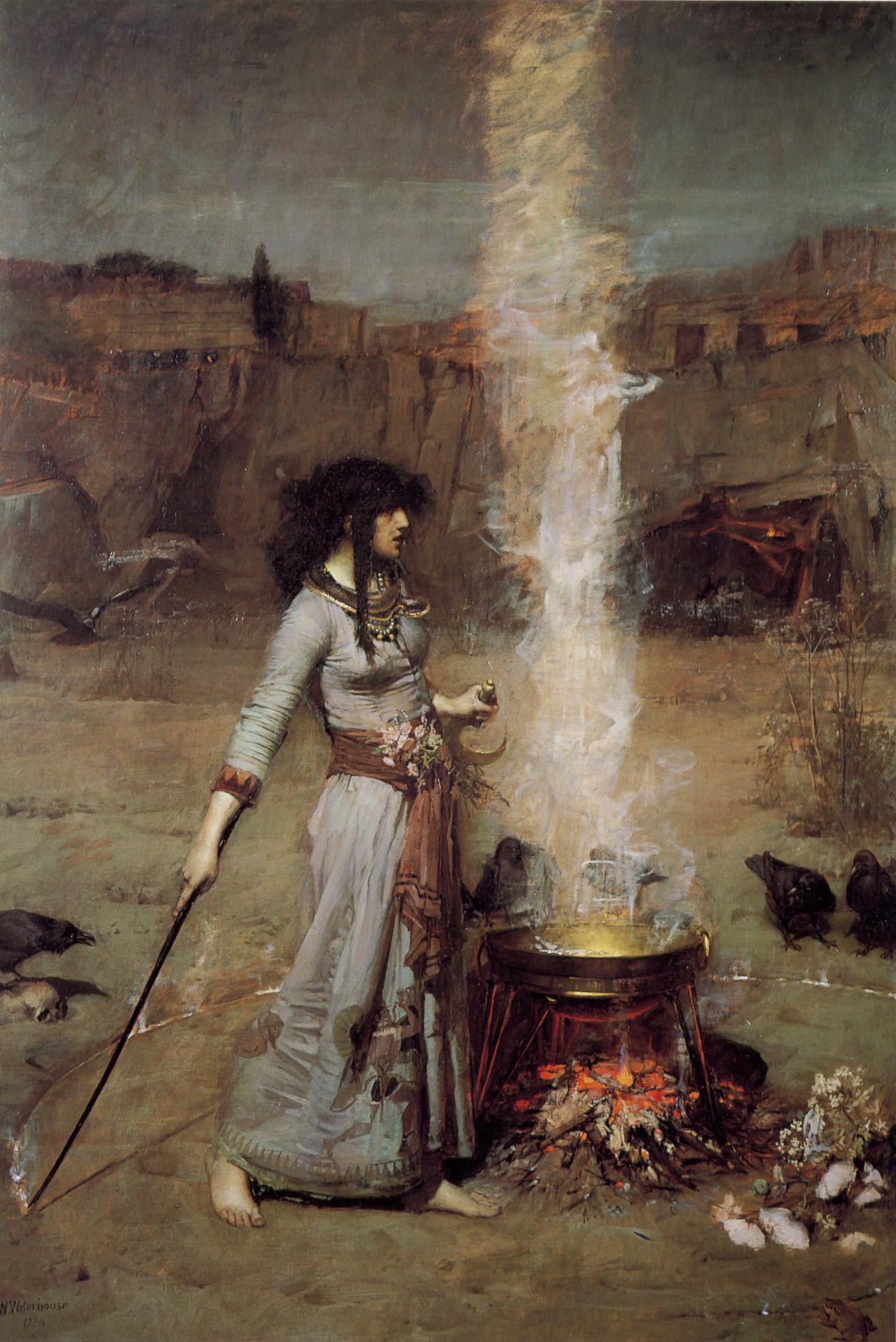
In the Pagan world, magic takes a lot of different forms.  In my pagan world of the Asatru, with its Viking heritage, there is a belief in magic.  It is full of shamanism as well as the simple idea of using consciousness to affect the world through the will of the practitioner.  Because in Norse mythology everything has a spirit, then the issue was influencing the will of those spirits to line up with the will of mage.  Most notably the magic of the Vikings seems to have focused on the idea of knowing and fate.  For one to decern the fate of a person and thus decided the best course of action was the goal of Viking magic.  This particular form of magic was called seidr.  The Vikings had other forms but this seems to have been their magical passion if you will.

I freely confess, pagan that I am, I am skeptical of magic.  It stems from seeing the value in science, but as some of the writings on magic point out, the end goals and means of science and magic are very different.  I can get that, so I am not closed off to the possibility of magic.  My problem is my own personal history as a Pentecostal Christian has soured me to the whole idea as what many times was considered ‘miracles’ was either very explainable as mass manipulation and psychology or straight up huckster fraud.  The idea of the divine powers reaching into the lives of people I can accept, I just think that the people who claim to do this need to be scrutinized with a very skeptical eye.

So what about magic in the real world?

Time to Look Through the Eye:

“To see the truth, change one eye for another”

Faith:

I can believe that the powers that might be would interact with the rest fo us humans. The question I have is whether this is necessary all the time. If in some ways this might be presumptuous on our part to even ask for it.  I start the Pagan Pulpit out with the following paragraph:

We don’t pray here – we figure God, the gods, goddesses, or whatever powers that be either know already, don’t give a fuck, or are busy with more important matters than our petty stuff. We also kind of assume that they expect us to do stuff that we can do for ourselves and that we will do them ourselves and not be lazy. We also believe in being good friends, so we don’t presume on our friendship with the powers that be by asking them all the time for stuff while giving them nothing in return.

I want to tell you I sincerely mean this. I am not going to presume on any friendship and that includes the divine powers. Faith that they exist – yes.  Presuming that they want to help me – no.

Meditation:

As I have meditated on this question of magic. my biggest personal struggle is that of prayer.  Mostly, as I look at Chrisitan prayer, I see it is talking to one’s self and interestingly enough part fo the self that we actually define as God.  You will find that Christians in general view this ‘God’ very differently.  Everyone has their own very unique perspective on who this person is and interestingly enough shaped in each persons own image of what they want.

Prayer to me seems presumptuous in and of itself.  But self-talk I see the need for as we all do it and those that pay attention to it often are more well adjusted. The real question I suppose is theological.

Theology:

Theologically speaking, the question comes back for me as to whether the powers are benevolent, malevolent or indifferent to the whole question of good and evil. Why would they help us if we ask? Can they be trusted?

Even in the mythologies, I know those are good questions.  Odin, for instance, has a higher purpose in mind and so will not hesitate to sacrifice you his devotee to that cause.   Loki certainly can’t be trusted.  Better not to pray at all and thus leave the whole magic of life to living as virtuous as possible for your own sake. Virtue has its own form of magic as do stories.

Spirituality:

My spiritual side longs for what magic could do, but my skeptical side says better to leave it alone. To practice the more subtle magic of living life as a follower of the Nine Noble Virtues and to tell tales as a Skald.  Bring the more common magic of virtue and story to people.  To not presume on the powers that be, but rather be self-reliant and work hard to attain that I wish.  Magic seems like a dangerous short cut.

Conclusion:

I guess I can leave my fellow pagans with some questions.  Is magic something you practice and why do you do it? Is my skepticism a good thing or a bad one?

For now, I will follow virtue and tell stories of life and the universe. It seems to be a safe path. I still don’t see a good reason to take the short cut of magic.

I remain,

The Rabyd Skald – Wandering Soul, Bard, and Philosopher. The Grey Wayfarer.

Skaal!!!

“A New Pattern?” – Odin’s Eye

Happy Thor’s Day.    

Discussion:

When I started this blog, I intended Odin’s Eye to be about my spiritual journey.  Probably more about my change in spiritual viewpoint or vision.  The pattern I established was pretty straightforward at the time although I established it a month or two after I started:

Deism, Bible Problems, Humanism, Christianity Problems, Paganism, Religion Problems, The Wayfarer’s Spiritual Side, My Theological Objections to Christianity Revisited.

I also established that on every pagan holiday, I would stop and comment that week on it.  That has been a fun journey in and of itself.  But it is also about to come full circle with the closing of the first year of this blog on September 30th.  Fall begins on September 22 and the pagan holiday is Mabon or for Vikings – Haustblót.  After that, the cycle starts again on October 1st.  I intend to continue to talk about pagan holidays but I want to get as truly Viking as I can the second time around.

Outside this though, I have had a pretty good debate running with myself about changing the pattern of the posts for Odin’s Eye.  Most notably do I want to go through the whole Chrisitntity issues again?  I am thinking of saving all that for a book or two, so what really is the purpose of Odin’s Eye? Well, it is about spirituality and my spiritual journey. At the same time, it is a place to pose spiritual questions to myself and perhaps you the gentle reader.  I guess the main thing is to stop talking about the spiritual past and embrace the spiritual present and look to the spiritual future.

My first step in revising the pattern was to eliminate the negative in a lot of ways and also to get rid post types that go over old ground.   This leaves:

Deism, Humanism, Paganism, The Wayfarer’s Spiritual Side

The more I thought about it though, the whole deism and humanism questions are pretty settled for me and boil down to two fundamental truths. 1) I hold the possibility of divine power or powers, and 2) I believe that to solve human problems, humans are going to have to do it themselves.  The powers might help or might not, better to be self-reliant first.  I am not sure I really need to discuss these anymore with myself.  I side very much with enlightenment thinking for my rational and more practical side. But eliminating these two posts leaves me with only two:

Paganism, The Wayfarer’s Spiritual Side

I don’t think that is sufficient enough of a rotation to keep me off my soapboxes.

It is really the whole Asatru and Pagan side I struggle with more. Getting a grip on the wisdom and intuition side of things that involve is the struggle now.  It is the nature of this struggle I would rather talk about now.

If I go the spirituality and paganism route the list of topics changes dramatically and gets quite long actually.  The thing is that some of my other post types handle a lot of this but what lies outside on the fringe where Odin’s Eye can help me come to a better understanding of these issues. I began to realize after while this topic is so big, and for me largely unexplored, there is really no way to establish a pattern.

So I am going to do something uncharacteristic for me.  Be open each week to any topic with only the boundary of it has to be something spiritual that is not necessarily covered by other things I do on the blog. I short these topics are going to come more from my times of meditations than a rational pattern that I simply follow.  I am opening myself up once a week to letting the topic be spiritual in nature and not chosen so much as it becomes an interest through meditation.

I am going to remove one filter for the Eye and replace it with another. Religion needs to go as it is negative in a sense, filtering out the religious aspects of things was a part of looking through the eye.  I no longer seek to do that, but discover the fuller spiritual truth of something.  I am going to replace religion with meditation.

Time to Look Through the Eye:

“To see the truth, change one eye for another”

Faith:

When I put any subject through the filter of faith, what I am asking at that point is what I believe about that subject?  The introduction tells people what I know about a particular subject, but faith is an exploration of what I believe about it. The idea is to set up where I am, then the other three filters follow which will possibly change that belief.

Meditation:

Meditation is the first filter.  It is calming my mind and opening up to what the powers, universe, whatever might inspire me to think about that topic.  Words, questions, thoughts, etc. that come from my times of meditation on the subject.  Then asking how these affect my beliefs about it.  It going to require me to keep my paper journal handy during every meditation session, but I think it will be worth it.

Theology:

Once I get to this question it is more about how this topic influences my understanding of the divine. Simple but a necessary question for me as someone who still practices theology. For me, the delving into the spiritual side of things is motivated in part by theology and understanding the divine.

Spirituality:

This is putting everything in a context filter.  How is my overall understanding of spirituality affected by this now?  Have my beliefs about this subject changed due ot putting it through my spiritual filters? What is my overall spiritual viewpoint now?  It is the bringing it altogether filter.

Conclusion:

I, of course, will have some concluding remarks about each subject and I might pose a few questions for you the gentle readers that might have a greater understanding of certain subjects I am struggling with. A good post wrapup will be what I am looking for here.

I am hoping these changes will be effective in helping all of us understand the spiritual side of life better.  Of Wolves and Ravens is about philosophy, but Odin’s Eye is about Spirituality and as such needs to have more spiritual methods of finding what to talk about.

I remain,

The Rabyd Skald – Wandering Soul, Bard, and Philosopher. The Grey Wayfarer.

Skaal!!!

“Objections to Christianity – The Justice of the Biblical God – An Unbalanced Scale” – Part 4 – (Revised August 2019) – Odin’s Eye – Theological Objections to Christianity

Happy Thor’s Day.  

August 2019 Revision Notes:

It has been almost a year since I wrote these originally starting in November of 2018.  When I got to the rotation in Odin’s Eye the last time where I was going to deal with these objections again, I saw no need for revision but rather simply laid it out there that no one had responded to them to that date and moved on into the rest of the Rotation for Odin’s Eye. 

This time though I feel that I need to spend four weeks of Odin’s Eye doing some revisions that will either clarify my position, add some other thoughts or edit for other issues.  Such edits will be marked by italics.  When archived, they will appear under the original post on this Page: My Four Theological Objections to Christianity

 Mostly though this is a cut and paste with some revisions. As the series goes on there will be more revisions as I can see the need for things to change a bit in the other three objections.

In part four, I felt the need to add a few paragraphs for hopefully a clearer explanation. But also there are some additional arguments that trouble me about the whole afterlife thing with Christianity. I also completely rewrote my conclusions. 

Introduction:

I am wrapping up my four main theological objections to Christianity with the simple but profound fact that the god of the Bible is very suspect in as far as whether or not he is just and acts with justice. I would go so far to say that the god of the Bible does not follow his own clearly stated guidelines for justice – 1) “Eye for eye, tooth for a tooth” and 2) Restitution Included. Namely that the punishment should fit the crime and that restitution when merited should be offered.  This is the standard of justice found in the Torah or Law of Moses. Jesus of Nazareth takes this on in the Sermon on the Mount in Matthew 5-7 pointing out that the principles of justice were still valid and in fact because things should be done for the love of God, they were even more challenging.  God expects Christians to still be just and follow his principles of justice. The issue is: does the god of the Bible follow his own rules.  I would say not.

Faith:

From a standpoint of my own faith, the biblical god’s justice, and in particular the doctrine of Hell, has always been a problem.  My standard answer throughout my days as a pastor to others that asked was that the justice of God was a mystery.  That someday, we would know it all and see that this god was just to send people to hell.  Even if they were people who we loved and who this god claimed to love. But it was more than that as some of the stories of god executing justice were a little lacking justice themselves.

Job’s trial is a good example where God allows the Devil to kill all of Job’s children and servants save a few and does it simply to test Job to see if he will remain faithful.  The Biblical god’s answer of – “I am god, that’s why.” is a little lacking in reasoning for a supreme being for one and the whole situation is lacking in compassion not just for Job but for all the people slain for another.  They all lived and died simply to satisfy a bet between the Devil and the almighty is a little much to reconcile with the idea of God is love.  Stuff like this definitely tests your faith and it should.

Religion:

The thing is most religious responses to the justice of God dilemma is either to cite ‘mystery’ (read – I don’t have a  reasonable answer, so I am going to punt) or our ignorance.  Simply put they both attempt to give a god a different standard of justice than we follow.  How convenient, but also telling that we cannot even use the standard of justice of ‘eye for an eye’ with the biblical god. The very standard that this god gives, he does not follow.

The fact that I used to come up with this double standard for god myself bothered me for years when I realized that is what I was doing.  A standard of justice is only viable if it is evenly applied to all.  It should be logical and consistent enough that it CAN be applied to all without exception. We have learned not to tolerate double standards between those that lead and those that follow, so why here?  Why does this god of the Bible get a free pass for being hypocritical?

Religion does its damnedest to keep us from seeing this, and it does it by trying to make God so high his different standard of justice is justified.  It sounds like a ruling religious class seeking to justify why they can impose rules on others that they don’t have to follow themselves.  After all, they are ‘men of God’ and so as Cardinal Richelieu points out in the Three Musketeers movie in 1993 – “The Cardinal is not subject to the laws of men”.  Easy to justify if you create a different standard of justice for your god and you then say you are subject to that standard, not the standard of men.

Theology:

But the Biblical God fails theologically and it comes out best in the doctrine of Hell and final judgment.  Everything we will do is in a short temporal time of existence but everything about the final judgment of the god of the Bible is eternal.  In short, this god is going to punish us in a way that is eternal and permanent for our behavior in temporal and non-permanent existence.  This includes annihilation and eternal punishment views.  The only thing that might save Christianity here as far as theology is actually the idea of purgatory where the punishment is redemptive and non-permanent.  But even here there is a postulate that punishment can last centuries compared to the shortness of life.

So being burned like the rich man is said to be burned is somehow eye for eye and tooth for a tooth?  In that story, the rich man is burned not because he defied god but because he had a good life and Lazarus was rewarded because he had suffered in life.  Go look at the story (Luke 16) yourself, this is the rationale that is given.  So because a guy had it good he is punished with burning fire?  How is this eye for an eye? Justice would have been to have the two trade places for a second life, not that he is burned for a long time.

There is little justice in this story, just a god who on the one hand in the Old Testament tells people who prosperity is a sign of God’s blessing and then turning around and saying though that if you do become prosperous, the biblical God is going to burn you as punishment for it.  In a full analysis of the biblical account not only are there many accounts where god’s justice is a little suspect but where he violates the very rules he sets forward because he gets jealous or angry. Like the other mythologies, the biblical god is very human and reflects probably more of the attitude of the author of that particular passage than the almighty that actually might exist.

More troubling to me recently in August of 2019 is the fact that no theology of damnation other than purgatory by the Catholics, and even then it only works for Catholics, allows people who gain heaven to appeal for those that they love in Hell for God to be merciful.  I have to ask what kind of compassion anyone has that would allow their loved one to burn for all eternity?  I mean if someone I love like my children or grandparents were in the eternal lake of fire and I knew this, I would have enough compassion on them to be in front of God every single moment of eternity begging for his mercy for them. How can you even say you have a compassionate heart if you believe that your fellow human beings are going to be burned forever and ‘that’s just the way it is.”

But that brings up a question of God’s mercy.  Could you burn one of your children, parents, friends, etc. with fire forever simply because they violated your rules or didn’t believe something you told them?  For me, that is definitely a ‘no’.  My love for them far exceeds my desire for them to be under my control and doing things as I wish or that they absolutely believe me.  If that is true for me, why is God then an unmerciful bastard about this? How is it that he the God that IS Love, has less compassion for some of his children than me? Perhaps because he is a concoction of men who were in power that desired to control through fear? Yeah, I would bet that is it. 

Spirituality:

See the source image

For me personally, I come back to the quote I have used before.  If the god or gods are just then they will judge us based on the virtues we lived by.  If they are not just, then they do not deserve to be served.  If there are no gods then, we should live in such a way as to be fondly remembered. I worry less about an afterlife; because regardless, it is this life I must live either way.  I choose to live based on virtue because, in the end, it is all I really have.  My own personal responsibility for the life I live is mine alone. Cue Robert Heinlein.

See the source image

Conclusion:

I will revisit these objections in the future with other thoughts.  For now, if anything, these objections have gotten stronger and more detailed and still form a bedrock of why I think not only is Christianity a bad Idea, but I am now convinced it is largely a fraud. I would also contend that it has been used, much like Islam and Judaism as well, to deceive, control and manipulate others. 

The most troubling thing to me is I know many Chrisitan friends and former friends have read these and you know what?  Crickets. Silence. My eternal fate is not so important that they would even try to answer.  Perhaps the real truth is that these objections have no answer and the basically constitute the god Yahweh to the rest of mythology and as another concoction of men and his flaws simply are a reflection of their thoughts about him being flawed. Because they had flawed standards of justice and ulterior motives, the God they created’s execution of justice reflects this. 

It also speaks to the real beliefs of Christians.  I know for a fact, that many do not actually believe. I was minister for 20 years and I lost track of the number of people in my churches who when questioned, basically had done one of the following: 1) They had picked and chosen what parts of Chrisitan doctrine or the Bible they liked and discarded the rest.  2) They didn’t really actually believe anything, they just went along with it for the community and to keep family happy. When questioned further, it all came back to one of what I call my four objections in some form as to why they didn’t believe or what they had chosen to discard.  It for all of them had basically become tradition, not real faith or spirituality. 

This to me now is the most damaging thing – why have spirituality in your life that is not genuine?  Why do you have a part of your life basically be a fraud? Would it not be better to be truly honest with yourself about where you are spiritually speaking?  It is my four objections that started me on the path to honest spiritual reflection and being truly who I am.  I am now better for it and a better person in many respects.  Mostly, I have stopped being a liar.  This is the first real step down the path to finding truth.

I remain,

The Rabyd Skald – Wandering Soul, Bard, and Philosopher. The Grey Wayfarer.

Skaal!!!
“Objections to Christianity – Part 3 – The Cross and Empty Tomb – An Imaginary Solution to an Imaginary Problem”(Revised August 2019) – Odin’s Eye


Happy Thor’s Day

August 2019 Revision Notes:

It has been almost a year since I wrote these originally starting in November of 2018.  When I got to the rotation in Odin’s Eye the last time where I was going to deal with these objections again, I saw no need for revision but rather simply laid it out there that no one had responded to them to that date and moved on into the rest of the Rotation for Odin’s Eye. 

This time though I feel that I need to spend four weeks of Odin’s Eye doing some revisions that will either clarify my position, add some other thoughts or edit for other issues.  Such edits will be marked by italics.  When archived, they will appear under the original post on this Page: My Four Theological Objections to Christianity

 Mostly though this is a cut and paste with some revisions. As the series goes on there will be more revisions as I can see the need for things to change a bit in the other three objections. In part three, I felt the need to add a few paragraphs for hopefully a clearer explanation. 

Introduction:

I know I will probably get a reaction out of this one and I am not trying to be provocative.  I am simply trying to get people to see the logical problems of Salvation through Christ.  Once you dismiss sin as a made-up concept, you could say that it is really unnecessary to go after ‘God’s’ solution to the problem, but the whole of Christianity revolves around Christ’s work on the cross and the resurrection to save people from sin and from eternal damnation. You might say it is the core doctrine no matter what flavor of Christianity you live by so it deserves some attention.

For the sake of argument, let’s concede sin is real. Then does the solution the Bible presents God has for it make any sense? 

Faith:

Of course, the first thing that can be said is each flavor of Christianity stakes out is how said salvation is achieved with Christ.  The faith versus works controversy starts right away in the first century. James and Paul go at it right in the Bible.  Now I heard multiple explanations from both Protestants and Catholics of why James and Paul are not arguing about the same thing really but they practically quote each other with only one variation.  One says salvation in Christ cannot be of works so no one can boast, and the other one says that without works it is impossible to show faith. No matter how you logically try to get them to be ‘defending the same salvation only from different directions”; it is contradictory.  One is saying that works have nothing to do with salvation, and the other is saying it does.

So what this really shows is that even in the Bible and among early Christians, they had disputes and disagreements about how this works and thus it points to the Bible not being inspired by God, so much as it records those early debates among the faithful about how salvation worked.  That makes the Bible very human and also not the Word of God because if God had actually wanted to tell us how this works; because it seems it would be the most important thing for us to know, he would have made it plain, straightforward and quite frankly non-contradictory.

Religion:

Of course, every flavor of Christianity goes even further with specifics and added on things to the doctrine of salvation in Christ.  The Catholic Church plain out tells you that you can only be saved from death through them and no one else.  Many Protestant denominations will tell you the same.  My former denomination would tell people that they had the whole gospel, not just part of it.  Salvation is complicated by religion because religion seeks to use these ideas to keep people grateful and faithful for telling those people their version of ‘the truth’.

In the end, I would say that each variation of salvation through Christ is presented in a way that helps the group presenting it.  It is done to layout their other doctrinal tenants so their way of thinking about God is central to it all, and thus gives a theological force to everything they believe. Of course, this gives religion the guilt and punishment/reward options it needs to manipulate people. 

Theology:

Religion aside though, my objections are theological – what kind of God do we have, who claims to be merciful and loving, but demands for his followers to be forgiving without condition, but doesn’t do so himself?  It also brings up the question of the ability to forgive in that we are expected to forgive each other without condition because we can, even as sinners. Yet, a holy God can’t simply forgive without sacrificing his only begotten son in one of the cruelest ways ever devised by man.  He must have this sacrifice or he cannot forgive at all, and I must have faith in it and the resurrection or he will not forgive me specifically.  Worse yet if I don’t forgive others as a Christian, he won’t forgive me. He can choose to not forgive others and still be a holy God, but if I don’t forgive, I cannot be saved?  So I, as a ‘sinner’, have not only a greater expectation than my creator; but also I am more capable because I can do this forgiveness without conditions, but he cannot?

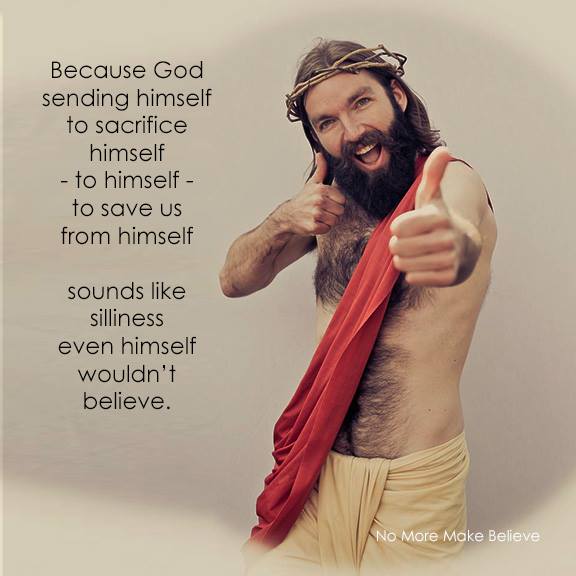
This bit of ‘logic’ pales in comparison to the fact that in order to forgive us he must sacrifice himself to himself, to appease himself to save us from himself. See the problem? Well Ed, what if then the whole doctrine of salvation as it currently stands is man-made and that isn’t the real doctrine of salvation God wanted? How then would we ever know the real one? It seems a little too confusing for something so important as eternal life.  My response that the current one is man-made? – exactly, and that is probably true from the start of Christianity to where it actually stands today.   It seems to me that this idea is just as man-made because a supreme being could have come up with the simple plan to just forgive people. As Jesus is praying in the garden “if it is possible, let this cup pass from me” we would see the opening up the heavens and God saying -“You know what, I have a better plan – let’s just forgive people like I expect them to forgive each other.” That would be just, logical and consistent.

There is also another theological side issue – How much of a sacrifice is it really for Jesus if he knows for certain (which he indicates three times in the gospels) that he will rise from the dead?  Honestly, if he knew that and most people who have faith believe he did and the text certainly seems to indicate he did, then it isn’t that big of a sacrifice? He knows he is not going to ultimately be dead in the end; so why not do it, as there is no ultimate risk to him?  In the end, Jesus is risking nothing himself as God, just going through the inconvenience of temporal suffering.  Why? To make a point? What point would that be, when there is nothing actually sacrificed in the end? He lives and knows he is going to live so why the anguish?

Spirituality:

I guess this leaves me with the question from a spiritual point of view as to what salvation is? Or does it?  I mean, if there is no such thing as sin, there is no need to be saved from it. Of course, then I could be left with the question of what the real divine reality might expect from me?  I guess the only thing then is to live a good life regardless of what that divine reality might be. Marcus Aurelius rightly observes, in my opinion, this in his famous quote on the good life.

See the source image

Of course, you are kind of left to things yourself as to define what virtues you will live by to attain that good life. In short, what is defined as a good life is left to you.

Conclusion:

The implications of losing the whole notion of sin and a need for salvation have been very liberating. There is no guilt or shame in my heart or mind at all these days.  I do try every day to be a better man than I was the day before. This, I have found is a far better way to live. 

Better yet, is discarding the notion of a loving God who also sends people he loves to hell.  Because the god of the Bible seems to have some major issues with justice, but that is the subject of the next post.  

I remain,

The Rabyd Skald – Wandering Soul, Bard, and Philosopher. The Grey Wayfarer.

Skaal!!!
“Objections to Christianity – Part 2 – Sin: An Imaginary Man-Made Problem” (Revised August 2019) – Odin’s Eye – Theological Objections to Christianity

Happy Thor’s Day

August 2019 Revision Notes:

It has been almost a year since I wrote these originally starting in November of 2018.  When I got to the rotation in Odin’s Eye the last time where I was going to deal with these objections again, I saw no need for revision but rather simply laid it out there that no one had responded to them to that date and moved on into the rest of the Rotation for Odin’s Eye. 

This time though I feel that I need to spend four weeks of Odin’s Eye doing some revisions that will either clarify my position, add some other thoughts or edit for other issues.  Such edits will be marked by italics.  When archived, they will appear under the original post on this Page: My Four Theological Objections to Christianity

 Mostly though this is a cut and paste with some revisions. As the series goes on there will be more revisions as I can see the need for things to change a bit in the other three objections. In part two, I felt the need to add a few paragraphs for hopefully a clearer explanation. 

Introduction:

My loss of faith really started here.  I can actually go back to a message I was preaching on sin and salvation through Christ and the fact this quote from Dan Barker from Losing Faith in Faith ( a book I still want to read) was rolling around in my head.  I was trying to think of something that would make his assertion wrong.  I got up preached the message and sat down.  I can site this moment as the time my crisis of faith began. I realized he was right.

I realized there is no proof that sin rationally exists.  I only believed that because that was what I was told by a preacher and read it in the Bible.  Unless the Bible was truly inspired, then I had no natural or logical proof that there was this thing called sin, a sinful nature or my actions were righteous or sinful. God Himself had never come down and told me I was a sinner, that was men either in the form of preachers or the men who wrote the Bible.  Over time, I began to realize that sin has the same problem as the inspiration of the Bible – the Bible asserts it but never proves it.

Going back to my pulpit moment, I sat there thinking and my faith started to unravel.  I sat there thinking: “I make a living by telling people they are sinners so they will feel guilty, then they accept the ‘gospel’ and feel better.  Out of gratitude they throw money in the basket and pay me. WTF.”  It was a bad moment for me, and one that led to my eventual downfall over two years later.

Faith:

If you are a believer you take the existence of sin as purely a matter of faith.  Basically, if you believe that sin exists, you do it for the same reasons you believe the Bible is inspired.  You have faith it is true – you hope and believe it is true, but you do not have a proof or a rational argument to say it is true.  The Bible writers assume sin is real and a problem.  They never prove it, and the believer is left to take that sin exists as a reality and that God has solved it.  You believe all that without rational evidence.  It is purely a matter of faith.

Now I want to emphasize that this does not disprove sin’s existence, but it puts on the same plane as believing in a lot of things that we believe exist but have no proof of.  The issue then is should we order our lives on faith in the idea that man is sinful, or go based on our own observations of human nature and conclude that if anything we can have faith in the fact that all human beings are human. 

Religion:

I now think that sin is a man-made concept.  It probably originally. like so many things might have had a good intention.  To keep people from making bad decisions given the cultural context.  I mean sex without birth control and modern medicine can lead to deadly diseases and unwanted pregnancies. So you tell people not to have sex except with people they are committed to and get married to so the child will be legitimate. The practical side of this is the lessened risk of STDs and unwanted pregnancies. It is a wise course of action.

When just showing the wisdom of this to others doesn’t work, you throw in the wrath of God to bring about a more forceful form of persuasion – tell them it’s a sin against God and He will bring down his wrath on the one who sins.  This is where you make up the concept that sexual sin is an affront to God and he will send you to hell if you don’t repent of it and stop doing it.  It is ultimately a fear tactic that uses guilt to prevent certain behaviors.

The dark side of this gets worse though as people genuinely think they’re taking the side of God when the punish sinners.  The real problem with sin is that some people think they have risen above the concept of it.  They feel qualified to judge others using their religious beliefs. It gets worse because the said concept can be held by people in power who wish to impose their views on people to create a ‘righteous society’.  To force others to follow your moral code of some behaviors being sin and thus outlawed. The problem is the difficulty using reason to prove something is a sin.  It’s not self-evident.

Theology:

I don’t believe in sin as a theological concept anymore. I think in large part it is a bad one because all it does is produce guilt and then in a guilt-ridden state people can be manipulated.  I haven’t looked at this fully but I have a theory a large part of religious people have a poor self-concept and that is because they have a large amount of guilt associated with their ‘sins’.  This leads them to think they are bad or even evil people and the cycle of self-destruction begins.  You spend a lot of time putting on masks at that point to protect yourself from the social wrath of being a sinner while at the same time being wracked with guilt because you can’t seem to escape your sin. If it sounds like I have been there – yep.  I would say a lot of my initial causes of depression came from this struggle.  Yes, I am saying that religion, particularly the Christian notion of sin,  may have has a great deal of influence in causing my depressive issues.

My theology about mankind has certainly changed since I discarded man as a sinner.  I don’t think of myself as a sinner but simply a human being. I am not all-powerful, all-knowing or all-present; so I am going to make mistakes and there is really nothing I can do about it. I have needs that are normal.  Wants that are normal.  I have my reason and wisdom to guide me. I am not perfect and I make mistakes and have errors in judgment, but that doesn’t mean I am a sinner, just human. To me, life is no longer about overcoming sin and removing it from my life.  Rather, it is about discovering the virtue in me and causing it to grow. And there is a virtue in who I am as a human being if I look for it and develop it.  It’s about growing into the best human being I can be.

Note: Unlike the atheist, I have not discarded the idea of a spiritual side to mankind at all, but rather I am saying that sin is not something I believe is real about it.  Humanity is more complicated than he is all bad or all good. 

Spirituality:

This is why spiritually speaking I spend more time meditating on the Nine Noble Virtues as a way to learn where I need to grow. I am not trying to get rid of sin out of my life, praying that God is gracious, etc. I have come to see some things as normal and human, not sinful.  My goal now is to build character, not remove sin because I think sin is a made up imaginary concept.  I meditate on the good things, not the bad things.  I grow the good in me, rather than trying to deny my humanity by calling it sinful. I find it makes me much happier and far more at ease in this world.

One good example of this is my changing attitudes about sex and sexual desire. I feel sexual desire is normal in humanity and it is normal to feel a sexual desire toward a lot of different people.  Lust is made up to me unless you are using the term to describe passionate sexual desire which is neither good nor bad. What might be a factor in sexual desires is wisdom and reason saying that not all sexual interaction is beneficial. Some of it could be detrimental.  The real issue is that sex in and of itself is not sinful in any form. Enjoy, but be smart and wise. 

In my case, sexual fidelity is part of my marriage because that is the oath I swore as a Chrisitan that I still honor. If it wasn’t, having sex with another woman would not necessarily be a violation of fidelity as there is no sin to it, but one might challenge my wisdom.  Like it or not people get jealous and envious and that can lead to relationship issues. There are also cultural expectations to consider which do have an effect on how a person is perceived. This is not about sin anymore is the point, but rather what effects it might have on relationships and troth issues may or may not be affected depending on the specific nature of oaths of fidelity. 

Conclusion:

After concluding that the Bible is a human book with no proof of inspiration and the sin is a concept made up by the writers of the Bible.  There are only two things left on my four objections to Christianity.  The first is the other imaginary thing the Bible creates which is the solution to sin being Salvation in Christ and finally, the god of the Bible seems to have very suspect standards of justice.

The Rabyd Skald – Wandering Soul, Bard, and Philosopher. The Grey Wayfarer.

Skaal!!!
“Objections to Christianity – Part 1 – The Bible’s Inspiration by God” (Revised August 2019) – Odin’s Eye – Theological Objections to Christianity.

Happy Thor’s Day

August 2019 Revision Notes:

It has been almost a year since I wrote these originally starting in November of 2018.  When I got to the rotation in Odin’s Eye the last time where I was going to deal with these objections again, I saw no need for revision but rather simply laid it out there that no one had responded to them to that date and moved on into the rest of the Rotation for Odin’s Eye. 

This time though I feel that I need to spend four weeks of Odin’s Eye doing some revisions that will either clarify my position, add some other thoughts or edit for other issues.  Such edits will be marked by italics.  When archived, they will appear under the original post on this Page: My Four Theological Objections to Christianity

 Mostly though this is a cut and paste with some revisions. As the series goes on there will be more revisions as I can see the need for things to change a bit in the other three objections.  In this one, however, the objective remains pretty much the same. 

Introduction:

I want to state upfront, this is a long post. I want to be complete as possible in stating this objection and the ones that follow.  Mostly as I will state later that I for a long time wanted answers; I still do.  It was hard leaving my faith because I wanted so desperately to believe. Reason itself eventually prevailed and I will stand by that decision.   The reason I am putting a lot of words into this is that I still would accept answers: if they could be proven rationally that Christianity is the true religion.

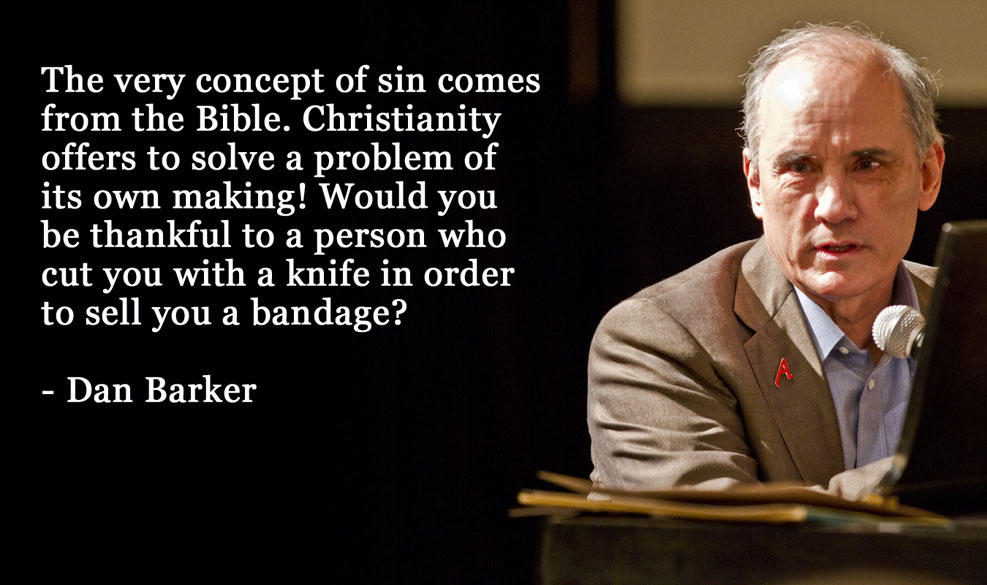
I have written on my crisis of faith a couple of times. Despite some people’s assertion that this was due to personal events, it actually started in 2015 with my second objection which is that I think ‘sin’ is a man-made up concept.  It started when I preached a message about sin and I had heard a quote that week from a critic of Christianity that basically said sin was made up and that because of it Christianity solves a problem of its own making.

I will get into this moment in more detail in my second objection post, but it got me rethinking everything in the light of skepticism and I began to form four theological objections for which I still have no satisfactory answers. While the sin question got my original thinking going, it is this first question involving the Bible and divine inspiration that forms the foundation of the other three.

Now, I want to state for the record that I am no amateur when it comes to the Bible or Theology.  1) I have degrees in both Biblical Studies (BA) and Theological Studies (MA).  2) I am a ‘professional’ theologian and have been since 1996.  3) I was a Christian from the time I was eight and as I approach my 50th birthday that would have been close it forty-two years. 4) I was a pastor (now retired) for twenty years and have spent many years since school studying the Bible and engaging theological questions.  5) I have had several crisis moments in my theology and up until two to three years ago I could answer them all or found ways to explain them.  Not anymore.

I will also say I am not hostile to Christians, I get it.  It took me a long time to face the facts of the objections I will present in this series. I still am open to anything that answers them.  My largest problem when I discuss this is people sometimes get offended because I seem to be very aggressive, but I am not really doing that, just being as honest as I can.  People don’t always like it when you ask questions that are hard about what they believe. Cognitive dissonance is a real thing, so I get.  Understand I am not being hostile to your faith if you have it.  I am just being hostile to mine or what mine used to be. That’s because I take as a central core idea that if the God of the Bible is the real god and the Bible is inspired by him, then it should make sense and have rational proof this is so.

Faith:

Bottom Line, faith is trusting in something that you have no evidence for and that is the problem.  You hope it is true and you believe it is true, but you don’t know it is true. This is particularly true for many church doctrines and one of the most notable is the divine inspiration of scripture.  The reason I can say this is no matter what school of thought you follow in looking at inspiration, there is no evidence that God came down and inspired the Bible.  You simply have to believe the simple statement “All Scripture is given by inspiration of God.”  There is no attempt to prove this, just a statement of fact that the reader must simply accept.

An example is probably in order:

“The Rabyd Skald’s writings are inspired by the god Odin.  Everything he writes comes straight from the mouth of the god Odin.” 

You say ridiculous.  I ask why?  You say because I simply have made an assertion and have offered no proof that what I say is true. I want to tell you the Bible does the exact same thing with the exact same level of proof that God came down and directly inspired the writers of the Bible – none. It’s pure faith, no evidence even from the Bible itself.  The Bible writers simply assert this; they never prove it.

Religion:

Looking at the doctrine of inspiration historically, once again we have no proof of the inspiration of Scripture by God, just the creation of the doctrine of inspiration and various councils of men deciding which books are inspired.  There is no record of God coming down and saying – “these books are my inspired word.” Just groups of men doing that.  That is what you actually see.

It stands to reason that religions do this.  In the end, you need a common core of beliefs and authority and it is far easier to make a group of writings do that because it has a greater chance of standing the test of time.  Especially if you inject a tradition of copying and transcribing these books from one generation to the next. Even in this though, two problems develop. 1) People abuse the authority of said books and can twist their meaning and 2) the transcription of said books can be flawed.

The second brings up an additional inspiration question which is: ‘Is the Bible still inspired even though people have put mistakes into it and changed it from one language to the next where meaning is going to get changed?’  The human factors are definitely present in the Bible.  Does that undermine inspiration or simply point to the fact that the Bible is a wholly human book? Because we don’t really have proof God is involved, are we just making up the whole divine inspiration thing in order to make this human book have more significance?

Theology:

I spent a great deal of time and digital ink pouring over this question of inspiration.  On my blog All Things Rabyd (which is still there although no longer active)  I spent nine posts looking at the various theories of divine inspiration.  You can find the link to all of them here. I eventually settled on Dynamic Inspiration as the best possible explanation to handle the human element of the bible.  That much like the doctrines of Christ state Jesus was 100% God and 100% Man, so was the bible the same way.  It satisfied me for a while but there was a fatal flaw in the whole thing.

The flaw? I still had no proof positive that the 100% divine inspiration part was real.  There is no photograph of God reaching into the head of Paul or Moses inspiring them to write things.  I mean you could say God is the inspiration for the Bible like a person might be inspired to write about nature from being outside. There is however no proof that God took an active hand in telling the authors what to write or how to write it.  That is purely a matter of whether you believe that or not.  It really is blind faith when you consider that particular question.

Spirituality: 

I will probably handle other objections involving scripture at a later date.  My purpose today is to get the main parts of my first objection to Christianity out there.  The question always comes – do I still read the Bible and what value do I place on it?  Well, yes I do.  I value it in that it contains a lot of ‘truth’ small ‘t’.  I just don’t think it’s the Truth with a capital ‘T‘.  Rather a lot of men wrote about their sincere belief in God.  God inspired them in that way and they wrote but in the end, it was human inspiration ABOUT the divine.  It was not God coming down and whispering in their ear what to write, no matter what their claims.

It also, because it is a human book and not divine to me, contains a lot of Bull Shit and spiritual opinion by ancient authors which may or may not be valid.  You still have to use a lot of judgment in looking at the Bible because if some of it is objectively true then the god of the Bible becomes at times both inconsistent and a sadistic tyrant.   

For me, I still draw a lot of inspiration from the Bible.  Some of its stories are great.  It has men wrestling with the question about God.  Some of the teachings of Christ are some of the best on human relationships you will ever see.  That said, it is only one avenue of being inspired, not the only one and it is a very human book.  In short, it has its flaws, and I think some of the morality it promotes could be questioned as to whether it actually does good or not.

Conclusion:

When the doctrine of inspiration goes, then you can look at the Bible objectively.  This caused me to really realize the god of the Bible has a few problems.  1) Sin seems to be made up as a concept and used to control the behavior of people 2) The plan of salvation God comes up with does not speak well of supreme being because it makes God both sadistic and masochistic. 3) God’s justice seems a little suspect especially when you consider final judgment.

The Rabyd Skald – Wandering Soul, Bard, and Philosopher. The Grey Wayfarer.

Skaal!!!