“Basic Pagan Principles – Freedom of Choosing Deity” – The Pagan Pulpit

Happy Sun’s Day

Announcements:

We don’t pray here – we figure God, the gods, goddesses, or whatever powers that be either know already, don’t give a fuck, or are busy with more important matters than our petty stuff. We also kind of assume that they expect us to do stuff that we can do for ourselves and that we will do them ourselves and not be lazy. We also believe in being good friends, so we don’t presume on our friendship with the powers that be by asking them all the time for stuff while giving them nothing in return.

We also don’t take an offering here.  We figure the powers that be probably don’t need it.  Let’s be honest, offerings are not given to the divine powers, they are given to an organization to support it.  Just being honest. God, the gods or whatever never sees a dime, farthing or peso of that money; it all goes to the church, mosque or shrine.

Theme Song: “Krigsgaldr” – Heilung

Good beat to this one. It’s actually in English so enjoy it.

Meditation:

Image may contain: one or more people, text and outdoor

This idea extends very much to a man’s religion and spirituality.

Text:

In all pagan religions, it is up to the individual to determine what Deity means to them, who or what Deity is right for them and how they ultimately develop their relationship with their chosen Deity. Pagans have many different ideas about what encompasses Deity and how their Deity is represented. It is up to the individual, through study of their religion, meditation and in some cases prayer, to determine what image of Deity is right for them.

Source: http://exotic-pets.yoexpert.com/exotic-pets-general/what-are-some-of-the-basic-principles-of-paganism-2192.html

Sermon:

I am very much interested in Norse Mythology. I love the stories of the gods and goddesses of that pantheon because they resonate with my northern soul and are very cool to put it simply.  The question comes: do I actually believe that the gods and goddesses of Norse Mythology – do they actually exist?  I would say a rational ‘no’ but at the same time, the pagan idea is that we all conceive of the divine in our own way and it is very possible that divine powers like the Norse pantheon exist.

In reality, we all do this to the divine, the pagans are simply honest about it. I spent 40 years as Christian and half that time as a pastor and I can tell you each individual Christian conceives of the god of the Bible in a very unique way.  What happens is each Christian resonates with a different part scripture, usually with a single author or book/passage in particular, more than others and they conceive of their version of the Christian god that way. If you talk to 100 Christians about a certain aspect of the biblical god, you will get 100 distinct answers.

Pagans just honestly say this is normal and that what is really happening with all of us.  They take the honest step and say each person’s view of the divine reality is going to be unique and that is what should be. Let each individual decided for themselves what the divine is like and how to relate to it. Talk about a spirituality form that doesn’t have the religious aspect of control to it.  The ultimate freedom is here where you get to decide what the divine might be like and how to both approach them and worship them if at all.

I don’t think it takes too long for people to see how I do this. I resonate with Odin a lot.  The pilgrim side of Odin in particular.  The wanderer looking for truth and knowledge where ever he can find them for me is a powerful and truthful image that relates to me very well. I don’t pray to him because it is my concept and I recognize that.  Could I go to a pagan blot and offer up a cup in his name? Yeah, sure. But it would be about community and reaffirming my commitment to the ideals I hold dear for my life.

Odin’s myth is the creator of mankind, so I can look at him as a diest would look at the divine.  Thankful for being created, but pretty sure he has more important things to look after than my petty stuff. I need to take care of that shit myself.  Going back to the Responsibility of Action as one of the other principles. Yes, I do conceive of deity in my own way, but as a pagan, I simply can also accept that others do the same and that is OK as well.  We all seek for the divine, if they exist, in our own way and it is not wrong just the reality of what we do as human beings.

If there is any lesson to be learned here is that we should all just relax when people have a different concept of the divine reality.  We shouldn’t force ours on them or accept it when they force theirs on us. We are all just pilgrims looking for the divine in our lives. We shape the understandings we have of that ourselves and that is alright by me as a pagan.

Parting Thought:

Image may contain: 1 person, beard and text

I remain,

The Rabyd Skald – Wandering Soul, Bard, and Philosopher. The Grey Wayfarer.

Skaal!!!

“People as Sacred” – Odin’s Eye – Humanism

Happy Thor’s Day

Discussion:

A humanist is a person who sees human beings and the human race as the central thing to solving human problems.  A pagan is a person who finds spirituality in all things.  I want to talk about how these two intersect.  For me, people are both the solution to their problems and sacred as part of the universe.  I don’t look to political or religious forces to solve human problems.  Both of those things tap into tribalism hard and push us to fear and hate one another. If you looking for the evil that might exist, you don’t have to look too far into any political or religious organization and you will find some.

As a humanist, I don’t think political ideology solves problems. Speaking as a political scientist, I can tell you that politics is about putting groups of people against one another to gain power, not solve problems.  Unless you see solving the problem as subjecting other people to what you think is right and forcing them, politics and government is not the way to go.

As a pagan, and former Christian, I can see how religion is used much the same way as it influences culture to label things ‘sinful’.  Once again, this is then used to put groups of people against one another as ‘the righteous’ put themselves against ‘the sinners’. Using shame, shunning and general looking down noses at others because ‘they don’t have the truth of our faith’, you can see once again how this is used to control people through fear and manipulation. Sorry, religion tends to create more problems not solve them.

It seems if human beings want actual solutions to their problems, they might want to look at themselves and stop joining religious and political groups that are not about solving problems but rather are about control.  Time for an alternative way of looking at people that might actually solve their problems.  Time to start looking at people as sacred.

Time to Look Through the Eye:

Faith:

Having faith in human beings to solve their own problems is difficult at first.  Both the above forces fo government and religion do some pretty good PR to label some people as the problem and having the need for others to control them. I always marvel at political and religious leaders ability to label whole groups of people as the problem and not themselves of course.  They are the solution.

I can say that if you sit back and really think about it there are two things I can have faith in: 1) That things are getting better all the time for humanity, and 2) That a whole bunch of people are trying to convince you that things are getting worse for their own gain.  But if I look at it objectively and consider people being sacred. You can have faith in each individual human being to solve their own problems if they are given the freedom to do so. Letting people be themselves is the most sacred and loving thing you can do for someone else.

Religion:

Religion, in general, sees humans as problematic or having problems.  Paganism sees them as sacred. Not problems but wonderful parts of the universe. Religion involves chains and spirituality involves removing them.  The first step in seeing people as sacred is to stop thinking they need religion to help them overcome their problems.

Because each person is sacred, they hold within themselves the ability to solve their problems.  Religion always tries to get a person to look to the divine, or faith or something outside one’s self to solve the problems they have but in truth, each person’s decisions will either lead them into problems or out of them.  Religion makes a lot of false claims and promises they cannot prove, but one thing you can know for yourself is there is always a better path that you can take as a human being if you tap into it.

Theology:

What needs to change is our understanding regarding humanity.  As a Christian, I taught mankind is sinful and only god can get them out of the problems that cause. The problem is there is no evidence that sin even exists outside the say-so of the Chrisitan preachers. That theology certainly does not look at people as sacred, that is part of the goodness that is creation.

As a pagan humanist, my viewpoint of humanity is very much changed.  Each person is unique and the most sacred thing they all have is the ability to choose their own direction.  To choose their own path. It is this that must be guarded and protected as the previously mentioned forces of politics and religion will always try to take this away.  What makes a person sacred is their ability to sovereignly choose for themselves the path they want to walk.

Spirituality:

The spiritual side of all this is that to walk this path we have far more going for us in helping us to do do this.  That in addition to their being a rational and logical side to life, there is an emotional and passionate side.  There are also the factors of driving needs and wisdom gained through experience.  All these combine into a spiritual walk that allows us to use all we are as human beings to set and guide the choices we make.

Part of that is respecting that people are sacred and walking it as a spiritual path is to guard it for ourselves and respect it in others. To interfere in a person’s choice, even benevolently, is to look at them without this respect for the fact that they are sacred and what makes them sacred is their ability to choose for themselves what path they are walking.

Conclusion:

In the end s much as sometimes I can think people are stupid in their choices, I respect that their ability to choose is sacred to them.  It is what makes each individual unique to me and worthy of a measure of respect.  Now, this doesn’t mean all choices are good ones or even benevolent and some choices can be stopped if they violate this principle.  A choice to force, coerce or defraud someone is one that does not have this respect of another person’s sacredness. It should be stopped. But there are many choices that I would not make but they are not violating the principle of sacredness so I should not interfere.

It is amazing to me what peace of mind comes when you leave people to be sacred in their own lives. The freedom from the desire to control and manipulate is a wonderful one. It also brings about the simple truth about yourself – you are the product of your choices.  Those choices are sacred no matter if they were good or bad because as a human being you made them.  That is freedom with responsibility.

I remain,

The Rabyd Skald – Wandering Soul, Bard, and Philosopher. The Grey Wayfarer.

Skaal!!!

“Asatru and Courage” – Of Wolves and Ravens – Courage

Happy Tyr’s Day

Discussion:

“Courage is the bravery to do what is right always.”

Principle – Act with Courage at the right time

As I was reading the Asatru website Ravenbok on Courage I realized that there is one aspect of courage that even that website admits that most followers of Asatru fail at and that is having courage about what they believe. It is this folding to the prevailing Christian culture or whatever other religious culture exists and not coming out and telling people you are pagan is what they are talking about here.  Courage is lacking in this regard although anyone who wants to know where I stand simply has to read this blog and its The Pagan Pulpit.

Just for the record, I am a diest humanist that has very pagan tendencies when it comes to spirituality.  I don’t really have a problem saying it.  Social acceptance be damned!  Perhaps this is one area of Asatru I do better in.  I don’t proselytize as that is not very pagan but if someone asks, I sure as hell will tell you where I stand.

But I get it.  For literally millennia the Abrahamic religions have hunted down pagans and killed them.  Hell, the Bible has in the book of Joshua that not only justifies this Genocide but clearly paints a picture that the biblical god would not be pleased with his people unless they killed every man woman and child.  Well, except virgin girls so the men could make them their wives. In this atmosphere, it can still be hard to have the courage to say you’re a pagan to people who have demonstrated historically that they will come up with multiple and twisted reasonings to subject and kill those that disagree with them.

For myself, I follow the virtues of Asatru and they remind me Courage is a commitment to do the right thing at the right time, every time. That includes when people ask me what church I go to tell them –  I don’t go to church.  My place of worship is every place that I am and my act of worship is to act at all times according to the virtues of Asatru.

Website: Ravenbok – The particular page is: The Values of Asatru

To the Wolves and Ravens:

“Feed the Wolves, but Listen to the Ravens first.”

Needs (Geri):

Courage is the most needed virtue in the face of Fear.  Courage is a choice and a needed choice if one is going to do anything.  Our world gives us lots of things to fear. Politics and religion encourage us to fear because it makes us easier to manipulate. Courage is the needed choice to be free.

I need a lot more courage in expressing my self verbally. I guess it is my personality.  The few other INFJ types in know all have the same problem.  Being natural empaths we don’t want people to feel bad because then we feel bad ourselves. So we find alternate ways of expressing our feelings.  In my case, I find it far easier to write my feelings than say them.  That way I can’t feel people’s reactions to my written words.  I need to overcome this to a point that I can face those feelings bravely.

Wants (Freki):

It is this freedom that gives the desire (want) to embrace liberty and self-reliance. Better to live free and die than to bow in chains.  You need and want courage because it is the means to liberty and freedom of choice. Otherwise, your fears will lead you into chains.

I know there is a freedom o open expression.  I have had it a couple times where I and the other person could talk freely about what we felt and ti was very liberating.  I just have to have the courage to take the steps I can on my side to get there.

Reason (Huginn):

That said, there is a great deal of difference between foolhardy and courage.  There is no courage in paying a price or dying for nothing. Courage should cause us to fight for the things that matter.  Part of real courage is reason.  Rational courage is what we are making choices about not being afraid of the things in our way of a better life, not knee jerk martyrdom.

When it comes to expressing myself verbally,  I know what I need to do.  I know it is reasonable and wise.  That is not the problem.  It is, in the end, making the choice to be brave.

Wisdom (Muninn):

Some times the wisest path to walk is the one that involves facing our fears and overcoming them.  It gives us the strength to face later challenges.  Courage has wisdom to it when it is used for a purpose because it leads to the building of character.  And no one has ever built character into their lives without acts of courage.  Fear and cowardice only lead to the things people despise in their more rational and wise moments.

Conclusion:

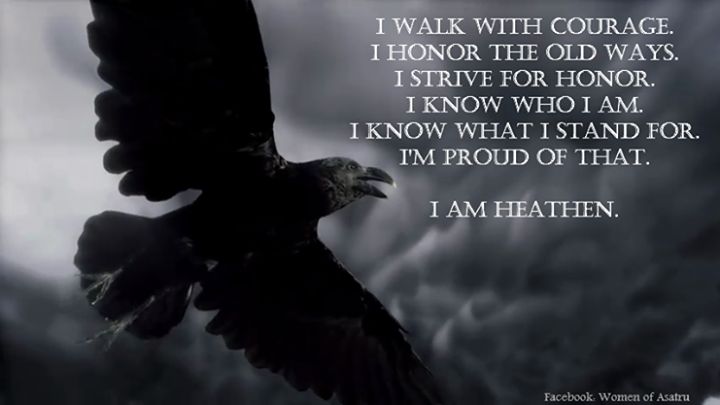
‘I walk with courage. I follow the old ways. I strive for honor. I know what I stand for.  I am proud of that.  I am heathen.’

I remain,

The Rabyd Skald – Wandering Soul, Bard, and Philosopher. The Grey Wayfarer.

Skaal!!!

“Basic Pagan Principles – Everything is Sacred” – The Pagan Pulpit

Happy Sun’s Day

Announcements:

We don’t pray here – we figure God, the gods, goddesses, or whatever powers that be either know already, don’t give a fuck, or are busy with more important matters than our petty stuff. We also kind of assume that they expect us to do stuff that we can do for ourselves and that we will do them ourselves and not be lazy. We also believe in being good friends, so we don’t presume on our friendship with the powers that be by asking them all the time for stuff while giving them nothing in return.

We also don’t take an offering here.  We figure the powers that be probably don’t need it.  Let’s be honest, offerings are not given to the divine powers, they are given to an organization to support it.  Just being honest. God, the gods or whatever never sees a dime, farthing or peso of that money; it all goes to the church, mosque or shrine.

Theme Song: “Rune” – SKALD (lyric video)

English Translation: https://lyricstranslate.com/en/r%C3%BAn-rune.html

A little long about the Runes.

Meditation:

Image may contain: text, outdoor and nature

Just a little reminder of last weeks lesson before we hit this one.

Text:

Most pagan religions believe that everything in the universe is sacred, but the definition and level of sacredness applied to an object will generally vary from one pagan to another. For some pagans, all parts of our universe are considered divine and as such, sacred and worthy of our deepest respect.

Source: http://exotic-pets.yoexpert.com/exotic-pets-general/what-are-some-of-the-basic-principles-of-paganism-2192.html

Sermon:

Everything is sacred in paganism.  This means there is no distinction of things as evil or good which is the first significant implication of this principle.  No object or thing is better than another.  Objects and places are all sacred. So they cannot be evil or good. Moral ‘evil’ or ‘good’ is found in our actions, results, and intents, not things. Yet all things have a spiritual quality to them.  This is mostly to remind us that we are connected in some way to everyone and everything around us.

Like all things pagan, this principle is individually applied and its application is as individual as the pagans themselves. We each see some things as more sacred than others. That’s why in some forms of paganism there are still religious aspects with sacred places, practices, and rituals.  Some consider the universe itself as divine while others see it more as spiritual but not necessarily divine.  Like I said at this point there is a lot of variances but in the end, there is nothing wrong with any of these views. Paganism is very genuinely tolerant, so to each their own.

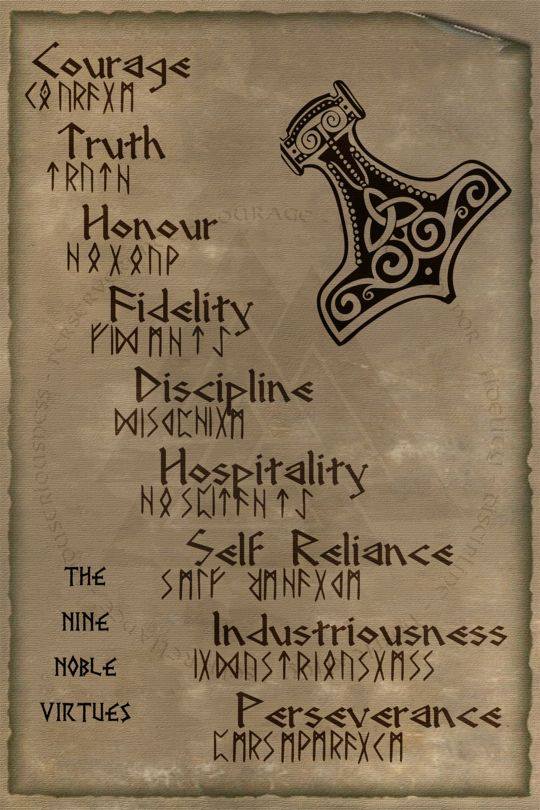
For me, the religious aspects of paganism are not my thing. I live with a more deistic mindset on those things, although I understand the benefits of community and honoring things that are virtuous and respecting the past, present, and future actions of my fellow human beings.  I suppose I consider human beings and their liberty as the most sacred thing as a humanist, so it is reflected in my paganism. For me, my paganism is ultimately found in Asatru and following the Nine Noble Virtues.

As far as the rest of creation as being sacred that includes the things that man creates. not just the natural world.  Human beings and what they do are also natural and I feel the whole natural/ artificial thing is a bunch of noise.  Where did the so-called ‘artificial’ come from if not nature?  A computer is just as sacred to me as a tree.  Beavers create dams, bees make hives, humans create computers.  The difference is only in the mind of people who want to use this distinction to control others. I am far more a conservationist than an environmentalist.

The beauty here though is once again freedom of choice about it.  It is simply a principle that flows out of the previous principles that your beliefs are your own and you alone are responsible for them.  This includes how you look at the world around you.

Parting Thought:


Image may contain: text

Tolerance (the real stuff), admiration, compassion, kindness – these are real love and they don’t involve – obedience, conformity, fear or submission.  Those are not aspects of love – rather they are aspects of slavery.

I remain,

The Rabyd Skald – Wandering Soul, Bard, and Philosopher. The Grey Wayfarer.

Skaal!!!

“The Virgin Birth of Jesus” – Odin’s Eye – Bible Problems

Happy Thor’s Day

Discussion:

What I am about to do here is give at sample or teaser of what I am doing for my non-fiction book.  What I am doing is taking my expertise gained from a biblical studies degree, a theological studies degree and twenty years experience of being a pastor and doing a class I did many times – Life of Christ.  I am however this time doing it from a skeptics point of view.  I am doing it as a non-believer and a critic of Christianity and The Bible.

Today I am going to give a brief synopsis about why I think the virgin birth story is a tall tale concocted by many people who had personal and political reasons to do so.  The theory I am running with here is my own which is that there was a man named Jesus of Nazareth and that he did indeed have disciples.  That those disciples watched Jesus as he fought the religious establishment.  That establishment then did perhaps have him crucified by the Romans because they came to hate him and the threat he posed to their political and religious power.

This is where those disciples create mythology surrounding the man known as Jesus of Nazareth.  They knew the Messianic prophecies and began to retroactively go back to his life and spin things to fulfill them.  One of those things involved the fact that there was a prophecy where the Messiah had to be born of a virgin.

Therefore the Lord Himself will give you a sign: Behold, a virgin will be with child and bear a son, and she will call His name Immanuel. – Isaiah 7:14

One of the things that may have very well have been true about Jesus is that his origin may have had a little scandal attached to it.  That is there was a question as to who his father was or that it was clear he was conceived out of wedlock.  As a political scientist, I can see how scandal can be turned to opportunity if it is spun right.  So, no Jesus wasn’t the product of an illicit affair or the fact that Joseph and Mary had sex before the wedding day, let’s write it this way to turn him into the Messiah.

Now in the sixth month, the angel Gabriel was sent from God to a city in Galilee called Nazareth, to a virgin engaged to a man whose name was Joseph, of the descendants of David; and the virgin’s name was Mary. And coming in, he said to her, “Greetings, favored one! The Lord is with you.” But she was very perplexed at this statement and kept pondering what kind of salutation this was. The angel said to her, “Do not be afraid, Mary; for you have found favor with God. “And behold, you will conceive in your womb and bear a son, and you shall name Him Jesus. “He will be great and will be called the Son of the Most High; and the Lord God will give Him the throne of His father David; and He will reign over the house of Jacob forever, and His kingdom will have no end.” Mary said to the angel, “How can this be, since I am a virgin?” The angel answered and said to her, “The Holy Spirit will come upon you, and the power of the Most High will overshadow you; and for that reason the holy Child shall be called the Son of God. “And behold, even your relative Elizabeth has also conceived a son in her old age; and she who was called barren is now in her sixth month. “For nothing will be impossible with God.” And Mary said, “Behold, the bondslave of the Lord; may it be done to me according to your word.” And the angel departed from her.  Luke 1:26-38 – NASB

Suddenly the scandal becomes an opportunity to tell the story in a different way and Jesus fulfills the prophecy of being born of a virgin.  So what is the actual evidence?

Time to Look Through the Eye:

Faith:

In order to believe in the virgin birth, you have to believe that God can make a woman pregnant which is not a stretch if you accept an omnipotent god. That Joseph was not involved and that he suddenly became cool with the fact that another man has sex with his bride to be and knocked her up.  He has to buy the story himself.

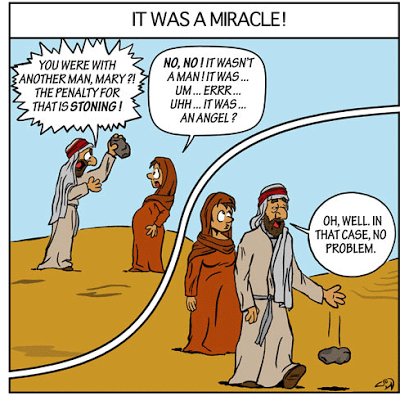
Mostly though you have to believe that Mary herself is not lying about the angel.  Because the only witness of that event is Mary herself.  Understand that even if I take the account as true, the only witness even in the gospels of the event is Mary and the only gospel that records it is Luke.  Luke is probably the last synoptic gospel to write.  One could theorize that Luke is reacting then to the fact that Mark says nothing about a virgin birth and Matthew only deals with Joseph’s reaction and no one has addressed Isaiah’s prophecy to that point.  If you believe in the virgin birth, you simply taking the word of one witness – Mary.  A girl of fifteen who finds herself pregnant in a culture that stones women who commit adultery or at the best puts away women privately to live out their days in silence.  Which is more likely at this point – God impregnated her or that she came up with a story to cover her pregnancy out of fear of reprisal?  Or she made it up later to vindicate herself after the fact when people are starting to believe her son is the Messiah.

Religion:

Let’s understand something. the virgin birth in the Bible does not stand alone as the only one.  Religions around the world have tons of virgin birth stories and Mary was not unaware of them. This is something that is well known and well published. Just look it up for yourself.

The thing is though for Christianity a lot of theology regarding sin and the biblical god is wrapped up in this story being true; so of course, they defend it regardless of how common such a story is in mythology around the world and how little testimony there is to support the actual story.

But understand that even under the Bible’s own standard of establishing every fact the virgin birth story fails.  It only has one witness Mary herself and she certainly has plenty of cultural and personal motivation to make it up.  Luke is the only direct record of it but it is still her story alone, he just records it. This fails the two or three witnesses required even by Biblical Standards, particularly the Law of Moses.

Matthew records Joseph’s response but even his response might have had a personal motivation if he either loved Mary or he was the cause of her pregnancy.  How he reacted really has only one witness – Joseph himself.  He may have simply been a man who took responsibility for his actions and we are assuming he was even around for Matthew to interview as he might have been dead.  It is easy to see how Matthew who was writing with the goal of persuading Jews to become Christians might make up Joseph’s story based on stories of others. But that makes is second-hand hearsay, not reliable evidence.

Theology:

This story absolutely is essential for doctrines such as original sin and the incarnation of Christ.  For the early Christians, they needed a story that fulfilled some of the prophecies so going back a retroactively recounting things with their own spin on it became essential for the accusation that the Jewish leaders had killed the Messiah.

The motivation for this is that Jesus may very well have been a man who successfully created a movement of reform and the Jewish leaders, by killing him, had created a martyr.  It is not hard to see how the disciples, motivated by a desire for the resurrection to be true and to create Jesus as the Messiah, would stretch the truth and follow rumors and ‘urban legends’ of Jesus of Nazareth to do so. For later Christians, these become the basis for theology that allows Jesus to be the answer to the sin question and how Jesus was both God and Man.

Spirituality:

While a great many Christians, particularly women, draw a lot of spiritual strength from Mary’s Story, I look at it more as identification with a character caught in a bad situation that has a great story to get herself out of it and go from being a immoral unwed mother, to the mother of the Messiah.  I can see where a lot of women would love that idea and emotionally and spiritually resonate with it. Even those who might think it is not true fully understand given Mary’s Culture why she would do it. In the movie Saved! – the character Mary remarks in one scene how she could understand, being pregnant herself in the movie, why a girl would make up such a story.

Conclusion:

My thoughts are this, I think Jesus of Nazareth was a real person but I think after thirty years before the first writing on his life a lot of mythology and what we would term ‘urban legend’ became built around him that also got into the story.  One of the examples is the virgin birth story which appears late in the accounts like it was a reaction to criticism of Jewish leaders that the prophecy in Isaiah is not fulfilled by Jesus of Nazareth.  So Matthew records the story of Joseph with his reaction to her being pregnant and later on a little bit after that Luke does the same from Mary’s point of view.  Except this does not even meet the Bible’s own criteria of ‘two or three witnesses” as each account is only one person’s perspective and with no other witnesses.

What really happened?  Most likely Joseph and Mary had sex before they were married.  A common tale even back then.  Joseph may very well have simply decided to marry her because it was his child; which oddly enough the Law of Moses would have accepted provided he gives up is right to divorce her later. Joseph and Mary would have lived with a cultural stigma after that which would have cast her in particular as an immoral woman.

Fast forward some decades and their son actually becomes a great Rabbi and critic of the religious leadership.  He gets killed and becomes a martyr.  Mary finds herself with the opportunity presented by the new but fanatical Christians to vindicate herself and be the mother of the Messiah, to no longer be considered an immoral woman.

So that is what she did.  The story gets changed so that she is a virgin and both she and Joseph have visits by angels no one else sees and they decide to get married after all. She was a virgin until after Jesus was born and the prophecy fulfilled.  Of course, there are no witnesses to this other than Mary herself and so we must take her word for it. No physical exam, no other witnesses of the angels in question, nothing but her word.

I think the more simple explanation is she made it up to vindicate herself.  It is not something Christians want to hear but it seems to be very likely given her culture and her desire to clear her name would have been very strong.  It is just unfortunate how far people have taken this legend. I mean people actually pray to this woman now and she is probably nothing more than a woman who either told the story to save her ass or vindicate herself as an older woman who had lived with the stigma of being immoral all her life. She definitely improved her status in retrospect so the story worked.

So there it is a sample page from my non-fiction book although it will be much more extensive and much more complete and referenced. Hope you enjoyed it.

I remain,

The Rabyd Skald – Wandering Soul, Bard, and Philosopher. The Grey Wayfarer.

Skaal!!!
“Asatru and Honor” – Of Wolves and Ravens – Honor

Happy Tyr’s Day

Discussion:

Honor is the feeling of inner value and worth from which one knows that one is noble of being, and the desire to show respect for this quality when it is found in the world”

Principle – To possess a feeling of inner value about myself and my future with a desire to find the same in others.

As I start the cycle of going through each of the nine noble virtues I am using a little help and I am also looking back at the last time I did this.

The help I am referring to is this website page which I have looked at often to make sure I was thinking about the Nine Noble Virtues in the understanding of some of those that follow Asatru. It has been a good resource for me and I want to share it.  For these discussions, I am engaging the ideas found here as I write, so it is a good backdrop.

Website: Ravenbok – The particular page is: The Values of Asatru

Last time I looked at Honor was January 8, 2019, and I described it as the most difficult virtue: Honor: The Most Difficult Virtue.  I would probably stand by that idea still as it is still the most difficult virtue to grasp because it is so personal.

Without honor we are nothing.  Honor is the central element of Asatru as far as its central moral imperative. If Norse mythology teaches anything that is truly valuable, then it is that honor matters. People with honor are valued and respected long after death, people without it are despised. Those trying to embrace the Asatru ideal of Honor should strive to be the former. To guide myself into a better understanding of it, I look to my wolves and ravens.

To the Wolves and Ravens:

“Feed the Wolves, but Listen to the Ravens first.”

Needs (Geri):

When I left my faith in Christianity, the need for a new moral compass was very real.  I was struggling with a lot of questions of self-worth,  What was my value if I wasn’t a Christian minister? The main question though was a question of the value of self. The need for honor was overwhelming in the light of the fact I really had nothing outside of my faith before.  My marriage at the time was bad.  My career as a minister was over.  What was central to myself was a big question.  I needed answers and I found the first and most significant answer in Asatru and its Nine Noble Virtues.  In particular, Honor became the foremost virtue in my mind in addressing these questions.

Wants (Freki):

Once I knew the need for honor was present, I wanted it.  It began to stabilize my life quite a bit.  I had a lot of questions but my conversion from Christianity to being a Deistic Humanist Pagan needed focus and some way to make it consistent. Honor became a particular challenge for me.  I was following my heart but it had no guidance or wisdom and Honor came in as I not only needed it, I wanted it so I could find a path back to being respectable without all the nonsense fo faith in the Chrisitan creed. I wanted to know that I was on a path where my inner value of myself would lead to an outward reputation that was respected or at least – feared.

Reason (Huginn):

Honor is knowing what is true about yourself.  This takes a hard look at yourself to see what is true and then change accordingly.  Meditation and thought about who you are is essential and I have found this road requires a lot of thinking things through to find the paths that need to be taken that are both reasonable and wise. This is the start of finding the honorable path. Asatru helps with this in that it gives me other virtues that are tools for finding honor – Truth and Fidelity being the most notable, but all the other virtues in a sense combine into honor. This path I am on is a rational one because of this.

Wisdom (Muninn):

I find that when it comes to honor, wisdom says that honor leads to a good path that is well chosen not just because it is of the most advantage to one’s self, but because it also benefits others. Honor leads to respect and respect is a benefit to anyone who has it.  It leads to a lot of benefits when you have a society where people are honorable and respected for it.  There is no coercion or fraud in such a society and everyone benefits.  This is the wise path made possible by being each person being honored as each person pursues Honor.

Conclusion:

I still struggle with honor mostly because I know I am capable of greater things than I am doing.  I just feel the need to catch my breath with all that is happened this past year. The taking stock of where I need to go and then move forward. What matters to me is Honor – my own feeling that I have value.  To know what is true about myself and work to make it better. I cannot walk the path as a follower of the virtues of Asatru or as The Grey Wayfarer without it. So it remains the most difficult but most essential virtue.

I remain,

The Rabyd Skald – Wandering Soul, Bard, and Philosopher. The Grey Wayfarer.

Skaal!!!

“Basic Pagan Principles – Full Personal Responsibility” – The Pagan Pulpit

Happy Sun’s Day

Announcements:

We don’t pray here – we figure God, the gods, goddesses, or whatever powers that be either know already, don’t give a fuck, or are busy with more important matters than our petty stuff. We also kind of assume that they expect us to do stuff that we can do for ourselves and that we will do them ourselves and not be lazy. We also believe in being good friends, so we don’t presume on our friendship with the powers that be by asking them all the time for stuff while giving them nothing in return.

We also don’t take an offering here.  We figure the powers that be probably don’t need it.  Let’s be honest, offerings are not given to the divine powers, they are given to an organization to support it.  Just being honest. God, the gods or whatever never sees a dime, farthing or peso of that money; it all goes to the church, mosque or shrine.

Theme Song: “O Valhalla” – SKALD (lyric video)

English translation: https://lyricstranslate.com/en/%C3%B3-valhalla-oh-valhalla.html

I like the sound of this pagan band.  They definitely set a tone here.

Meditation:

Yep.  I have come to see the pain this causes people which is unnecessary as the truth may be painful for a bit, but the long-lasting damage caused by a lie lived is far worse.

Text:

The development of your personal beliefs, morals and ethics is your own responsibility. The belief that we are products of our own environment does not stand within the pagan structure, as paganism teaches that it is the responsibility of each individual to learn to recognize what is right from wrong, regardless of our early environment.

Source: http://exotic-pets.yoexpert.com/exotic-pets-general/what-are-some-of-the-basic-principles-of-paganism-2192.html

Sermon:

The more full title should be: “Personal Responsibility for Your Actions and Personal Development”.  But as a title for a sermon, it is a little wordy. But the point is made as we move from Responsibility of Belief in paganism, we hit the idea that because all things are spiritual from our point of view; then that responsibility extends to full personal responsibility for one’s actions and personal development.

It is you and only you that can develop your moral code, ethics, and beliefs.  This is the simple truth.  You can be inspired by others, instructed and guided, but the decisions you make are yours and yours alone.  Therefore you bear the weight of the full responsibility for them.

There is no blaming parents or environment for one’s bad choices or even really giving credit to others for good ones. Not even the divine gets credit when you do something well other than perhaps giving you the base gifts and abilities you have.  You get the credit as well as the blame for every decision you make and your own moral development good or bad.

There is no excuse in paganism that allows you to do anything but take responsibility for your actions.  This, of course, lines up with the virtues of honor, fidelity, and truth.  Honor is achieved by taking responsibility leading to self-value.  Fidelity is involved because in so doing you are being loyal to your true self and Truth, of course, is needed to see the true path in order to do both.

Full…Complete…Responsibility.  There is no ‘be patient with me god is not finished with me yet’. Blaming the divine for your lack of making good decisions or lacking personal moral development, is not a pagan trait or virtue.  It is an excuse. No.  Take full responsibility for yourself and you will find greater fulfillment.  Trust me, you will feel better about yourself if you do.

Parting Thought:

Image may contain: 1 person, text

I remain,

The Rabyd Skald – Wandering Soul, Bard, and Philosopher. The Grey Wayfarer.

Skaal!!!

“Moving from Religious Slavery to Rational Freedom” – Odin’s Eye – Deism

Happy Thor’s Day

Discussion:

I remember as a pastor helping people through so-called tests of faith.  Now as a more deistic person in search of a rational divinity, I would say that it wasn’t so much a test of faith, but a person running into legitimate problems with their religion and their rational mind trying to get them to see that.  A lot of the times this doubt of ones religion is interpreted as doubt in one’s faith and that is only partially correct.  Regardless it is not a bad thing, but rather our own mind trying to help us see that we have bought into a pack of lies.

Religion doesn’t seem to have very many positive purposes.  It is used to control and manipulates through fear or by creating imaginary concepts that are passed off as read to change people’s thinking and thus their behavior. Occasionally a religion might talk about virtue or character that human beings should have or exercise and in that regard religion might do something positive.

For myself, this transition into being a deistic humanist with pagan tendencies is about firstly a search to see if a rational god can be found.  Secondly, I am trying to throw off the trappings of religion to embrace a more spiritual and practical philosophy of living my life. I work to be spiritually attuned to the world around me but rationally grounded.  Mostly though I seek to be free of religion’s negative effects and thus freer.

Time to Look Through the Eye:

Faith:

I have faith that there is something beyond ourselves.  We talk of romantic love for another person but there is no rational reason to believe it is anything more than hormones being exchanged.  Yet, there we are talking and very much believing we fall in love, that making love is more than just hedonistic pleasure for the purpose of procreation, etc. Concepts such as beauty and friendship fall into this category as well, there is more to human senses that the five senses and more to determine what is true and real other than the rational mind. I have faith that this is so still.

Religion:

I avoid religion as much as possible. I find people who are religious to be inherently self-righteous as much of religion centers on “we have found the truth about the divine”.  It is this belief that leads people to think they have arrived in some place that is superior to others whether they openly say so or not. They find themselves looking at others either as poor wretches who still need to find ‘the truth’ or ‘sinner in the hands of an angry god’.  There are inherent condescension and hubris to any religious belief.

Theology:

My theology as a deist pretty much does not have a divine entity or entities that intervene in human affairs. I won’t say that I don’t believe miracles are possible as even Einstien conceded in his probability based universe, all things are possible no matter how unlikely.  I have just seen too much as a Pentecostal believer to believe miracles are as common as they say.  I have seen a tremendous amount of con artist fraud and sleight of hand magician’s tricks to buy that it happens. I don’t fall into the deist problem of believing in the larger miracle of creation and not believing smaller things called miracles can’t happen, but I also have found that most miracles have a rational explanation and usually it is some form of deception followed by a large amount of confirmation bias.

Spirituality:

I would consider myself no longer religious but spiritual.  My rational mind is part of that spiritually.  I just think there is more to mankind that a computer lodged in the head of a biochemical body. If there is any spiritual practice that has changed for me is I don’t spend a lot of time praying, if at all.  I realized that people when they get a result they wanted often cite that as proof prayer works.  I challenge such people to rationally do an experiment for a bit.  Keep a record of everything you pray about and be absolutely honest about how all of the things on that list are ‘answered’ I know when I did this about 20% of the things I was praying for came about.  80% either didn’t happen at all or things went a completely different way from how I was praying.

No, I spend more time thinking and meditating on things to understand them these days rather than praying.  I find it leads to far more freedom of thought and a better way to navigate through life’s challenges.

Conclusion:

I became a diest because of ignorance.  I think the human race simply does not know enough to dismiss the possibility of the divine. What I also am fairly sure of is that most religions are irrational and are basically attempts to either fool people or control their thoughts and behaviors using appeal to divine authority to do so.  I search for a rational divine, not one which is defined by others through religion.  It has been a very liberating choice.

I remain,

The Rabyd Skald – Wandering Soul, Bard, and Philosopher. The Grey Wayfarer.

Skaal!!!
“Asatru” – Of Wolves and Ravens – The Nine Noble Virtues


Happy Tyr’s Day

Discussion:

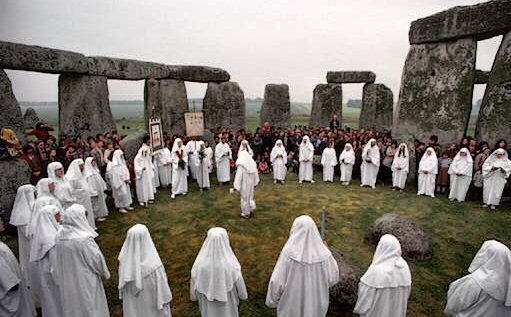
I started following the Nine Noble Virtues of Asatru simply because they were a good list of virtues I wanted in my life.  In large part, it was my constant meditation on the Virtue of Fidelity that eventually brought me back to my wife. These nine virtues are now a very essential part of my own spiritual practice using my understanding of what it means to be a pagan.  What it means to be an honorable human being for that matter.

What I began to discover is that Asatru is a whole very new and modern form of neo-paganism. It attempts to recapture the pagan root of the Germanic and Scandinavian world before Christianity took over. The video below is a very good overview of what Asatru is as a religion by a man taking a very informative view on it.  He recommends a book that is on the way to my house at the time of this writing. I want to learn more out of curiosity sake if nothing else.

My own practice has very little to do with the religious aspects of Asatru.  I follow the virtues.  I find the stories of Norse Mythology and the various practices of Asatru inspiring and fascinating but ritual and religion are not a central thing to me.  My issue is living a good life following after virtue.  I must say though if I was ever going to be ‘religious’ again – I would pick this one.  More practical than most of them.

I center most of my personal paganism on following a life philosophy that leads to prosperity of life. Whether it is the prosperity is foundational, business or for myself. If there is a god, or gods or whatever, I am fairly sure they expect me to handle my own issues.  There is no real wrong or right way to a pagan after all so perhaps my paganism is as much about my philosophy of life as spirituality. This actually fits well with Asatru so there is a lot of common ground between me and those who practice the more religious aspect of Asatru.  Both of us find the simplicity and challenge of the Nine Noble Virtues to be central to achieving personal peace and prosperity.

To the Wolves and Ravens:

Needs (Geri):

If you have ever lost your faith in something or left behind an old religion, you will know the need for finding something that grounds you and gives you ethical and moral focus. In my case, I found the Nine Noble Virtues fairly quickly to be a value centering philosophy that didn’t require the religious element.  There was a hole in my moral and ethical philosophy, a real need, and the NNV filled it quite nicely.

Wants (Freki):

I wanted something solid and simple as a philosophy to live by.  I got sick of the multitude of interpretive points one could give to Christian scripture and you could pretty much make the Bible say whatever you wanted with very few limitations. I also wanted to dump the whole appeal to authority issue and while the NNV are solid virtues, they can not be looked at authority so much as a guide.  The only authority I have for my moral philosophy and ethics is myself and so finding something solid to both meditate on and provide a basic framework for that was a big want.  The Nine Noble Virtues have performed well in this role.

Reason (Huginn):

The Nine Noble Virtues all have the reason element I was looking for.  There are very good solid rational reasons to embrace each virtue.  They have good results that lead to peace and prosperity.  They are rationally practical That said it still takes a lot of thinking to employ them and implement them.  They are not easy always in application but they work.

Wisdom (Muninn):

See the source image

I come back to the wisdom of this quote by Markus Aurelius all the time.  Virtue is its own reward in this life to be sure.  It creates solid memories for your loved ones and for yourself leads to prosperity and a good life. The afterlife, if there is one, simply becomes a matter of whether there is a good or evil judge on the throne.  The good judge should see ones’ virtue and reward it, the evil judge needs human defiance.

Conclusion:

Over the next nine weeks, I will be returning to the Nine Noble Virtues one at a time.  Every time I do this there is a spiritual awakening of a sort.  I may not be a religious follower of Asatru, but I respect the virtues that all of those who follow it try to live up to.  It is something I will continue for much of the foreseeable future.

I remain,

The Rabyd Skald – Wandering Soul, Bard, and Philosopher. The Grey Wayfarer.

Skaal!!!
“Basic Pagan Principles – Responsibility of Belief” – The Pagan Pulpit

Happy Sun’s Day

Announcements:

We don’t pray here – we figure God, the gods, goddesses, or whatever powers that be either know already, don’t give a fuck, or are busy with more important matters than our petty stuff. We also kind of assume that they expect us to do stuff that we can do for ourselves and that we will do them ourselves and not be lazy. We also believe in being good friends, so we don’t presume on our friendship with the powers that be by asking them all the time for stuff while giving them nothing in return.

We also don’t take an offering here.  We figure the powers that be probably don’t need it.  Let’s be honest, offerings are not giving to the divine powers, they are given to an organization to support it.  Just being honest. God, the gods or whatever never sees a dime, farthing or peso of that money; it all goes to the church, mosque or shrine.

Theme Song: ‘Úlfhéðnar’ – Norse Viking Music

If you want to get the most out of the Pagan Pulpit.  Put the theme song on a loop and then read the rest of it. The Ulfhedmar were the wolf warriors of Odin.

Meditation:

Image may contain: 1 person, text

It is important to know the difference.  One requires sleep and the other requires action.

Text:

The most basic tenant of paganism is that it is your own responsibility, not the responsibility of any government, institution, church or other people, to choose what you believe in regards to spirituality, values, ethics, the nature of Divinity, etc.

Source: http://exotic-pets.yoexpert.com/exotic-pets-general/what-are-some-of-the-basic-principles-of-paganism-2192.html

Sermon:

In Paganism there is no appeal to authority to justify your actions. This would violate the first of the basic tenets which is that each person is responsible for their own beliefs. This is called the Responsibility of Belief.

The first point of this is to accept your responsibility for what you believe. It is yours and no one else to decide what you believe and how you practice your spirituality.  It is yours alone and there is no one to blame or praise for where your spirituality is or your conduct regarding it. No blaming God.  No “God told me to do this.”  You act on your spirituality and take full responsibility for the results – good or bad.

The second point is to emphasize what cannot be used as a scapegoat.  The government is not responsible for your spiritual state, nor a religion, institution or community of people. None of these things can be responsible for where you are in regards to the spiritual part of your life.  Just you and only you.  Your spirituality is the product of your own choices and journey.  They should not be dictated to by anything else nor should you blame anything else for them.

The third point is the scope of what we mean when we say ‘spirituality’.  It involves all things that touch spiritual life, ethics, morals, values, the nature of Divinity, etc. These are all yours and no one else to take responsibility for.  If it can be considered spiritual in some way, then you are responsible for it. This is why I find most things have a spiritual side to them because they involve ethics, morals and simply a spiritual sense to them. There is more to this than pagan rituals and feelings.

There is no “Be patient, God isn’t finished with me yet” in paganism. No “I am waiting on God to make me more patient, loving, etc.”  If you feel you lack spirituality, a moral compass or ethical understanding; it is on you and you alone to fix that. That is the essence of Responsibility of Belief.

Parting Thought:

Image may contain: 1 person, text that says '"Now, every time I witness a strong person, I want to know: What darkness did you conquer in your story? Mountains do not rise without earthquakes" -Katherine MacKenett ITheMindsJournal THE HEMINDSJOURNAL'

The great face down the struggles of life and use them to become stronger.

I remain,

The Rabyd Skald – Wandering Soul, Bard, and Philosopher. The Grey Wayfarer.

Skaal!!!